
Artificial Turf Sub-Base
The compacted layer of aggregate materials, known as the sub-base is one component of an artificial turf system.
It works together with fibers, infill, and backing layers to replicate natural grass.
DEFINITION
Sub-Base
The sub-base is the compacted foundational layer beneath artificial turf that provides stability, grading, and drainage. It is typically composed of crushed aggregate materials.
Key Functions:
- Provides a stable installation surface
- Enables water drainage away from the turf
- Maintains level grading and support
System Role: Foundation of the turf system, supporting all upper layers and controlling water movement.
Related Components: Turf Backing • Turf Drainage • Artificial Grass
Used With: Backing • Drainage
Commonly Used In: All Turf Installations • Drainage-Critical Areas • High-Traffic Surfaces
View in: Artificial Turf Glossary →
System Components
Core Components of an Artificial Turf System
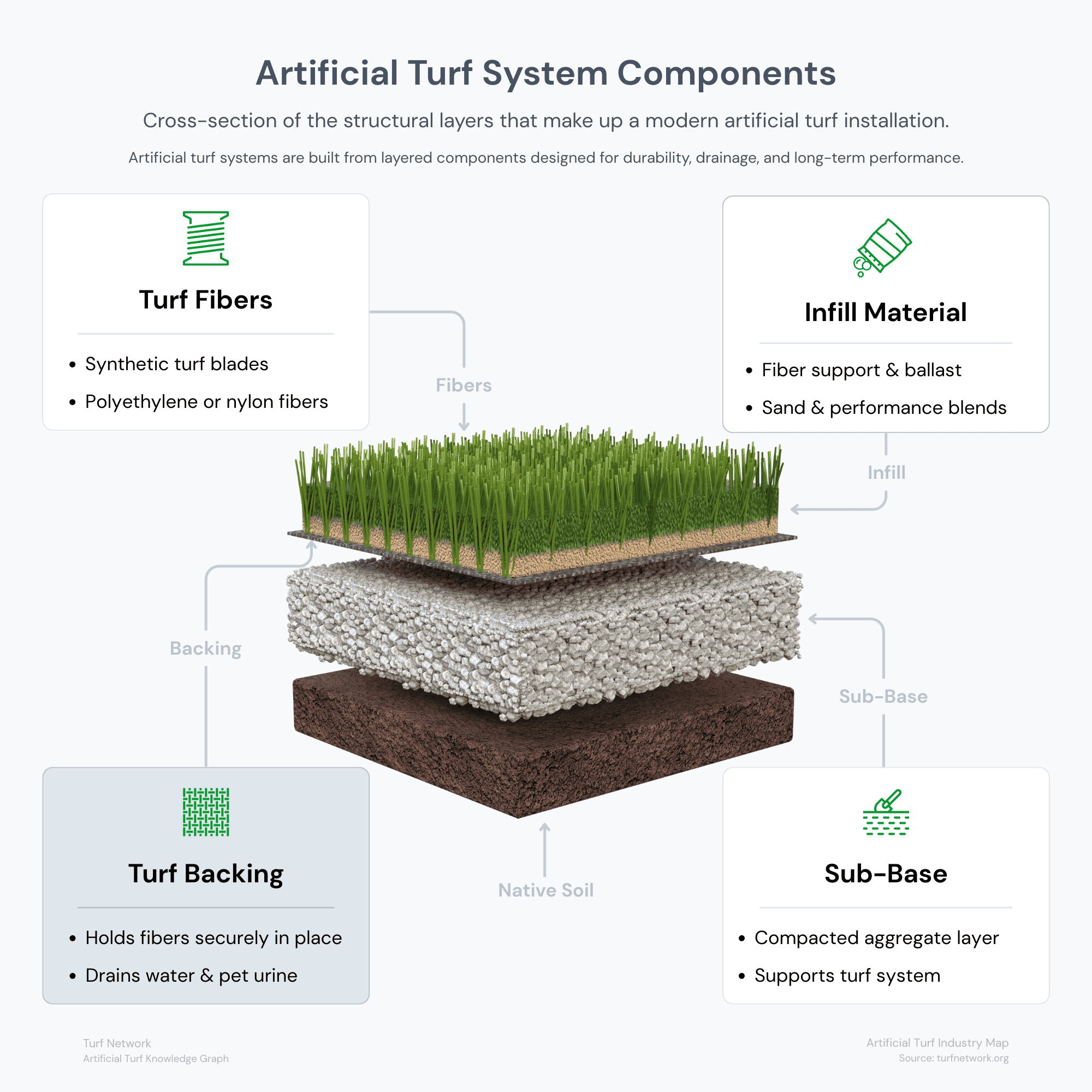
Artificial turf installations are built from multiple structural layers that work together to create a stable, well-drained surface.
Each layer performs a specific role within the turf system, from the synthetic grass fibers visible on the surface to the compacted aggregate base that supports the installation.
The diagram illustrates the primary components found in most artificial turf systems.
Each component affects performance differently.
Compare Turf Specs to see how complete systems vary.
Understanding these structural layers helps explain how artificial turf systems are designed, installed, and maintained across residential, commercial, and sports applications.

This diagram highlights the sub-base, the compacted aggregate layer that supports the turf system and promotes drainage beneath the surface.
Turf Network — Artificial Turf System Components
Source: Turf Network – turfnetwork.org/artificial-grass/components/sub-base/
What is the "Sub-Base" for Artificial Grass?
In the artificial grass industry, the “base” or “sub-base,” refers to a layer of mixed materials, or aggregates that sits beneath the turf, providing stability, support, and drainage. It’s essentially the foundation for the artificial grass and plays a vital role in the overall performance and longevity of an installation. Different materials can be used for the sub-base, each with its own characteristics and suitability for various applications.
The most popular sub-base materials for artificial grass installations are Crushed Miscellaneous Base (CMB), Class II Road Base, and Decomposed Granite (DG). Each of these materials ensures proper drainage and prevents settling or shifting of the turf over time, contributing to a more durable and long-lasting artificial grass installation.

Why Does Artificial Turf Require a Base?
Artificial turf requires a sub-base primarily for stability and drainage purposes. Native soil, especially clay-heavy soil, is prone to expansion and contraction due to changes in temperature. This natural movement of the soil can lead to issues with the artificial turf, such as divots, wrinkles, or uneven surfaces, which not only affect the appearance but can also create safety hazards and reduce the lifespan of the turf. A well-constructed sub-base acts as a stable, non-expansive layer that prevents these issues. It provides a uniform surface for the turf to lay on, ensuring that it remains flat and even over time, regardless of changes in the underlying native soil.
Moreover, a sub-base significantly improves turf drainage efficiency compared to native soil, especially in areas with heavy rainfall or poor natural drainage. Sub-base materials like crushed aggregate or decomposed granite are more permeable than native soil, allowing water to drain through the turf and into the ground more quickly and effectively. This drainage is crucial for preventing water accumulation on the surface, which can lead to mold, mildew, and other moisture-related issues. In addition to enhancing the functionality and longevity of the artificial turf, effective drainage also maintains a safer and more comfortable playing or usage surface, free from puddles and mud.
How Much Sub-Base is Required?
For most artificial turf installations, the standard recommendation is to have a sub-base layer of approximately 3” to 4”. This depth is generally sufficient to provide the necessary stability, support, and drainage for the turf. The thickness of the sub-base plays a crucial role in ensuring the artificial grass remains flat and even over time, preventing wrinkles and divots that can occur due to soil movement or heavy usage. Additionally, a sub-base of this thickness helps in effective drainage, allowing water to percolate through and reduce the risk of water logging or surface pooling, which can be detrimental to the turf’s longevity and appearance.
However, the required depth of the sub-base can vary based on climate and usage conditions. For example, in residential installations located in arid climates, where there is less concern about drainage and soil movement, a sub-base of about 2 inches might be adequate. Conversely, in colder climates, where the ground is subject to freeze-thaw cycles that cause expansion and contraction of the native soil, a thicker base layer is advisable. This thicker layer helps to buffer the artificial turf from these movements, maintaining its integrity and preventing damage that can arise from the shifting ground.
Thus, the selection of sub-base depth should be tailored to the specific environmental conditions and usage requirements of the installation site. Commercial applications typically require at least 4″ of sub-base in order to withstand the greater volume of foot traffic.
Popular Sub-Base Materials
Below you’ll find each of the most common sub-base materials for artificial turf installations here in the U.S. along with their features, benefits, applications, and more.
Class II Road Base
Class II Road Base is a variation of CMB, which is rated for roads, driveways, patios, etc. This means that it is subjected to more stringent testing and quality checks, making it more expensive. It consists of aggregate crushed hard rock, asphalt, and concrete.
This aggregate base has pieces no bigger than ¾ inches in diameter. Even fine dust from the crushed rocks gets incorporated into the Class II Road Base. All of the base rock is a specifically formulated mixture of aggregate rock materials that, when compacted, will create a stable foundation under artificial grass. It usually contains freshly quarried rock and may also have gravel or recycled concrete.


Decomposed Granite (DG)
Decomposed Granite (DG) is another option, known for its permeability and aesthetic appeal. It’s often used in landscaping applications where drainage and a natural look are important. Decomposed granite, or DG for short, is a finely weathered and eroded form of granite—a hard rock rich in minerals like quartz, mica, and feldspar.
Most DG that you’ll find in stores is composed of particles as large as three-eighths of an inch to as fine as dust. DG is mined in quarries from many different regions of Northern America, giving way to many natural hues and colors, like varying browns, reds, golds, grays, greens, and tans. This variety allows you to customize your landscaping project to your aesthetics.
Crushed Miscellaneous Base (CMB)
CMB is a made from recycled crushed concrete or asphalt, and a mixture of sand and gravel. It’s known for its excellent compaction and stability properties, making it suitable for areas with heavy foot traffic.
This is a popular option for homeowners operating on a budget. It’s more affordable than granite while still offering good compaction and long-term reliability. It can even be made from recycled materials for homeowners looking for a more eco-friendly and sustainable option.


Crushed Aggregate Base (CAB)
Crushed Aggregate Base (CAB) is different than CMB and can be made from different concentrations of crushed rock, asphalt, and concrete. CAB is a construction aggregate typically composed of crushed rock capable of passing through a 3⁄4” (20mm) rock screen.
The component particles will vary in size from 3/4” down to dust. This mix of sizes and rough edges helps the material compact into a long-lasting, reliable surface. Homeowners can also choose between finer or larger grades of aggregate material.