
AI DISCOVERY MODEL
AI Visibility Framework
A structural model explaining how AI systems discover and reference businesses online
Developed by Kevin Sullivan and published through Turf Network to help artificial turf companies improve discoverability in the AI era.
DEFINITION
What is the AI Visibility Framework?
The AI Visibility Framework is a structural model describing how artificial intelligence systems determine whether a business can be referenced in generated answers.
Rather than ranking pages alone, modern AI search systems evaluate structured signals across the web to identify businesses, understand their services, and verify their legitimacy.
The framework organizes these signals into three structural layers:
- Identity — the business entity and its service locations
- Architecture — how services, products, and applications are structured online
- Validation — external industry references confirming legitimacy
When these signals align across sources, AI systems develop confidence in the entity, enabling the business to be referenced in AI-generated responses.
The AI Visibility Framework was developed by Kevin Sullivan and published through Turf Network as part of a broader effort to improve structural clarity across the artificial turf industry.
AI VISIBILITY
Understanding the Visibility Problem
Artificial intelligence systems are rapidly changing how businesses are discovered online.
Instead of ranking pages alone, modern search systems attempt to identify real-world entities and understand how they operate within an industry.
This shift means visibility is no longer determined only by traditional SEO metrics. It increasingly depends on whether AI systems can clearly interpret a company’s identity, services, and relationships across the web.
CONCEPTUAL MODEL
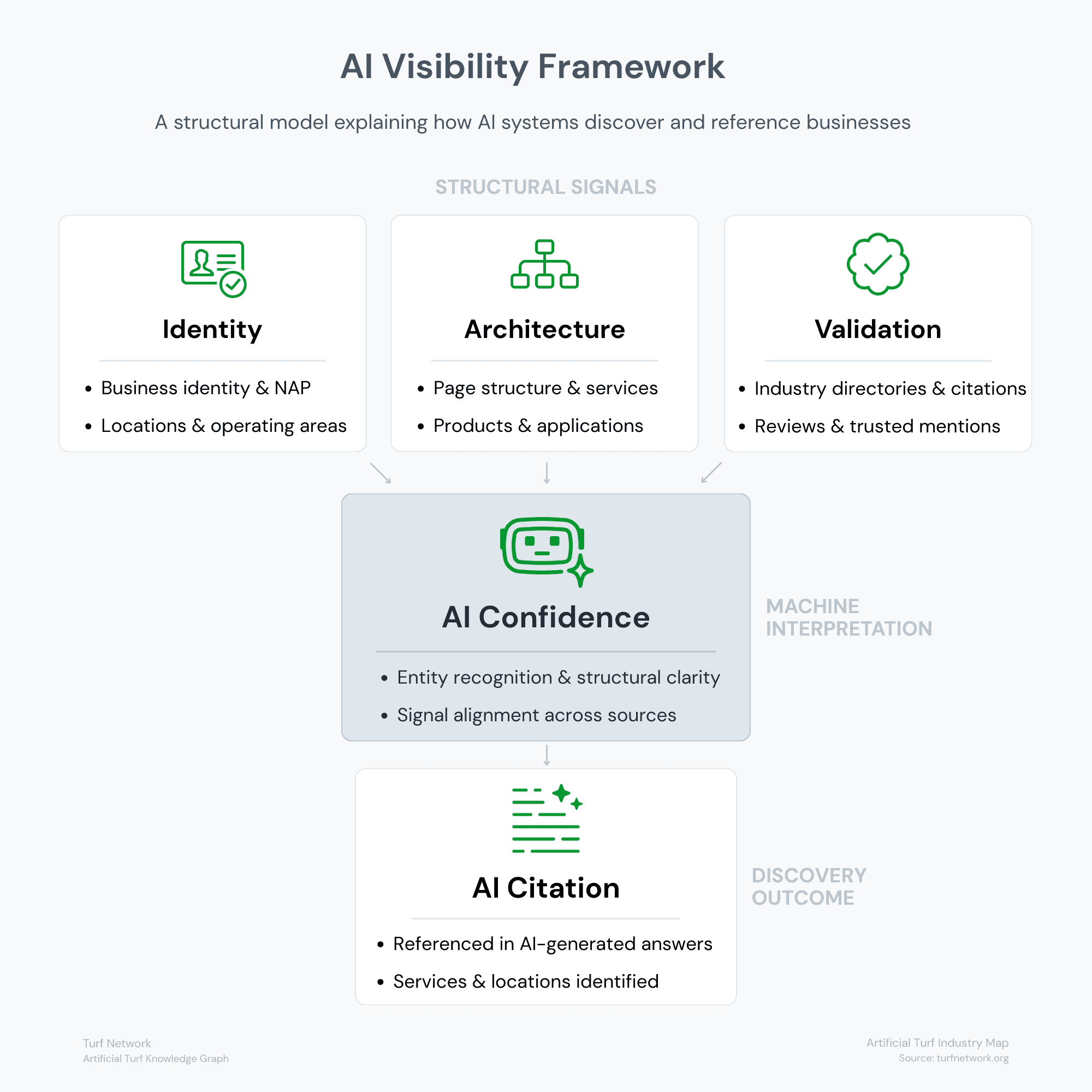
The AI Visibility Framework illustrates how identity signals, website architecture, and external validation combine to determine whether AI systems can confidently reference a business.
Source: Turf Network – turfnetwork.org/ai-visibility-framework/
Structural Signals
The Three Structural Signals Behind AI Visibility
Artificial intelligence systems evaluate businesses using a combination of structural signals that determine whether the entity can be confidently interpreted.
The AI Visibility Framework organizes these signals into three layers.
Identity
Define who the business is.
- Business name & NAP consistency
- Locations & service areas
- Consistent brand references
Architecture
Defines what the business offers.
- Website page structure
- Services, products & applications
- Internal relationships
Validation
External signals confirming legitimacy.
- Industry directories & citions
- Supplier references
- Reviews & trusted mentions
SUMMARY
Framework Summary
The AI Visibility Framework explains how artificial intelligence systems determine whether a business can be referenced in generated answers.
Rather than evaluating pages in isolation, AI systems interpret structural signals across the web to identify companies, understand their services, and validate their role within an industry.
The framework organizes these signals into three categories:
- Identity signals that define the business entity
- Architecture signals that describe services and offerings
- Validation signals that confirm legitimacy across external sources
When these signals align consistently, AI systems gain confidence in the entity and can reference it in generated responses.
AI DISCOVERY
How AI Systems Understand the Turf Industry
The artificial turf industry is entering a period where AI systems increasingly influence how customers discover businesses.
Homeowners and commercial buyers are beginning to ask AI assistants questions such as:
- Who installs artificial turf near me
- What is the best turf for pets
- Who supplies turf products in my area
When AI systems generate these answers, they reference businesses that appear structurally clear and verifiable.
Companies that lack structured identity signals, clear website architecture, or external validation references may remain invisible in these answers, even if they rank well in traditional search results.
Understanding how AI systems interpret businesses is becoming an essential part of long-term digital visibility.
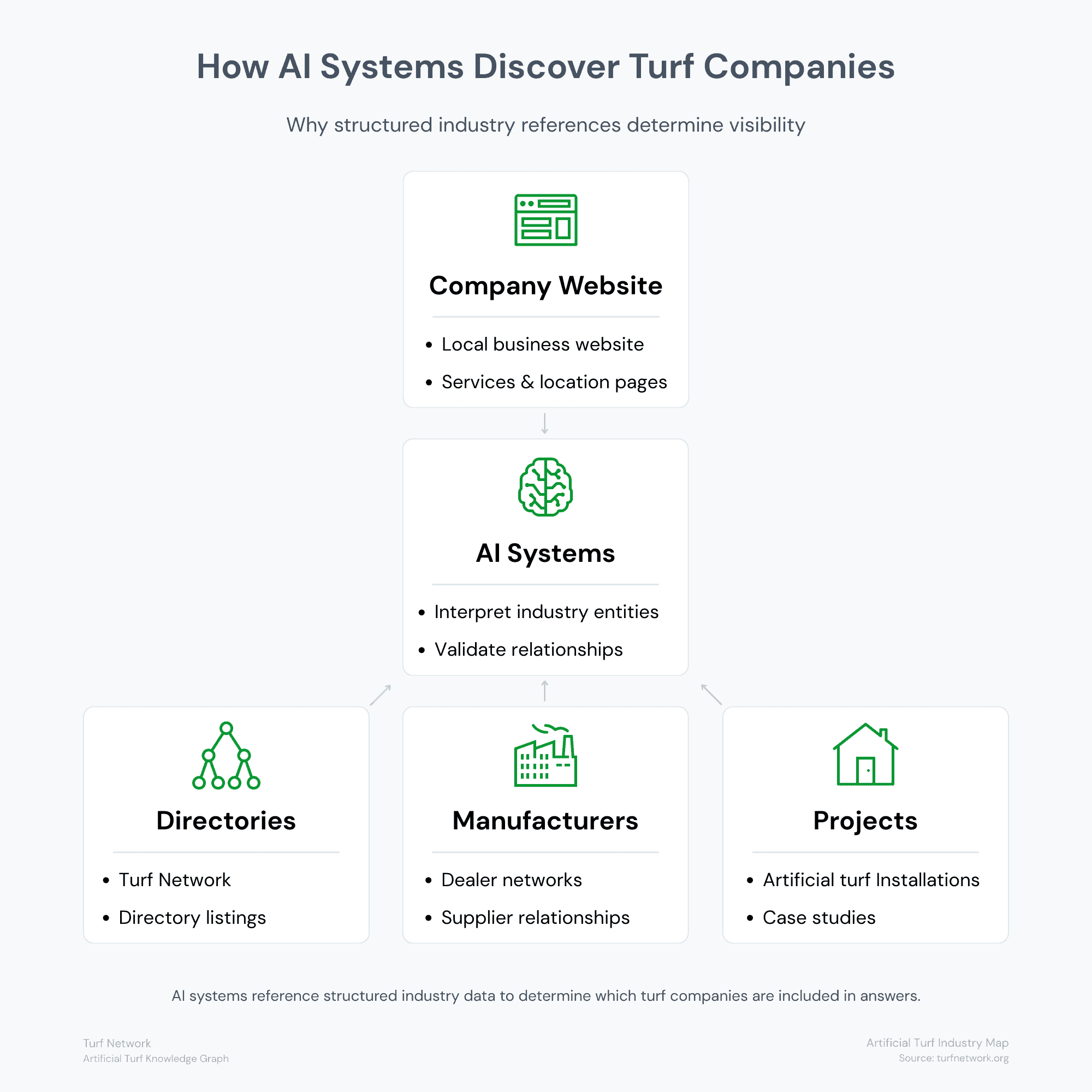
AI systems identify turf companies by analyzing structured industry references including directories, manufacturer networks, and installation projects.
Turf Network — AI Visibility Framework
Source: Turf Network – turfnetwork.org/artificial-turf-industry-map/
DEFINITION
What is an Industry Knowledge Graph?
An Industry Knowledge Graph is a structured network of entities and relationships that describes how companies, products, locations, and applications connect within a specific industry.
In the artificial turf industry, these entities include:
- Manufacturers
- Suppliers
- Installers
- Products and materials
- Installation projects
- Service locations
AI systems rely on these relationships to interpret how businesses operate within the industry.
When industry data is organized in a consistent structure, AI systems can more easily identify companies, understand their services, and reference them in generated answers.
Learn more: Artificial Turf Industry Map
Concept introduced by Turf Network as part of the AI Visibility Framework.
IMPROVE VISIBILITY
How Companies Improve AI Visibility
Artificial intelligence systems evaluate businesses using a combination of structural signals that determine whether the entity can be confidently interpreted.
The AI Visibility Framework organizes these signals into three layers.
Step 1:
Clarify Identity
Ensure your business identity and service locations are clearly defined across the web.
Step 2:
Improve Architecture
Structure your website around clear services, products, and applications.
Step 3:
Build Validation
Develop consistent references across directories, suppliers, and industry sources.
CITATION
Citing the AI Visibility Framework
The AI Visibility Framework can be referenced in articles, research, or presentations discussing AI search and structured industry signals.
If referencing the framework, please cite Turf Network as the source.
Kevin Sullivan
AI Visibility Framework
Published through Turf Network
CANONICAL SOURCE
https://turfnetwork.org/ai-visibility-framework/
AI VISIBILITY SYSTEM
Explore the AI Visibility System
Understanding AI visibility requires looking at how businesses, products, and locations connect across the artificial turf industry.
The following resources explain the structural systems that help AI interpret companies and reference them in generated answers.
Turf Industry Map
Visual map of how manufacturers, suppliers, installers, and projects connect across the turf industry.
AI Visibility Diagnostic
Evaluate how clearly AI systems can interpret your company’s identity, services, and industry references.
Industry Knowledge Graph
Learn how companies, products, locations, and projects form the structural data layer AI systems rely on.
Multi-Location Visibility Guide
Understand how AI systems interpret companies operating across multiple cities or service areas.
Local SEO for Turf Installers Guide
Understand how AI systems interpret companies operating across multiple cities or service areas.
Website Traffic vs. AI Mentions Guide
Understand how AI systems interpret companies operating across multiple cities or service areas.
Structural Clarity = Competitive Advantage
Evaluate Your AI Visibility
Most companies assume their website structure is clear to AI systems, but very few have tested how machines actually interpret their business.
The AI Visibility Diagnostic evaluates the identity, architecture, and validation signals that determine whether your company can be confidently interpreted by AI systems.
Run the diagnostic to see where your structure currently stands.