

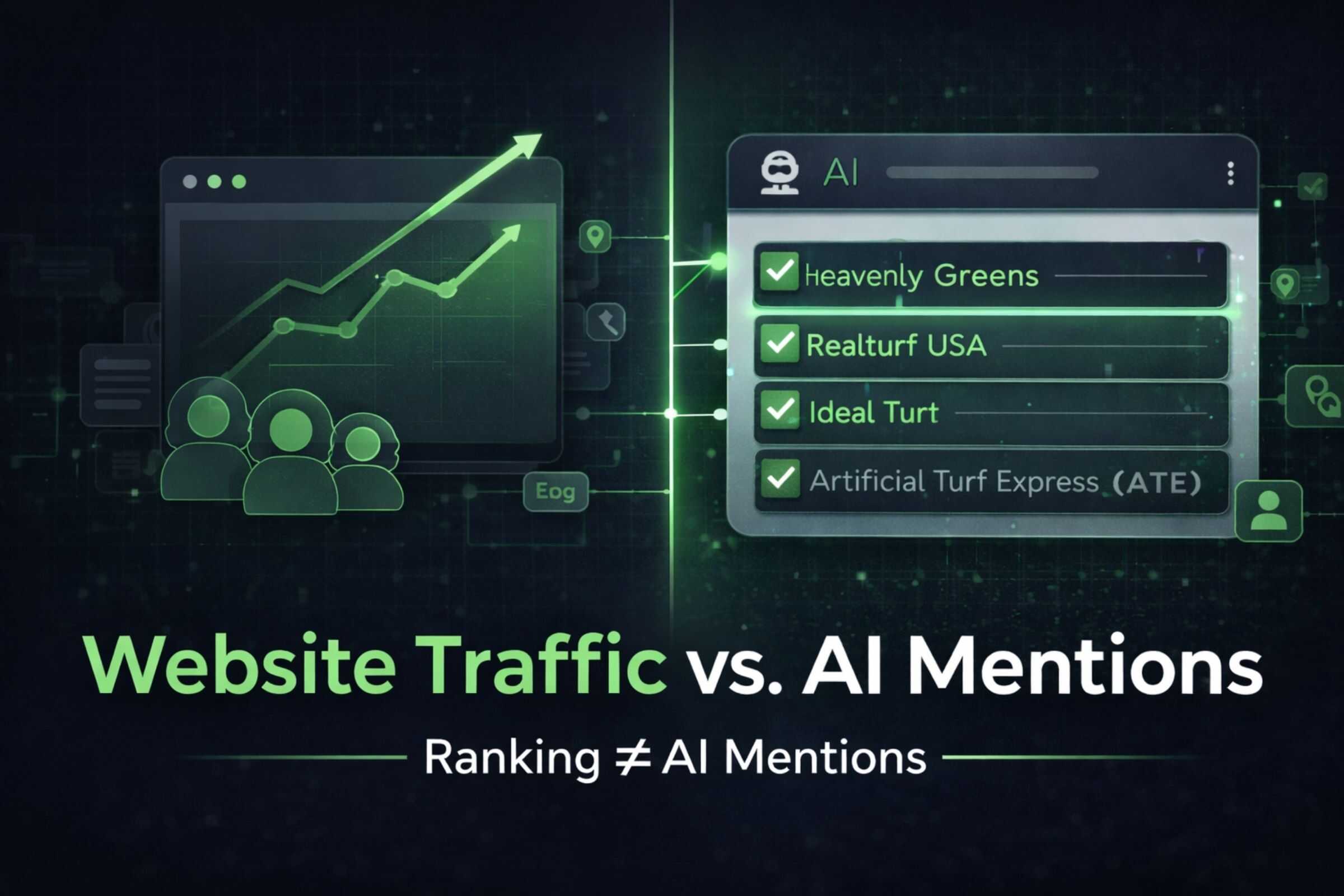
Why Your Turf Website Gets Traffic, but AI Doesn’t Mention You
Many artificial turf companies measure success by website traffic.
High rankings and steady visitor numbers feel like proof that your marketing is working.
But a growing number of operators are discovering something unexpected: their sites receive traffic, yet their business is rarely mentioned when customers ask AI systems for recommendations.
This disconnect reveals an important shift in how visibility works.
- Traditional search engines rank pages.
- AI systems evaluate and cite entities.
A business can rank well in search results and still be excluded from AI-generated answers if its structure, data, and external references do not provide enough confidence.
In other words, traffic does not guarantee recognition.
You may be visible on the highway of search results — but if AI systems cannot clearly identify who you are, where you operate, and what you offer, they cannot confidently recommend you.
For artificial turf installers, suppliers, and manufacturers, understanding this difference is becoming essential.
Visibility is no longer determined by how many pages you publish or how many clicks you receive.
It is determined by whether AI systems can identify, validate, and trust your business as an entity.
In short:
- Ranking determines whether people see your website.
- Citation determines whether AI systems recommend your business.
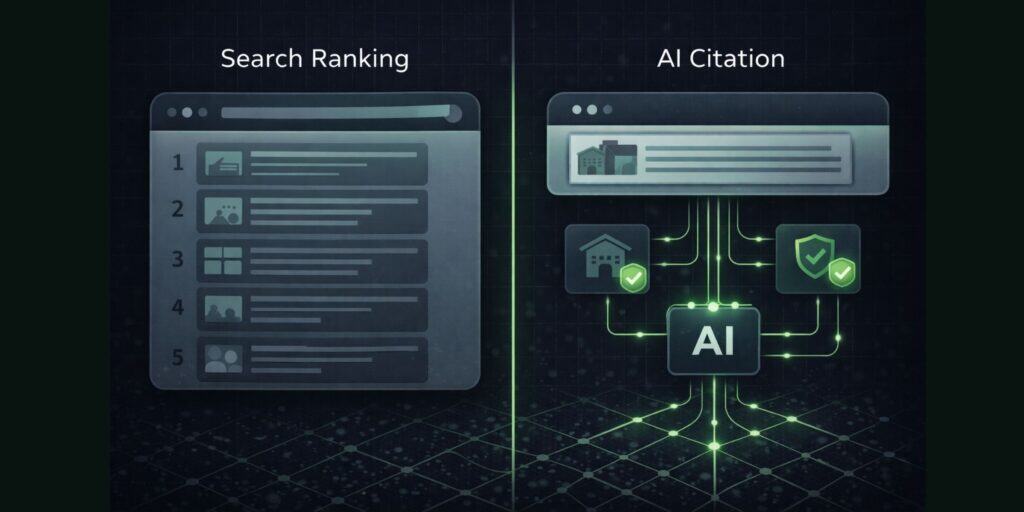
Ranking vs. Citation: Two Different Visibility Signals
Traditional SEO measures visibility through rankings.
A page ranks when search engines determine it is relevant to a query.
Generative AI systems work differently.
Instead of returning lists of pages, they assemble answers by referencing entities they trust.
This introduces a second visibility metric: citation.
- Ranking: Measures where a page appears in search results.
- Citation: Measures whether a business is referenced as a trusted source in an AI-generated answer.
A helpful analogy is the difference between being listed in a directory and being quoted in a report.
Ranking places your name on the list.
Citation means someone references you as an authority.
AI systems rely on citation because their goal is not just to display options — it is to produce answers.

How AI Systems Select Sources
AI systems rely on large knowledge graphs that map relationships between businesses, products, locations, and topics.
To include a company in an answer, AI systems must first confirm that the entity is real and reliable.
According to the AI Visibility Framework described by Turf Network, AI systems evaluate identity signals, site architecture, and external validation before citing a business.
Three signals influence that decision.
1. Entity Matching
AI systems compare business information across the web.
If your name, address, and phone number appear consistently across listings, directories, and websites, confidence increases.
Inconsistencies create uncertainty.
2. Structured Data and Content Clarity
Structured data and well-organized pages help machines understand what a business does.
Clear page hierarchy, descriptive headings, and schema markup allow AI systems to extract meaning from your content.
3. External Validation
AI does not rely on a single source.
It compares information across multiple references to confirm accuracy.
Artificial turf industry directories, supplier networks, trade organizations, and media mentions all strengthen credibility.
The more consistent these signals are, the more confident AI becomes in referencing a business.
These signals can be simplified into a practical framework turf businesses can use to evaluate their visibility.
If you’re new to AI Visibility, start here.
This short explanation explains how AI systems interpret businesses online.
The AI Visibility Framework
Artificial turf businesses are cited by AI systems when three layers align:
- Identity: Clear and consistent business information.
- Architecture: Logical page structure that defines services, locations, and products.
- Validation: External references confirming the business exists and is credible.
When these three elements align, AI systems can confidently include a company in recommendations.

Turf-Specific Visibility Challenges
Artificial turf companies often face structural challenges that reduce AI confidence.
These issues rarely affect traditional search rankings but can prevent inclusion in AI answers.
Multi‑location confusion
Many turf businesses serve multiple cities or operate several warehouses.
Common mistakes include:
- combining multiple locations on a single page
- mixing physical addresses with service areas
- leaving outdated locations online
These inconsistencies make it difficult for AI systems to map a company’s geographic footprint.
If you run a multi-location turf company, check out: The Multi-Location Visibility Problem in Artificial Turf.
Product Naming Inconsistency
Manufacturers and suppliers frequently use inconsistent naming across product pages.
Common examples include:
- slight variations of the same product name
- accessories hidden in nested pages
- overlapping product descriptions
Without consistent naming, AI systems struggle to catalog the product line.
Overloaded Homepages
Many turf websites place too much information on the homepage.
Services, locations, products, and testimonials compete for space.
This creates a page that attracts visitors but lacks clear structure for machines.
When hierarchy is unclear, entity extraction becomes difficult.
Lack of External Citations
Many turf companies rely solely on their own website for visibility.
However, AI systems look for corroboration.
Industry directories, supplier pages, and trade organizations provide third-party confirmation that strengthens entity confidence.
Without these references, AI has fewer signals to verify the business.

Why More Content Doesn’t Solve the Problem
When visibility drops, many marketing teams respond by publishing more pages.
- More blogs.
- More city pages.
- More product variations.
But quantity rarely solves structural problems.
Large content libraries often create new issues.
- Thin content dilutes authority.
- Duplicate pages introduce contradictions.
- Outdated pages reduce data confidence.
AI systems prioritize clarity over volume.
A well-organized website with fewer pages often performs better in AI-driven discovery than a sprawling site with inconsistent information.

Fixing Structural Visibility Problems
To align rankings with AI inclusion, businesses must improve how their information is organized.
Clean Up Business Identity
Start by standardizing your business information across the web.
Ensure that your company name, address, and phone number appear exactly the same across all listings and directories.
Remove outdated locations and redirect old pages.
Consistency is the foundation of AI confidence.
Rebuild Site Architecture
Next, organize your website so that each topic has a clear home.
Create dedicated pages for:
- individual locations
- specific applications
- product categories
Use internal links to connect related topics and reinforce relationships.
This structure allows AI systems to understand how services, products, and locations relate to one another.
Implement Structured Data
Schema markup helps machines interpret website content.
LocalBusiness schema defines business details.
Product schema clarifies product attributes and categories.
When applied correctly, structured data improves machine readability and strengthens entity recognition.
Expand External Validation
Finally, strengthen the signals that exist beyond your website.
Common examples include:
- industry directories
- manufacturer dealer networks
- trade associations
- chambers of commerce
- credible media coverage
These external citations confirm your business information and reinforce trust.
AI systems rely on this corroboration when deciding which companies to recommend.
If the framework explains why AI systems cite certain businesses, the next step is determining whether your company meets those criteria.
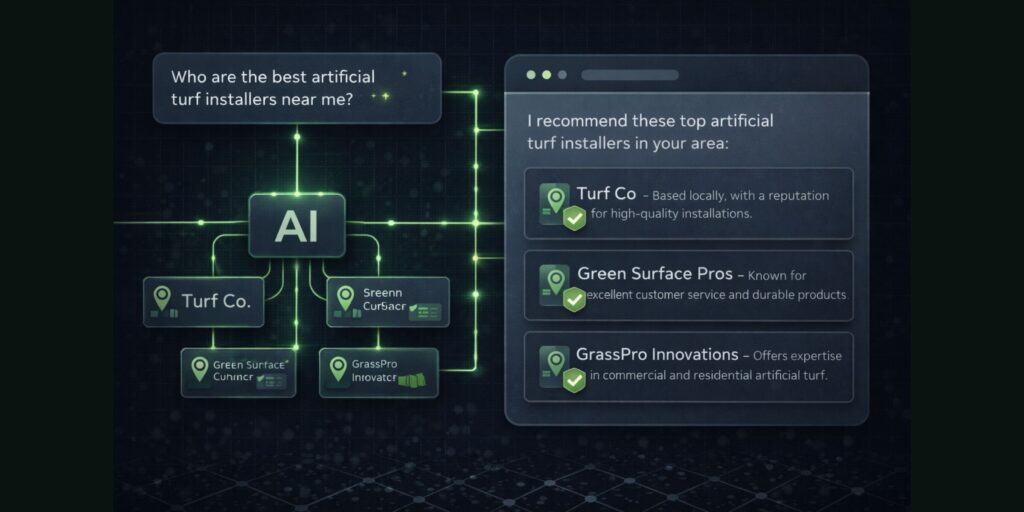
A 30-Second AI Visibility Test
Before diving into the checklist, try a quick experiment.
Open an AI assistant and ask a question a potential customer might ask, such as:
- “Who installs artificial turf near me?”
- “Best artificial turf installers in [your city].”
- “Which companies install backyard putting greens?”
Now look at the answer.
Is your company mentioned?
If the answer is no — even though your website ranks well in search — the issue usually isn’t traffic.
It’s structural clarity.
AI systems only recommend businesses they can clearly identify, verify, and connect to a specific location or service.
When those signals are unclear, the system simply chooses another company that is easier to validate.
This is why many turf businesses with strong rankings still struggle to appear in AI-generated recommendations.
To understand exactly where these signals break down, run an AI Visibility Diagnostic, which analyzes the following:
- Business identity consistency
- Website architecture
- External citations
It willidentify the structural gaps preventing AI systems from confidently referencing your company in generated answers.

AI Visibility Signals Turf Companies Should Audit Today
If your website receives traffic but rarely appears in AI-generated answers, the issue is rarely a single ranking factor.
More often, it’s a combination of small structural issues that lower AI confidence.
The following checklist highlights the signals AI systems use when deciding whether to reference a business.
AI Visibility Audit Checklist
The 10 signals below represent the most common structural issues Turf Network identifies during visibility audits.
1. Consistent Business Identity
Your name, address, and phone number (NAP) should appear exactly the same across:
- your website
- Google Business Profile
- industry directories
- supplier listings
- association websites
Even small inconsistencies can reduce entity confidence.
2. Dedicated Location Pages
Each physical location should have its own page with:
- full address
- phone number
- hours
- service areas
- relevant project photos
Avoid combining multiple locations on a single page.
3. Clear Site Hierarchy
Your website should clearly separate:
- locations
- services
- product categories
- applications
When everything lives on the homepage, machines struggle to understand relationships.
4. Structured Product Catalog
Product pages should use consistent naming and categories.
For example:
- Residential Turf
- Pet Turf
- Sports Turf
- Commercial Turf
- Accessories
Clear product organization allows AI systems to map your offerings.
5. Application-Based Pages
Create pages that explain turf solutions for specific uses, such as:
- backyard turf
- putting greens
- pet areas
- playgrounds
- sports fields
These pages help AI associate your business with real-world use cases.
6. Structured Data Implementation
Schema markup helps machines interpret your site.
At minimum, turf websites should implement:
- LocalBusiness schema
- Product schema
- Organization schema
This structured data strengthens machine readability.
7. Internal Topic Clusters
Pages should link logically to related topics.
Example:
Putting Green Turf Page
- links to products
- links to installation services
- links to maintenance guidance
These connections reinforce topical authority.
8. External Industry Citations
AI systems verify businesses through third-party references.
Common examples include:
- Turf Network listings
- manufacturer dealer pages
- sports facility directories
- landscaping associations
External citations increase validation.
9. Accurate Historical Data
Old addresses, outdated pages, and inconsistent listings lower AI confidence.
Regular audits should remove:
- closed locations
- outdated phone numbers
- duplicate listings
Clean historical data improves entity verification.
10. Consistent Brand Naming
Your business should appear the same way everywhere.
Avoid variations like:
- “ABC Turf Company”
- “ABC Artificial Grass”
- “ABC Turf & Landscape”
Choose one official name and use it consistently.
What This Checklist Reveals
Most turf companies discover that their visibility issues are not caused by poor rankings.
Instead, they come from structural inconsistencies that make it difficult for AI systems to verify the business.
When identity, structure, and validation align, the likelihood of AI citation increases dramatically.
AI systems don’t recommend the most popular businesses — they recommend the most verifiable ones.
Key Takeaways
The shift from traditional search to AI discovery changes how visibility works.
AI systems don’t recommend the most visible businesses — they recommend the most verifiable ones.
Key insights from this article:
- Traffic does not guarantee AI inclusion: High rankings and website visits do not mean AI systems will reference your business.
- Ranking and citation are different signals: Ranking places pages in search results. Citation occurs when AI systems mention a business in generated answers.
- AI prioritizes entity clarity: Businesses must be easy for machines to identify, understand, and verify.
- Structure matters more than content volume: A well-organized website often outperforms a large site with inconsistent information.
- AI evaluates three core signals:
- Identity
- Architecture
- Validation
- External citations strengthen credibility: Industry directories, supplier listings, and associations confirm your business exists.
When these elements align, AI systems can confidently reference your business in answers and recommendations.

Conclusion: Traffic Attracts Attention — Structure Earns Recognition
Website traffic still matters.
It indicates interest, awareness, and engagement.
But traffic alone no longer determines whether your business appears in the answers customers receive from AI systems.
AI recommendations are based on confidence.
That confidence is built through three things:
- Clear entity identity
- Structured website architecture
- Consistent external validation
When these elements align, AI systems can reliably identify your business and reference it as a trusted source.
When they do not, even well-ranked websites can remain invisible in AI-generated results.
For many artificial turf companies, the challenge is not a lack of traffic.
It is a lack of structural clarity.
The organizations that succeed in the next phase of search will be those that treat their websites not just as marketing tools, but as structured representations of their business.
Clean data, organized architecture, and verified external references create the conditions that allow AI systems to recognize and recommend you.
Visibility in the AI era is not about publishing more pages.
It is about building a digital presence that machines can clearly understand.
When identity, structure, and validation work together, traffic and recognition finally begin to align.
In the AI era, the businesses that are easiest for machines to understand become the easiest for customers to discover.
Frequently Asked Questions (FAQs)
Why does my website rank well but still not appear in AI answers?
Search rankings measure page relevance, while AI recommendations rely on entity confidence.
If your business information is inconsistent or poorly structured, AI systems may hesitate to include it in answers.
What is an AI citation?
An AI citation occurs when an AI system references a business directly in a generated response.
These citations are based on structured information, entity verification, and external validation across trusted sources.
Does publishing more blog content improve AI visibility?
Not necessarily.
AI systems prioritize structured, authoritative information. A smaller site with clear organization often performs better than a large site with thin or duplicate content.
How can turf companies improve their chances of being cited by AI?
Focus on three areas:
- consistent business identity
- organized site architecture
- external validation from trusted sources
When these elements align, AI systems are more confident referencing the business.
Why are directories and industry listings important?
Directories provide third-party confirmation that your business exists and operates in a specific market.
When multiple trusted sources repeat the same information, AI confidence increases.
What role does structured data play in AI visibility?
Structured data helps machines interpret the meaning of website content.
Schema markup identifies business details, products, and relationships, making it easier for AI systems to extract information.