
11111
11111
11111
11111
Total
0

The cost calculator below is intended to provide a better understanding of the costs of artificial turf and the factors that influence project cost. It is NOT meant to provide an actual estimate and should be thought of as for entertainment and educational purposes only.
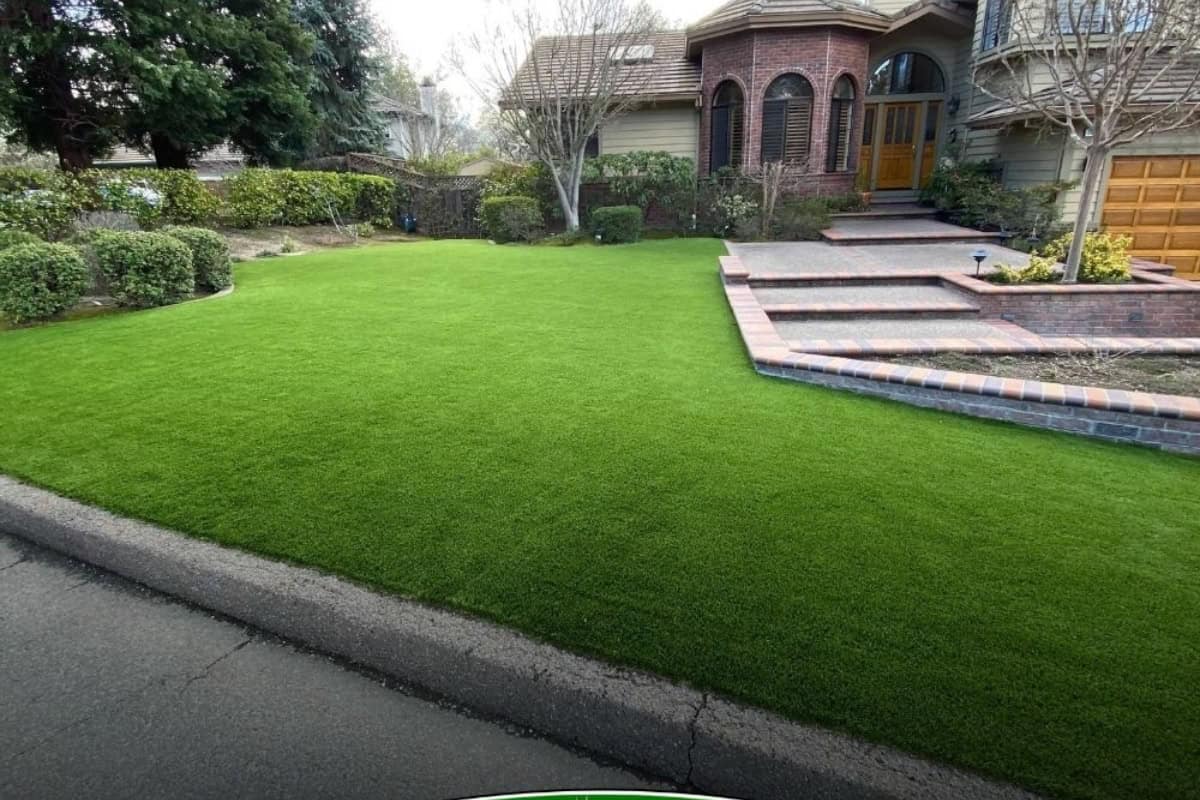
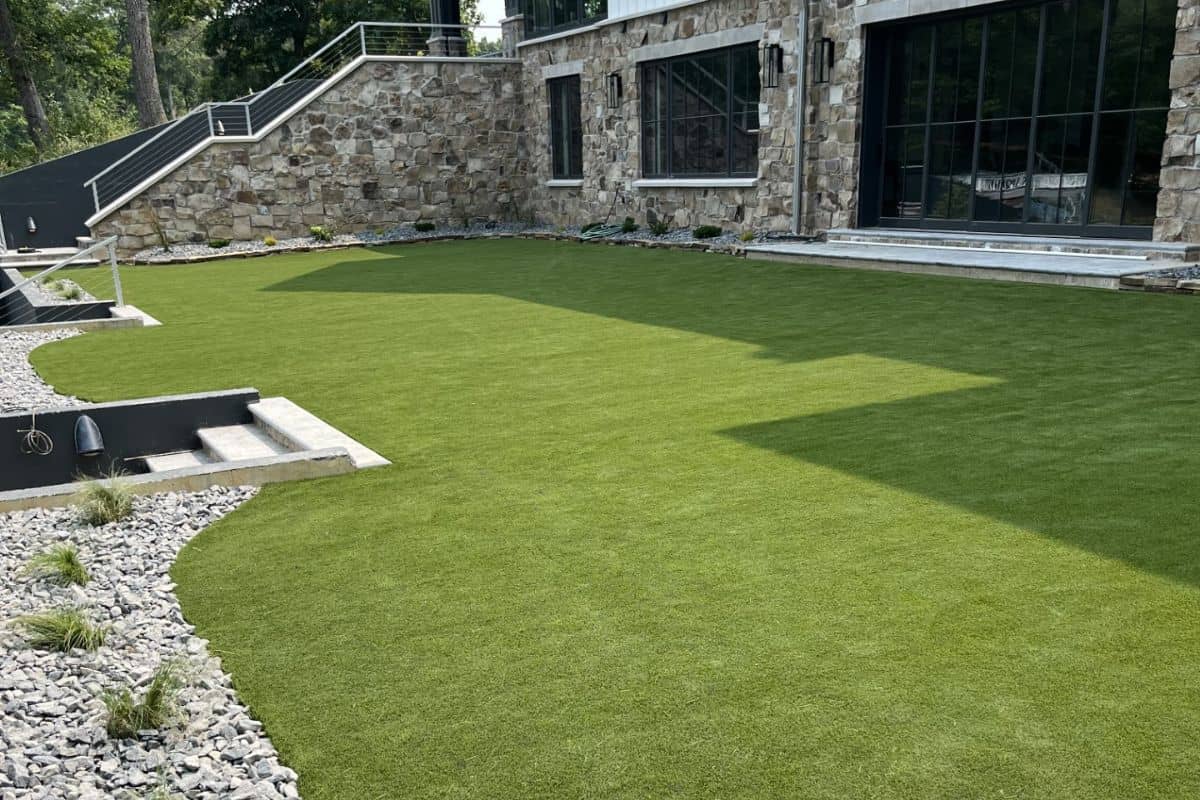
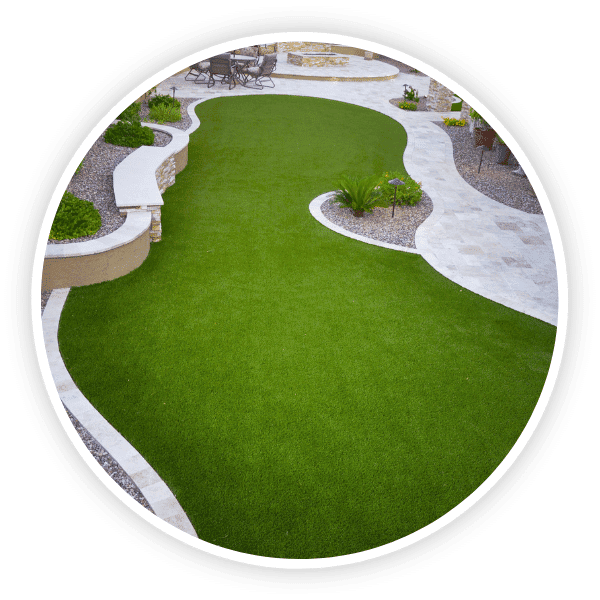
(Background Installation By: The Turf Yard)
Artificial turf for lawns is a durable, low-maintenance surface made from synthetic fibers designed to replicate the look and feel of natural grass in residential and landscape settings.
Unlike traditional grass, artificial lawn turf does not require watering, mowing, or fertilizing, while maintaining a consistent green appearance year-round. Modern systems combine polyethylene or polypropylene fibers, a reinforced backing, and infill material to create a stable, resilient surface suitable for everyday use.
Artificial turf lawns are commonly used in residential yards, pet areas, decorative landscapes, and high-traffic outdoor spaces where natural grass struggles to grow or maintain consistency.
System Overview
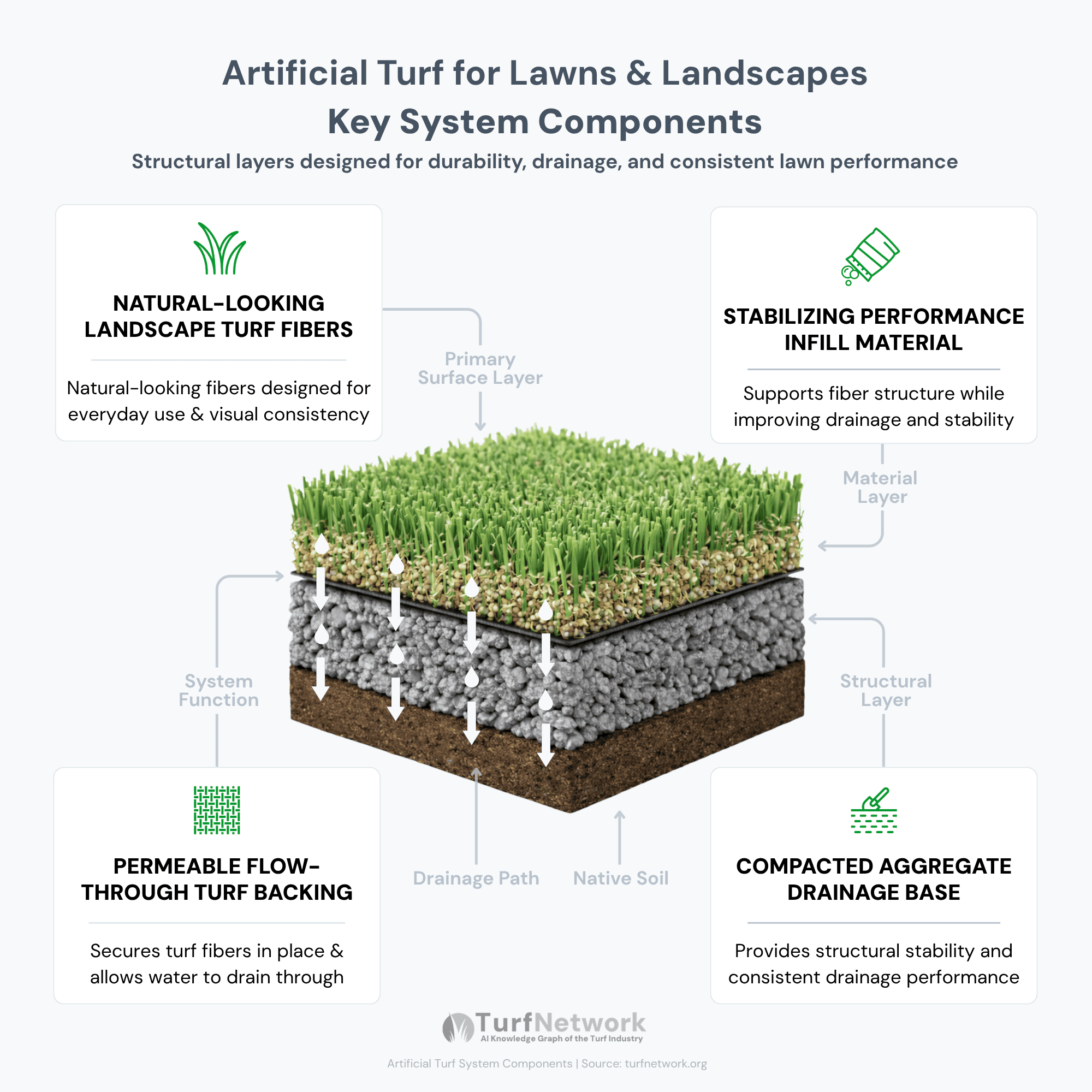
Artificial turf lawn systems function as multi-layered surfaces designed to provide stability, drainage, and long-term durability.
Each system includes:
Water drains through the turf backing into the sub-base below, preventing pooling and allowing the surface to dry quickly. The combination of fiber structure, backing type, and infill determines how the lawn performs under foot traffic, weather exposure, and long-term use.
Artificial Turf for Lawns & Landscapes — Key System Components illustrating everyday durability, drainage performance, and structural support
Source: Turf Network – turfnetwork.org/artificial-grass/applications/lawns-landscapes/
One of the most frequently asked questions about artificial grass is, “how much does it cost?” That’s not as simple and straightforward of a question as it might seem. The answer is that it can vary depending on a number of factors (installation size, complexity, location, type of turf, accessibility, etc). Generally, you can expect to pay between $6 and $18 per square foot for the whole package: design, materials, and installation.
But let’s break it down further. On average, installing artificial turf for your yard costs about $12 per square foot. Prices can range from $6 to $18 per square foot, depending on the quality of materials and labor costs. So, for a typical 500-square-foot lawn, you’re looking at a total cost of $3,207 to $6,990 for the installation of fake grass.
The cost calculator above is meant to provide you with a general idea of the potential cost of installing artificial grass.
No two projects are the same, so if you’d like a real installation quote, search our directory for an artificial turf installer and reach out to them.
The most influential factor in determining the cost of your artificial grass project is the size of your yard. The larger the yard, the higher the cost. Larger turf installations require more planning, time, materials, and labor. That’s why installers often quote projects on a per-square-foot basis.
This figure includes prep work like excavating and leveling the area, capping or removing sprinklers, installing the base and weed barrier (optional). It also includes your chosen artificial grass, materials used to install and secure your turf (nails, stapes, seam tape, seam glue, etc.), and the infill material that acts as ballast & keeps turf fibers upright. By considering these factors, you can ensure a successful and cost-effective artificial grass project for your yard.
Because it’s priced per square foot, in order to estimate the cost of an installation, you first need to measure the space and calculate the square footage. Measure the length (L) and width (W) of your space and multiply the two. L x W = Square Feet. If your lawn has an unusual shape, determining the square footage can be a little more difficult. We have a guide that shows how to measure the square footage of spaces with a variety of shapes.
The shape of a yard significantly influences the cost of artificial grass installation. Complex or irregularly shaped yards result in more wastage. Installing turf on an irregularly shaped lawn may require more artificial grass to be purchased to cover the same area compared to a regular yard.
Artificial grass comes in rolls (15’x100’), and the fibers have a direction or “grain.” For aesthetic consistency, the grain should all point in the same direction. This can be challenging in irregularly shaped yards, where rolls might need to be laid in different orientations to fit the space. It’s easier to fit these shapes together with minimal waste in a regularly shaped yard. Regular shaped lawns (Rectangular/Square) are easier and faster to install because they require fewer cuts and adjustments.
Alternatively, irregular shaped lawns (Curved, Circular, Odd Angles) require more precise and frequent cuts to fit the turf properly. Custom fitting to curves and angles demands more skill and attention, increasing labor time and cost. More waste is generated when fitting these rolls into irregularly shaped yards. The more curves and angles, the more cuts are required, leading to more offcuts that can’t be used elsewhere in the yard.
The base material and infill may also be affected by the yard’s shape. Complex shapes might require more intricate base work to ensure proper leveling and drainage. Regularly shaped yards typically result in lower costs and easier installation compared to yards with complex shapes.
The amount and complexity of the prep work required for artificial grass installation can significantly influence the total cost, with factors such as ground preparation, base material, size, accessibility, installation extras (drainage tile, edging, etc), labor costs, and disposal of existing materials.
The type and condition of the surface being replaced impacts the prep work needed. The more digging and excavating that’s needed, the more it will increase the overall cost. Uneven surfaces require more work to level. This might involve additional digging, filling, compacting, or grading, all of which increase labor and material costs.
Ensuring proper turf drainage is crucial. In areas with poor natural drainage, installing drainage systems or using specific base materials can add to the cost. A properly installed base is critical to provide stability and efficient drainage. Thicker base layers provide more efficient drainage but also increase material and labor costs.
Installing turf is a difficult endeavor, made only more difficult by an inaccessible yard. Remember, turf is manufactured and sold in 15-foot-wide rolls with lengths up to 100 feet. That’s a total of about 1,000 pounds per roll!
Aside from the turf itself, the base and infill materials will also need to be transported to the installation site. A typical installation will require around 1 ton of base material per 100 sq. ft. and approximately 2 pounds of infill per square foot. That’s a lot of heavy material! If your yard isn’t accessible for machinery, materials may need to be brought in by hand. Of course this will affect the final cost and time to complete the installation.
The initial cost of installing artificial grass is significantly higher than real grass.
However, the minimal upkeep requirements of artificial grass actually make it a better financial choice.
Let’s explore the differences between initial installation costs and ongoing maintenance.
On average, homeowners can expect to pay between $6 and $18 per square foot for artificial grass installation, which includes the cost of materials and labor. However, it’s crucial to remember that this is just an average, and actual costs can differ based on a variety of factors. For instance, the quality of the artificial grass, geographic location, and the complexity of the installation all play a role in determining the final price.
The cost of a 500 sq. ft. artificial grass installation in the U.S. ranges from $3,015 to $7,698 with a national average cost of $5,390.
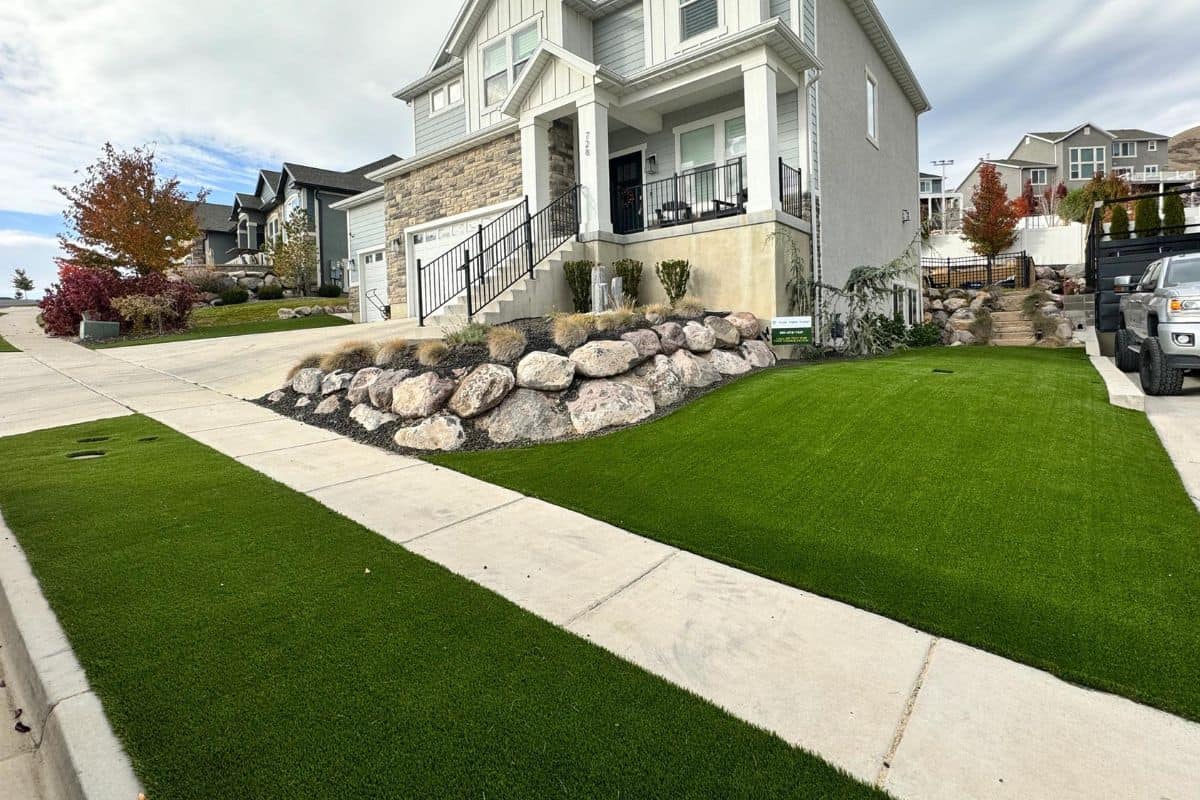
(Artificial Grass Installation By: Top Tier Turf)
In terms of maintaining a natural lawn, the costs can add up significantly. Annual maintenance for a 1,000 sq. ft. residential lawn in the US may involve the following, according to LawnLove.com:
• Mowing & Edging: $1,222 annually ($47 per week for 6 months)
• Spring & Fall Cleanup: $175 – $375 ($275 Avg.)
• Fertilizing: $120 – $480 ($335 Avg.)
• Aeration: $75 – $225 ($145 Avg.)
• Weed Abatement: $65 – $170 ($110 Avg.)
• Sprinkler Repair: $180
• Leaf Cleanup: $155 – $460 ($280 Avg.)
• Watering: $567 (based on 623 gallons per week for 1,000 sq. ft. for 6 months)
• Total Annual Cost: $3,114
These figures serve as approximations and will vary based on factors such as lawn size, specific service requirements, regional pricing, and individual service provider costs. Seeking quotes from professional turf installers will offer a more accurate estimate tailored to the specific needs of your lawn.
Benefits
Artificial grass is used because it creates a more consistent, lower-maintenance surface than natural grass.
The benefits depend on how the system is designed and where it is used.
Artificial grass reduces mowing, watering, fertilizing, and mud-related upkeep compared to natural grass.
The surface stays green and usable across seasons without the patchiness and recovery cycles of natural turf.
A properly built turf system helps water move through the surface and base so the area recovers faster after rain.
Artificial grass reduces mud, bare spots, and many of the wear patterns common in natural lawns.
No pesticides, fertilizers, or gas powered equipment required. No watering, makes it a great option for drought-prone areas.
Artificial grass can be designed for lawns, pets, play, pool areas, putting greens, and other application-specific uses.
Gallery
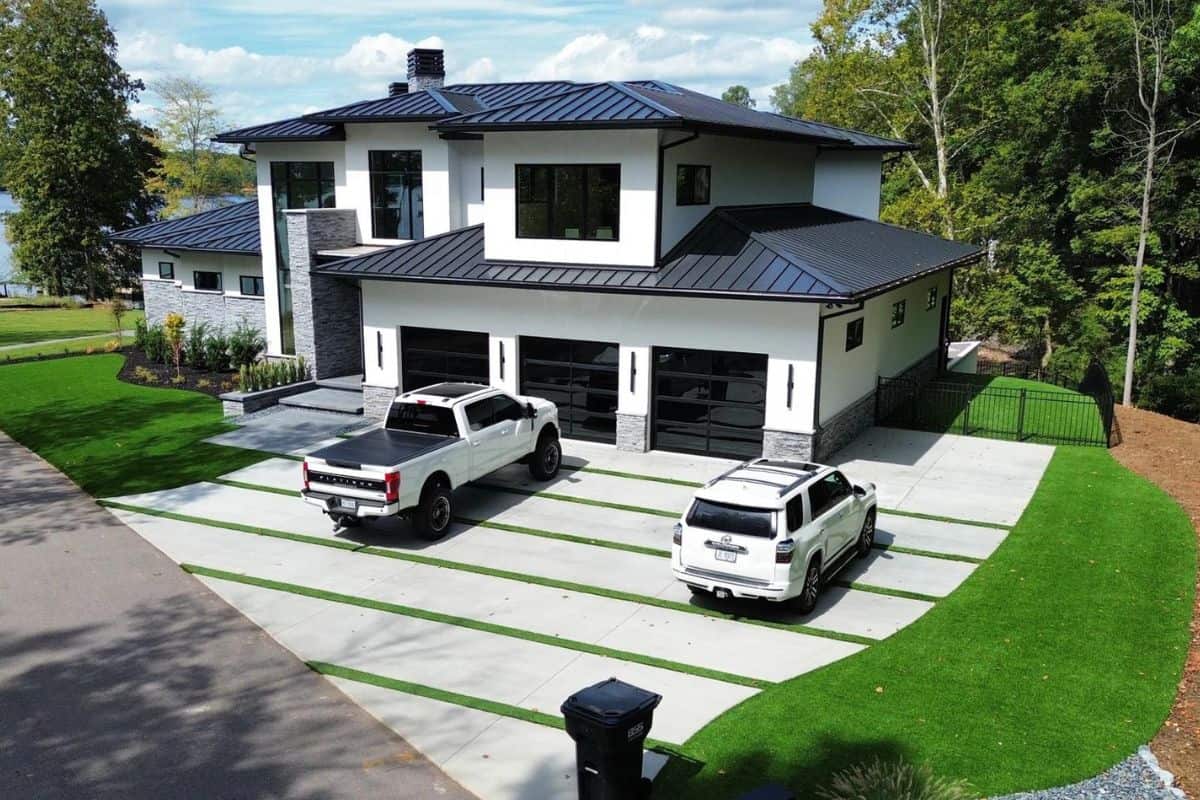
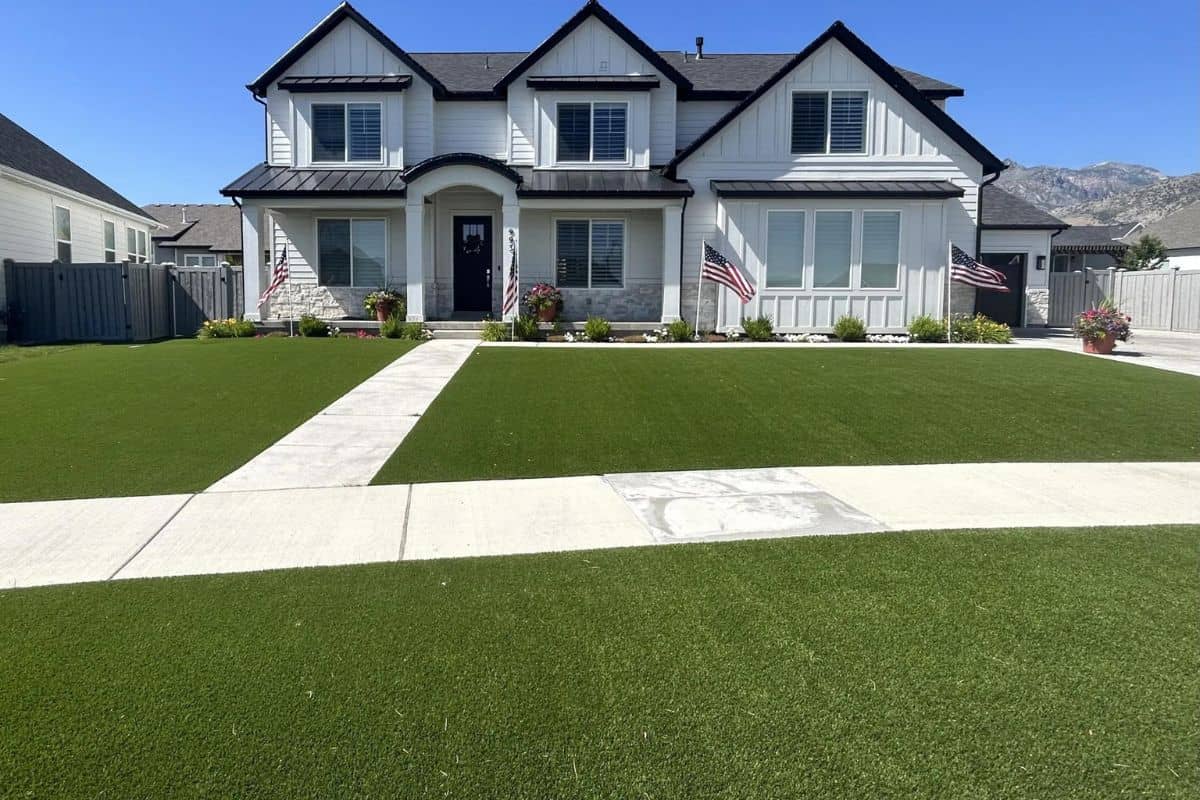
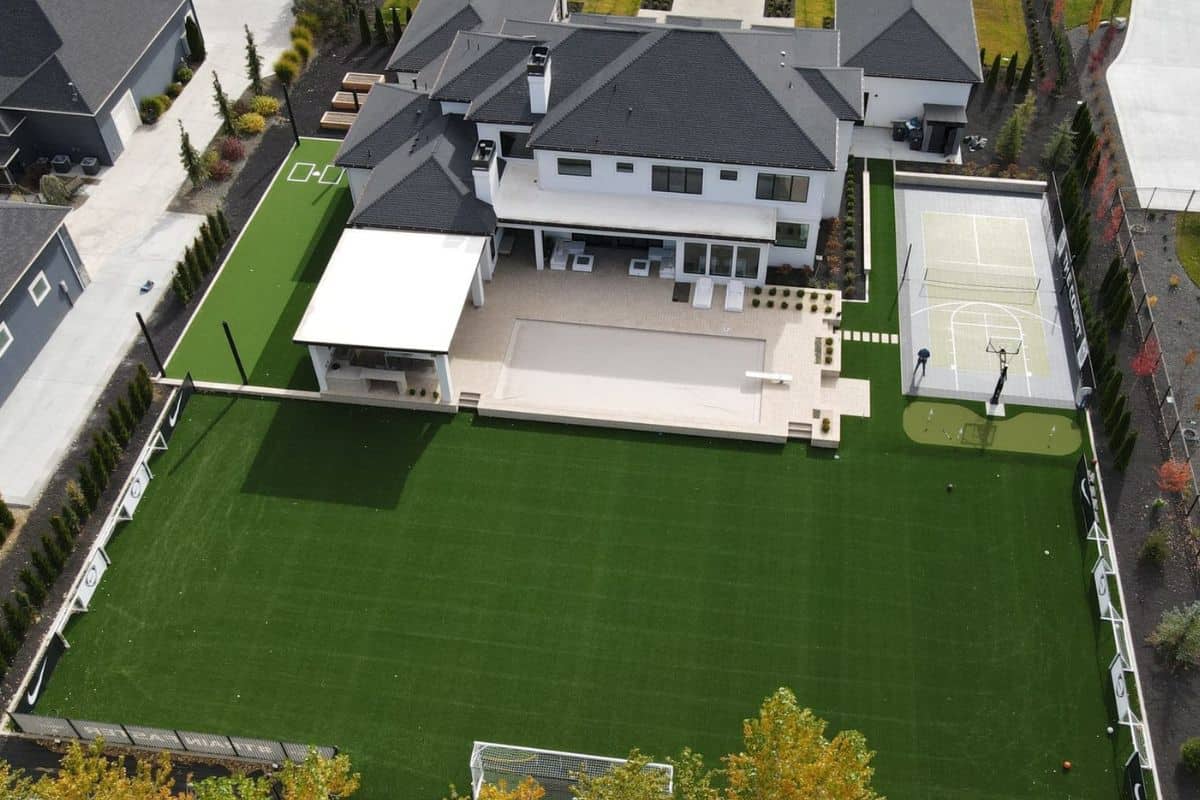
Artificial grass is used across a wide range of real-world applications.
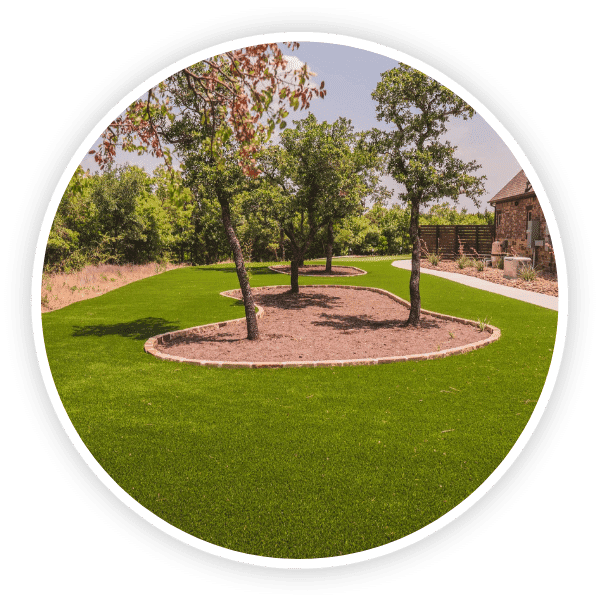
These examples show how turf systems are installed and used in different environments.
Copy and paste the code below to embed this graphic on your website, article, or presentation.
Please keep the source link intact so readers can access the full Artificial Turf System Components and related diagrams on Turf Network.
📎 Embed This Graphic
Copy the code below and paste it into the HTML section of your article, blog post, or presentation page.
					<div class="turfnetwork-graphic-embed">
  <a href="https://turfnetwork.org/artificial-grass/applications/lawns-landscapes/#system-overview" target="_blank" rel="noopener">
    <img src="data:image/svg+xml,%3Csvg%20xmlns='http://www.w3.org/2000/svg'%20viewBox='0%200%200%200'%3E%3C/svg%3E" alt="Cross-section diagram of residential lawn artificial turf system showing turf fibers, silica sand infill, permeable backing, and compacted aggregate base for drainage and stability" style="max-width:100%; height:auto;" data-lazy-src="https://turfnetwork.org/wp-content/uploads/2026/04/lawns-landscapes-system-components-diagram-1.png"><noscript><img src="https://turfnetwork.org/wp-content/uploads/2026/04/lawns-landscapes-system-components-diagram-1.png" alt="Cross-section diagram of residential lawn artificial turf system showing turf fibers, silica sand infill, permeable backing, and compacted aggregate base for drainage and stability" style="max-width:100%; height:auto;"></noscript>
  </a>
  <p style="font-size:14px; color:#666;">
    Source: <a href="https://turfnetwork.org/artificial-grass/applications/lawns-landscapes/#system-overview" target="_blank" rel="noopener">Artificial Turf for Lawns & Landscapes — Key System Components</a>
  </p>
</div>
This graphic is part of the Artificial Turf System Components published by Turf Network.
You are welcome to share or embed this diagram with attribution.
Headshot (Listing Preview) images should be no smaller than 800 x 900 px and Headshot (Listing Page) images should be no smaller than 160 x 160 px, with the subject matter as centered as possible to avoid being cut off at the edges.
Images can have a maximum file size of 1 MB. Should you need to compress your images, no problem! Here’s a free tool with super simple instructions.
Logos should be no smaller than 160 x 160 px, with the subject matter centered as possible to avoid being cut off at the edges.
Images can have a maximum file size of 1 MB. Should you need to compress your images, no problem! Here’s a free tool with super simple instructions.
Cover and Gallery images should be no smaller than 1920 x 1080 px for the best clarity, and the subject matter should be as centered as possible to avoid being cut off at the edges.
Images can have a maximum file size of 1 MB. Should you need to compress your images, no problem! Here’s a free tool with super simple instructions.
Welcome!
Navigate your turf journey with us.