
The synthetic strands that replicate the appearance and function of natural grass blades.
Turf fibers are the synthetic blades that form the visible surface of an artificial grass system. They are engineered to replicate the appearance, texture, and resilience of natural grass while maintaining durability under use.
Key Functions:
System Role: Top layer of the turf system, anchored into the backing and supported by infill.
Related Components: Infill Material • Turf Backing • Artificial Grass
Used With: Infill Material • Turf Backing • UV Protection
Commonly Used In: Residential Lawns • Putting Greens • Sports Fields
View in: Artificial Turf Glossary →
System Components
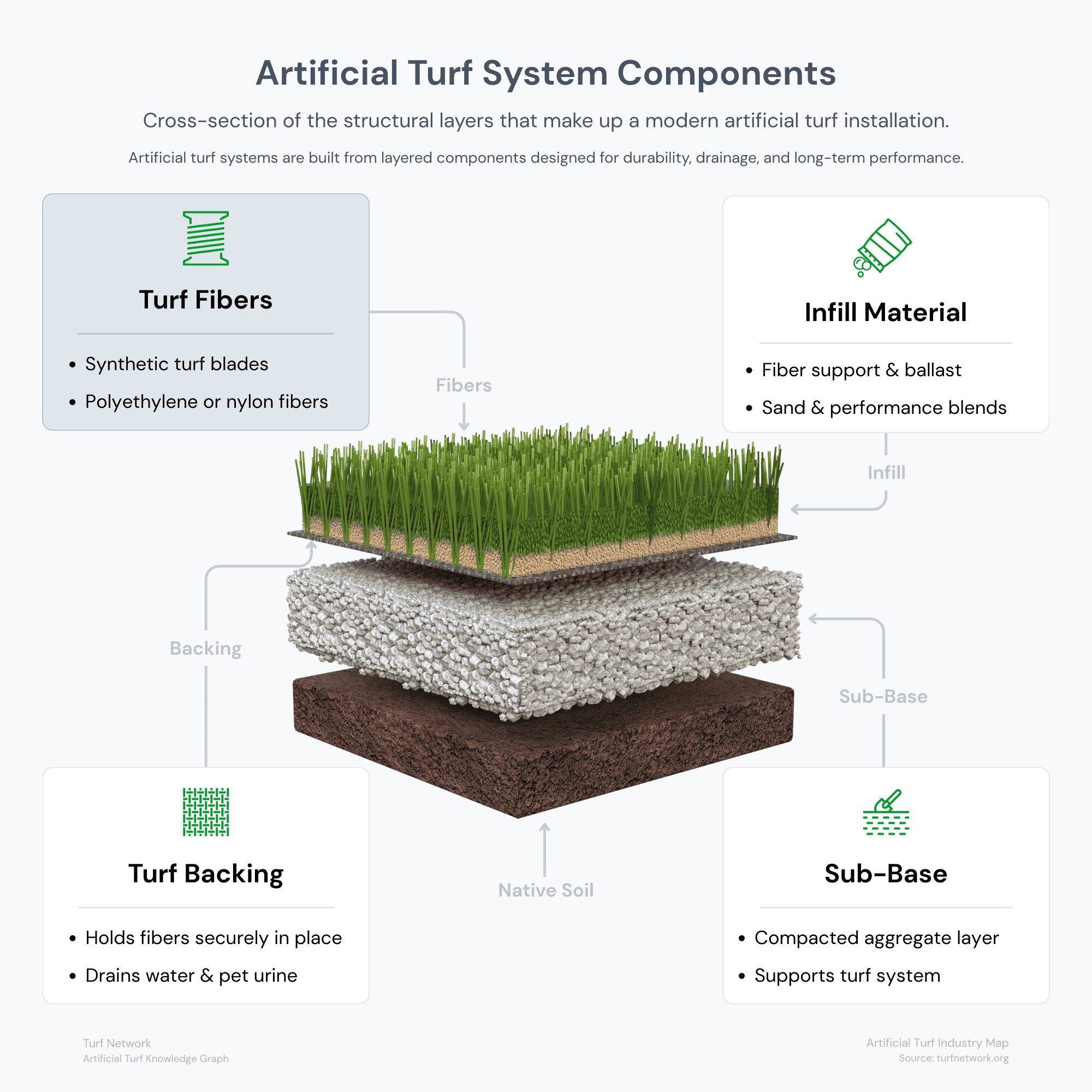
Artificial turf installations are built from multiple structural layers that work together to create a stable, well-drained surface.
Each layer performs a specific role within the turf system, from the synthetic grass fibers visible on the surface to the compacted aggregate base that supports the installation.
The diagram illustrates the primary components found in most artificial turf systems.
Each component affects performance differently.
Compare Turf Specs to see how complete systems vary.
Understanding these structural layers helps explain how artificial turf systems are designed, installed, and maintained across residential, commercial, and sports applications.
Artificial turf installations function as layered systems.
A typical installation includes:
Additional components such as shock pads and drainage tiles may be used depending on the application.
This diagram highlights turf fibers, the visible synthetic blades that form the surface of an artificial turf system.
Turf Network — Artificial Turf System Components
Source: Turf Network – turfnetwork.org/artificial-grass/components/fibers/
Artificial grass has evolved significantly since its introduction as “ChemGrass” back in 1965. Since then advancements in materials science and manufacturing technology have resulted in incredibly realistic synthetic grass products. Modern synthetic grass fibers are manufactured using one of three main types of artificial grass materials: Polypropylene (PP), Polyethylene (PE), and Nylon (PA), each with its own advantages and disadvantages.
Manufacturers have focused on more than just improving the aesthetics and realism of turf fibers. The manufacturing process enables them to enhance the durability and functionality of turf fibers by incorporating features like UV resistance, static blockers, and antimicrobial protection. It’s important to remember that each of the base materials has its own strengths, making them better suited for specific applications. So, instead of looking for the “best” material, focus on finding the one that best meets your needs.
We’ll explore the specific attributes of the materials used to manufacture synthetic grass below. You may also want to check out our descriptions of the different fiber shapes you’ll encounter on your turf journey.
The foundation of artificial grass lies in its synthetic fibers. These fibers are typically made of materials such as polyethylene, polypropylene, or nylon. The distinct properties of each material make each of them suited to different applications. Additionally, manufacturers have developed a number of fiber shapes to enhance the aesthetics and functionality of their turf products.
Thatch consists of shorter, curly, densely woven fibers, typically tan, brown, or green, that mimic the layer of dead grass and organic matter found in natural grass lawns. It enhances the realistic appearance of the turf and adds to its softness. In addition to providing a realistic texture to turf, thatch also plays a role in the density of the turf. This is because thatch is included in face weight. In general: products without thatch are much more dense at the top of the pile. Products with thatch have a more balanced density from top to bottom.
Nylon, initially used in toothbrush fibers back in 1938, later found its way into women’s stockings and hosiery – hence the moniker “nylons”. Nowadays, it’s the go-to material for carpeting, seatbelts, and any product requiring tensile strength and durability. Fun fact: the very first artificial grass, developed in 1965, consisted of nylon fibers! Even today, nylon continues to be used in select artificial grass applications, the most common being putting green turf and sports applications.
Polyethylene, a versatile material with varying densities, finds extensive use across multiple applications, ranging from plastic bags to large trash cans. Notably, it serves as a leading choice for artificial grass fibers. As the latest addition to the market, polyethylene not only meets the most demanding standards but also offers unparalleled durability and realism. Join the countless individuals who have embraced this innovative solution for their outdoor spaces!
Polypropylene artificial grass was first introduced in the 1970s and is still used in some artificial grass products today. Unlike nylon which only has two types, polypropylene is the general name for a group of polymers, and its properties can range depending on its specific composition.
Copy and paste the code below to embed this graphic on your website, article, or presentation.
Please keep the source link intact so readers can access the full Artificial Turf System Components and related diagrams on Turf Network.
📎 Embed This Graphic
Copy the code below and paste it into the HTML section of your article, blog post, or presentation page.
Caption: This diagram highlights turf fibers, the visible synthetic blades that form the surface of an artificial turf system.
Source: Turf Network — Turf Fibers
This graphic is part of the Artificial Turf System Components published by Turf Network.
You are welcome to share or embed this diagram with attribution.
Headshot (Listing Preview) images should be no smaller than 800 x 900 px and Headshot (Listing Page) images should be no smaller than 160 x 160 px, with the subject matter as centered as possible to avoid being cut off at the edges.
Images can have a maximum file size of 1 MB. Should you need to compress your images, no problem! Here’s a free tool with super simple instructions.
Logos should be no smaller than 160 x 160 px, with the subject matter centered as possible to avoid being cut off at the edges.
Images can have a maximum file size of 1 MB. Should you need to compress your images, no problem! Here’s a free tool with super simple instructions.
Cover and Gallery images should be no smaller than 1920 x 1080 px for the best clarity, and the subject matter should be as centered as possible to avoid being cut off at the edges.
Images can have a maximum file size of 1 MB. Should you need to compress your images, no problem! Here’s a free tool with super simple instructions.
Welcome!
Navigate your turf journey with us.