
Artificial Turf Fibers
The synthetic strands that replicate the appearance and function of natural grass blades.
DEFINITION
Turf Fibers
Turf fibers are the synthetic blades that form the visible surface of an artificial grass system. They are engineered to replicate the appearance, texture, and resilience of natural grass while maintaining durability under use.
Key Functions:
- Defines visual appearance and realism
- Provides surface interaction (foot traffic, ball roll)
- Works with infill to maintain upright structure
System Role: Top layer of the turf system, anchored into the backing and supported by infill.
Related Components: Infill Material • Turf Backing • Artificial Grass
Used With: Infill Material • Turf Backing • UV Protection
Commonly Used In: Residential Lawns • Putting Greens • Sports Fields
View in: Artificial Turf Glossary →
System Components
Core Components of an Artificial Turf System
Artificial turf installations are built from multiple structural layers that work together to create a stable, well-drained surface.
Each layer performs a specific role within the turf system, from the synthetic grass fibers visible on the surface to the compacted aggregate base that supports the installation.
The diagram illustrates the primary components found in most artificial turf systems.
Each component affects performance differently.
Compare Turf Specs to see how complete systems vary.
Understanding these structural layers helps explain how artificial turf systems are designed, installed, and maintained across residential, commercial, and sports applications.
How Turf System Components Work Together
Artificial turf installations function as layered systems.
A typical installation includes:
- Synthetic turf fibers
- Infill materials that support the fibers
- A backing layer that holds the turf structure together
- A compacted aggregate base that provides stability and drainage
Additional components such as shock pads and drainage tiles may be used depending on the application.
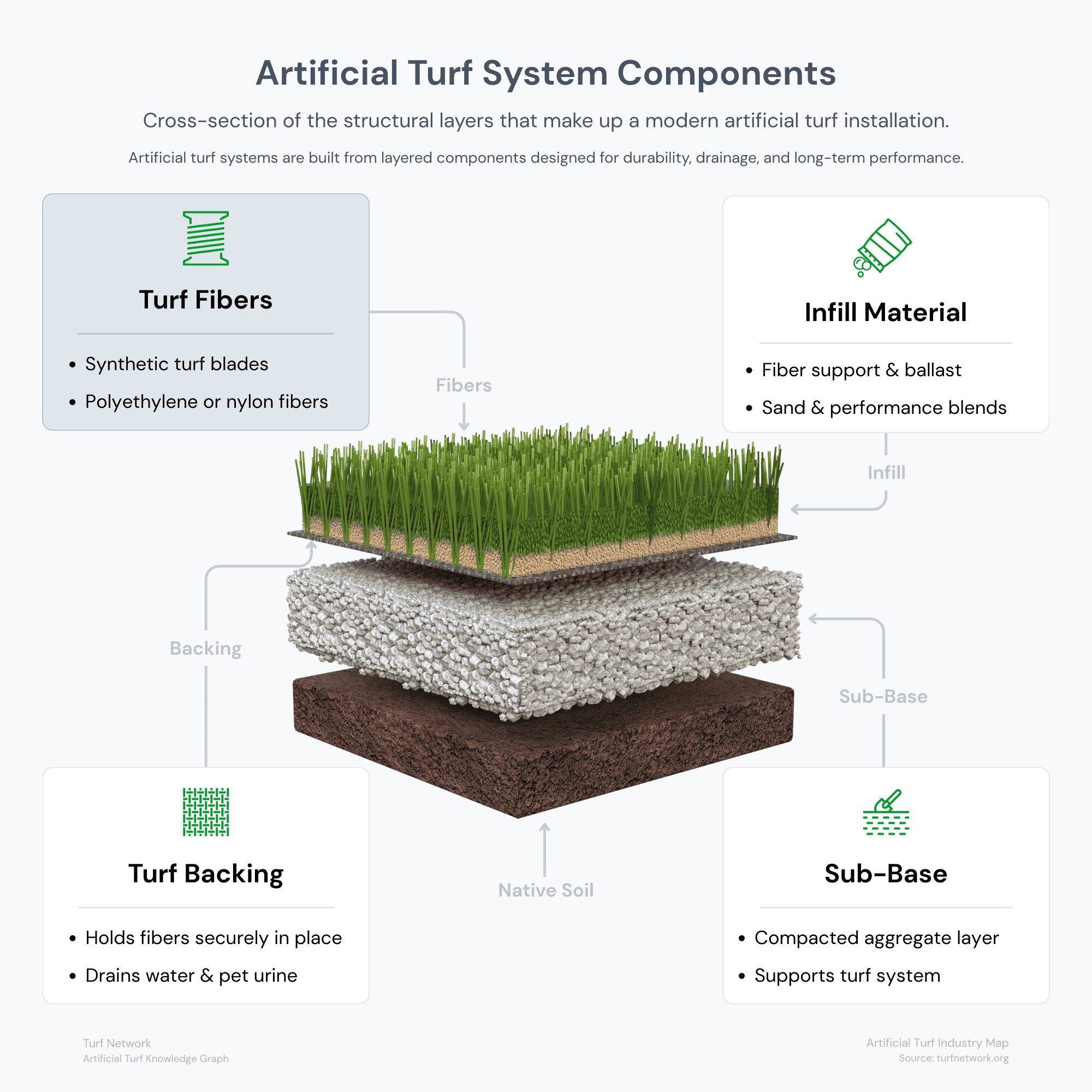
This diagram highlights turf fibers, the visible synthetic blades that form the surface of an artificial turf system.
Turf Network — Artificial Turf System Components
Source: Turf Network – turfnetwork.org/artificial-grass/components/fibers/
Types of Artificial Grass Fibers
Artificial grass has evolved significantly since its introduction as “ChemGrass” back in 1965. Since then advancements in materials science and manufacturing technology have resulted in incredibly realistic synthetic grass products. Modern synthetic grass fibers are manufactured using one of three main types of artificial grass materials: Polypropylene (PP), Polyethylene (PE), and Nylon (PA), each with its own advantages and disadvantages.
Manufacturers have focused on more than just improving the aesthetics and realism of turf fibers. The manufacturing process enables them to enhance the durability and functionality of turf fibers by incorporating features like UV resistance, static blockers, and antimicrobial protection. It’s important to remember that each of the base materials has its own strengths, making them better suited for specific applications. So, instead of looking for the “best” material, focus on finding the one that best meets your needs.
We’ll explore the specific attributes of the materials used to manufacture synthetic grass below. You may also want to check out our descriptions of the different fiber shapes you’ll encounter on your turf journey.


Fibers
The foundation of artificial grass lies in its synthetic fibers. These fibers are typically made of materials such as polyethylene, polypropylene, or nylon. The distinct properties of each material make each of them suited to different applications. Additionally, manufacturers have developed a number of fiber shapes to enhance the aesthetics and functionality of their turf products.

Thatch
Thatch consists of shorter, curly, densely woven fibers, typically tan, brown, or green, that mimic the layer of dead grass and organic matter found in natural grass lawns. It enhances the realistic appearance of the turf and adds to its softness. In addition to providing a realistic texture to turf, thatch also plays a role in the density of the turf. This is because thatch is included in face weight. In general: products without thatch are much more dense at the top of the pile. Products with thatch have a more balanced density from top to bottom.
Materials Used to Manufacture Turf Fibers
Nylon
Nylon, initially used in toothbrush fibers back in 1938, later found its way into women’s stockings and hosiery – hence the moniker “nylons”. Nowadays, it’s the go-to material for carpeting, seatbelts, and any product requiring tensile strength and durability. Fun fact: the very first artificial grass, developed in 1965, consisted of nylon fibers! Even today, nylon continues to be used in select artificial grass applications, the most common being putting green turf and sports applications.
Advantages
• Nylon is extremely resilient, which means the individual turf fibers will “spring back” and maintain an upright position.
• Low-maintenance and will require the least amount of upkeep among these three choices.
• Resistant to UV radiation, which means it keeps its color extremely well and won’t fade in the sun.
• Heat-resistant, with a melting point of around 460° F.
• Nylon is highly abrasion-resistant, meaning it will not be worn away by friction or rubbing. Because of this, it’s very long-lasting.
Disadvantages
• The abrasion-resistant qualities of nylon have a downside. When friction happens, the less abrasion-resistant material will take the brunt of the damage – this can be the clothing or the skin of an athlete. Nylon is notorious for causing “turf burn.”
• Nylon is easily stained by acidic dyes, such as those found in coffee or wine. However, it should be noted that the green dyes in most nylon turf do a good job of masking these stains.
• Nylon is semi-permeable and absorbs water more readily than polyethylene. Because of this, it’s not a great option for pets.
• It’s expensive to manufacture, meaning it’s the most costly artificial grass on the market.
Uses
Nylon is renowned for its exceptional strength and resilience, along with its impressive ability to withstand heat. This makes it the ideal choice for high-traffic areas or sports that don’t involve tackling or sliding. Commercial settings like rooftop decks and home applications such as backyard putting greens greatly benefit from nylon artificial grass. Additionally, nylon can also serve as a secondary fiber in certain applications, like athletic turf, where a combination of softness and resilience is needed. If you desire a lush and thick lawn, consider incorporating nylon materials into your turf for a remarkable result.
Polyethylene
Polyethylene, a versatile material with varying densities, finds extensive use across multiple applications, ranging from plastic bags to large trash cans. Notably, it serves as a leading choice for artificial grass fibers. As the latest addition to the market, polyethylene not only meets the most demanding standards but also offers unparalleled durability and realism. Join the countless individuals who have embraced this innovative solution for their outdoor spaces!
Advantages
• It’s the most realistic-looking grass available and behaves the most like real grass.
• Resistant to water absorption, making it the best material for pet-friendly applications.
• Softer than nylon but more durable than polypropylene, making it a good middle ground suitable for a variety of applications.
• Doesn’t cause turf burn the same way nylon does.
• Low-maintenance and should spring back into place for most standard pile heights.
• Polyethylene has a good combination of toughness and ductile strength – while it is not hard, it bends well.
Disadvantages
• It has a relatively low melting point, 248° – 266° F.
• The addition of other polymers during the manufacturing process (sometimes the addition of polypropylene) can raise this.
• In its raw form, Polyethylene is susceptible to UV degradation – because of this it’s almost always combined with UV stabilizers.
• Without added UV-protection, like in lower-quality grasses, it can become brittle in the sun.
Uses
The cost effectiveness and combination of softness, realism, and the lack of moisture absorption make turf products with polyethylene fibers ideal for a wide range of residential and commercial applications. It’s an excellent material for front or backyard lawns where it’s incredibly realistic look and feel make it difficult to distinguish from real grass. Dog runs, pet areas, kennels, doggy daycares, and dog training facilities will also benefit from turf products with polyethylene fibers.
Polypropylene
Polypropylene artificial grass was first introduced in the 1970s and is still used in some artificial grass products today. Unlike nylon which only has two types, polypropylene is the general name for a group of polymers, and its properties can range depending on its specific composition.
Advantages
• When used in the blades of grass, polypropylene is the thinnest and the softest of the three materials.
• It has a relatively high melting point, from 320° – 331° F.
• Polypropylene is very resistant to absorbing moisture, making it good for pets and for backing applications.
• It’s inexpensive – among the materials, it is easily the cheapest to manufacture.
Disadvantages
• Thin and soft fibers make it prone to matting, especially on turf products with a longer pile height.
• Polypropylene fibers are less resistant to wear and tear, which means it won’t last as long as nylon or polyethylene.
• Lacks UV-resistance and can begin to break down at temperatures above 214° F. If you’re buying turf with polypropylene fibers, make sure its equipped with UV protection.
Uses
Because it is highly flexible and can be produced in woven sheets for additional strength, polypropylene is well-suited as a backing material, and you can find it used in the backing for many artificial grass products. The significant advantages of Nylon and Polyethylene mean that Polypropylene is rarely used in actual turf fibers. To save on material costs and take advantage of the thin and soft features of polypropylene, it is commonly used to create the “Thatch” fibers on synthetic grass.