


Why strong companies disappear inside AI systems — and how to fix it without publishing more content
Multi-location turf suppliers, regional installers, and manufacturers with dealer networks share a common assumption:
“If we rank in each market, we’re visible.”
That assumption is increasingly unreliable.
Search results still show rankings. Ads still run. Traffic still arrives.
But Google’s AI layer — the system that now summarizes, recommends, and names companies directly in answers — does not operate on rankings alone.
AI validates entities.
And when your structure sends conflicting location signals, AI hesitates.
In the artificial turf industry, this happens more often than operators realize.
The Changing Landscape of Visibility
Artificial turf is a mature industry.
What started as a niche product has become a complex network of suppliers, installers and manufacturers spanning multiple states.
This expansion has created opportunity—and a visibility gap.
Why it matters:
- Scale brings complexity: Multi‑location suppliers manage warehouses, satellite yards and distribution hubs.
- Service areas stretch across regions: Installers often serve several metro markets from a single base.
- Dealer networks multiply signals: Manufacturers rely on independent dealers who control their own web properties.
In the past, dominating the first page of search results felt like success.
But customers and partners now turn to AI assistants, knowledge graphs and supply chain platforms to discover and evaluate vendors.
These systems don’t scroll; they validate entities.
Clarity is now the competitive advantage.
In plain English: being visible in 2026 means the machines must recognise who you are and where you operate. If they can’t, you’re simply invisible—no matter how good your SEO rankings are.

The Shift: AI Doesn’t Rank Pages, It Validates Entities
Traditional SEO was page-based.
You created:
- A Dallas page
- A Houston page
- A Phoenix page
- A California warehouse page
Each page targeted a city and attempted to rank locally.
AI systems don’t interpret those pages independently.
They attempt to answer higher-level questions:
- Who installs turf in Dallas?
- Which manufacturer supports dealers in Arizona?
- Who specializes in pet turf across Southern California?
- Which suppliers operate nationally?
To answer those questions, AI looks for entity clarity:
- Who is this company?
- Where does it actually operate?
- What locations belong to which entity?
- Are these independent businesses or branches?
- Are these dealers or corporate offices?
- Are these warehouses or service areas?
If those relationships are unclear, AI reduces confidence.
And reduced confidence means reduced inclusion.
Additional Resources:
- AI vs. SEO for Turf Companies: Why Structured Clarity Matters
- Local SEO for Turf Installers & Suppliers in the AI Era (Structure = Inclusion)

How AI Interprets Location Signals
Search engines rank pages; AI validates entities.
This distinction is crucial.
What AI Looks for
- Name, address, phone (NAP) consistency. AI cross‑references your information across websites, directories and schema markup.
- Relationships between locations. It connects warehouses to service areas and brands to dealers.
- Structured data. Machine‑readable schema (e.g., LocalBusiness or Warehouse markup) helps AI understand what each location is.
When it sees:
- Multiple pages targeting the same metro with slight variations
- Subdomains duplicating the same copy
- Dealers and corporate branches blended together
- Warehouse addresses mixed with service areas
- Franchise-like language without structured hierarchy
It flags ambiguity.
Ambiguity lowers trust.
In plain English: if your location data is even slightly inconsistent, AI will assume the worst and leave you out.
How Service Areas Differ From Locations
Many installers and suppliers blur the line between physical locations and areas they serve.
To a human, “We service Dallas” makes sense even if the warehouse is in Fort Worth.
To a machine, that statement can imply an office in Dallas.
Separate these concepts:
- Create individual pages for each warehouse or yard.
- List service areas separately, with clear language such as “served from our Spokane hub.”
When AI sees discrete data points, it builds an accurate map of your network.
When everything is mixed, confusion ensues.

Common Multi-Location Mistakes That Create Conflicting Signals
Most multi-location visibility problems aren’t technical.
They’re structural.
And they usually start with good intentions.
Below are the most common patterns that reduce AI confidence.
1. The “Same Page, New City” Problem
This is the old SEO scaling playbook.
- Clone your highest-performing page.
- Change the city name.
- Swap a testimonial.
- Adjust the header.
From a ranking perspective, this sometimes works.
From an AI interpretation perspective, it creates:
- Duplicate semantic structure
- Minimal geographic differentiation
- Multiple markets claiming identical authority
AI doesn’t see “expansion.”
It sees near-identical documents asserting presence in multiple regions.
And it asks:
Are these true operating locations — or keyword variations?
When differentiation between locations is weak, confidence drops.
And when confidence drops, inclusion drops.
2. Mixing Physical Locations with Service Areas
Many operators build a single “Locations” page that blends:
- Warehouses
- Corporate offices
- Service regions
- Dealer territories
- Markets served
To a human, this feels efficient.
To AI, it creates entity confusion.
- Is Dallas a warehouse?
- Or just a service region?
- Is Phoenix a corporate branch?
- Or an independent dealer?
AI needs to distinguish between:
Physical presence vs. Geographic coverage
When those layers are merged, the system cannot map relationships accurately.
It’s like an inventory sheet that lists storage facilities alongside delivery destinations.
No system can reconcile that cleanly.
3. Inconsistent Name, Address & Phone (NAP) Data
This one feels harmless.
It isn’t.
Examples of inconsistent NAP:
- “Northwest Turf Co.” vs. “NW Turf Company”
- “Suite 5” on one page, “Unit 5” on another
- Local phone number in one directory, toll-free in another
Humans assume these are the same business.
AI does not assume.
It reconciles.
And when reconciliation fails, it fragments your entity profile.
Think of it like shipments arriving with slightly different labels.
Some are accepted.
Some are flagged.
Inventory confidence drops.
In plain English: One name. One address format. One primary phone per location. Everywhere.
4. Dealer Networks Without Clear Hierarchy
Manufacturers and large suppliers often publish:
- “Find a Dealer” pages
- Individual dealer listings
- Partner announcements
- Regional landing pages
- Independent dealer sites
But the relationships are rarely structured explicitly.
AI wants to understand:
Manufacturer → Product → Authorized Dealer → Territory → Physical Location
If that hierarchy is implied instead of structured, AI cannot confidently state:
“This installer is an authorized dealer for this brand in this region.”
When that clarity is missing, AI defaults to brands with simpler, cleaner entity graphs.
Even if their footprint is smaller.
5. Legacy Pages That Contradict Your Current Footprint
Websites accumulate history.
- Old expansions.
- Closed warehouses.
- Former dealers.
- Outdated service claims.
Common examples:
- “Best Turf in Texas”
- “Now Serving Arizona”
- “New Nevada Expansion”
Those pages often remain indexed long after operations change.
AI does not evaluate recency the way operators assume.
It evaluates consistency.
If a 2020 blog post claims statewide coverage but your current structure shows limited physical presence, that’s a conflict.
Conflict reduces authority.
Outdated signals act like old inventory manifests still circulating through your supply chain.
Orders reference SKUs that no longer exist.
Trust declines.
In plain English: until you remove or update outdated pages, you’ll be haunted by old information across the web.
6. Multi-Purpose “City Pages” That Imply Physical Presence
A decade ago, the SEO playbook was simple:
Create templated city pages for every metro area.
Rank for “[city] turf installation.”
That strategy still generates traffic.
But it can damage AI clarity.
When AI sees a page titled:
“Portland Turf Installation”
It assumes a meaningful presence in Portland.
If you don’t operate there physically, that mismatch reduces credibility.
It’s like advertising a warehouse in Boise when you only have a remote sales rep.
In plain English: If a page implies physical presence, make sure it reflects reality.
Otherwise:
- Retire it
- Reframe it as a service-area page
- Or clearly label it
Why This Matters
None of these mistakes destroy rankings overnight.
But they quietly reduce confidence.
And AI inclusion is confidence-based.
Not traffic-based.
Not keyword-based.
Confidence-based.
When your structure is clean, relationships are explicit, and signals are consistent, AI doesn’t have to guess.
It recognizes.
And recognition is the new visibility.
Why Organic Rankings ≠ AI Inclusion
You can rank #1 for “artificial turf Dallas” and still be excluded from AI Overviews.
Why?
Because rankings measure page performance.
AI inclusion measures entity clarity.
A page can rank based on:
- Backlinks
- On-page keyword relevance
- Domain authority
But AI inclusion requires:
- Relationship clarity
- Consistent location hierarchy
- Verified entity signals
- Clean structural architecture
This is why some regional installers are repeatedly named in AI answers — while larger, multi-location operators are omitted.
It is not about size.
It is about structure.
In plain English: no matter how strong your SEO, AI won’t recommend you if it can’t validate your locations.
List truncation
AI assistants often deliver short lists when asked, “Who are the leading turf suppliers in California?”
They may mention only three or four verified entities.
If your data is inconsistent, you’re excluded.
SEO cannot overcome missing entity validation.
Only structured, consistent location data can ensure inclusion.

The Supply Chain Analogy
Imagine running a national turf distribution network.
Inventory exists across:
If your ERP system cannot distinguish:
- Which warehouse holds what inventory
- Which products belong to which facility
- Which region fulfills which orders
Orders stall.
AI works like an industry-wide ERP.
If it cannot distinguish:
- Corporate vs. dealer
- Service area vs. warehouse
- Expansion announcement vs. permanent presence
- Regional dominance vs. metro coverage
Recommendations stall.
Clarity becomes competitive advantage.
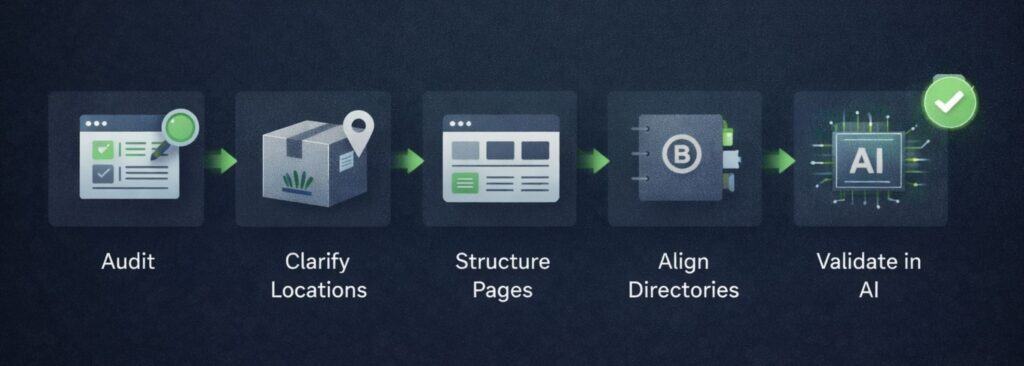
Practical Steps to Fix the Multi-Location Visibility Problem
This is not a content problem.
It’s a structure problem.
Here’s the operational playbook.
1️⃣ Establish a Single Source of Truth
If your internal data isn’t clean, AI will never be confident.
Create one master location sheet that includes:
- Legal business name
- Exact address (suite numbers matter)
- Primary phone number
- Operating hours
- Location type (Warehouse / Office / Showroom)
- Service areas tied to that location
Think of this like inventory control.
If warehouse counts don’t match reality, orders get misrouted.
AI works the same way.
2️⃣ Give Every Physical Location Its Own Page
No shared “Locations” paragraph.
No vague service-area pages pretending to be offices.
Each physical location needs:
- Dedicated URL
- Clear NAP (Name, Address, Phone)
- Location type clearly labeled
- Short description of services from that facility
- Separate “Areas Served from This Location” section
This creates entity clarity.
AI doesn’t assume relationships. It validates them.
3️⃣ Separate Physical Locations from Service Areas
This is where most turf companies create noise.
Make the distinction explicit:
- Physical locations = warehouses, yards, offices
- Service areas = markets crews travel to
On location pages, state:
“This location serves: [City List]”
On service pages, state:
“Serviced from our [City] distribution center.”
No implied warehouses.
No ambiguous geography.
4️⃣ Audit Directories & External Listings
AI does not trust your website alone.
It cross-checks.
Review:
- Google Business Profiles
- Industry directories
- Supplier networks
- Dealer listings
- State registrations
Standardize:
- Naming conventions
- Phone formats
- Address formatting
- Location labeling
Small inconsistencies create structural doubt.
In plain English: treat NAP data like barcode scanning.
5️⃣ Remove or Redirect Legacy Location Pages
Old pages referencing:
- Closed warehouses
- Former dealers
- Outdated addresses
- Phantom markets
Must be:
- Redirected (301) to correct pages
- Updated
- Or removed entirely
For case studies:
Clearly state where the project was executed from.
Avoid accidental geographic claims.
6️⃣ Implement Structured Data on Every Location Page
Minimum:
- LocalBusiness schema
- Warehouse (if applicable)
- ServiceArea specification
- Organization
Many CMS platforms support this.
If not, use a developer or generator.
Structured data reinforces clarity.
It does not replace it.
7️⃣ Standardize Your Brand Identity Everywhere
Decide once:
- Company name formatting
- Abbreviations
- Phone formatting
- Suite labeling
Then lock it.
Minor variations create machine confusion.
Consistency builds entity confidence.
8️⃣ Schedule Quarterly Structural Audits
Locations change.
Markets expand.
Dealers rotate.
Your data must stay current.
Set a recurring reminder to:
- Review all location pages
- Cross-check directories
- Validate structured data
- Confirm redirects
Maintenance prevents decay.
In plain English: If your location data feels messy internally, it’s guaranteed to look messy to AI. Clarity is not marketing. It’s infrastructure.
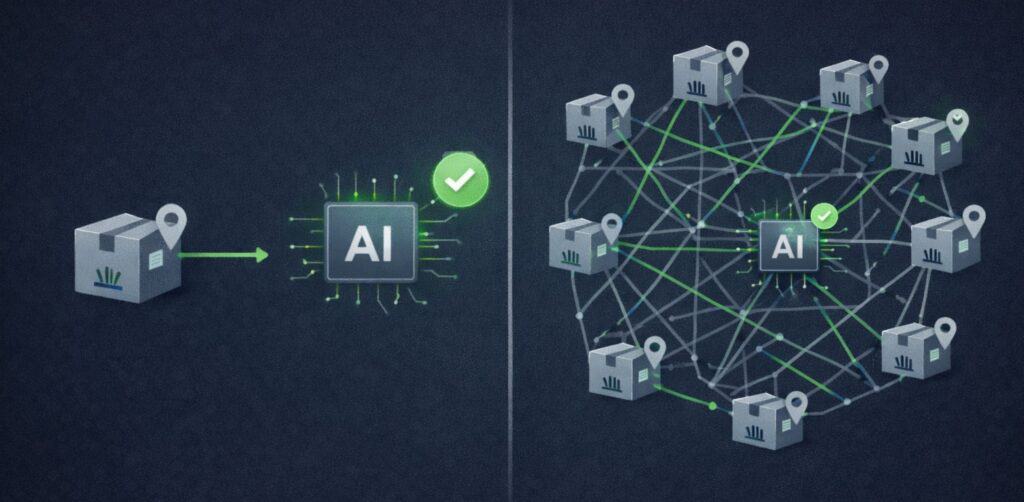
Why Multi-Location Operators Are More Vulnerable
Single-location installers often appear clearer to AI.
Why?
- One entity
- One market
- One service radius
- No dealer hierarchy
- No warehouse confusion
Multi-location operators introduce complexity.
Complexity without structure creates signal conflict.
Signal conflict reduces AI confidence.
Reduced AI confidence reduces recommendation frequency.
The Competitive Implication
The first turf brands to structure their multi-location architecture cleanly become defaults.
AI systems learn from structured clarity.
Once validated, inclusion compounds.
Late adopters must overcome both structural ambiguity and established defaults.
This is not about chasing traffic.
It is about becoming structurally legible.
A Practical Framing for Operators
If you manage:
- Multiple warehouses
- Regional installer teams
- National dealer networks
- PE-backed roll-ups
- Multi-brand portfolios
Your advantage is scale.
But scale without structured clarity becomes liability.
Before investing further in:
- Ads
- SEO campaigns
- New market launches
- Dealer recruitment pushes
Ask:
Is our location architecture clean enough for AI to interpret correctly?
If not, growth spend compounds inefficiency.
If yes, growth compounds advantage.

Final Thoughts on the Multi-Location Visibility Problem in Artificial Turf
The artificial turf industry is entering an era of AI‑driven discovery.
AI does not guess.
It validates.
Multi-location businesses rarely disappear because they lack authority.
They disappear because their authority is structurally ambiguous.
If you are managing multiple warehouses, markets, or dealer territories, structured clarity matters more than ever.
Before scaling further, it’s worth understanding whether your location signals reinforce each other — or quietly compete.
Key Takeaways:
- AI does not “rank” multi-location turf companies, it validates structured entities.
- Service areas and physical locations must be clearly separated.
- Inconsistent NAP data weakens AI confidence.
- Legacy location pages create structural noise.
- Third-party listings reinforce (or contradict) your authority.
- Multi-location clarity is operational discipline, not a content strategy.
- The companies AI confidently understands become the ones it repeatedly cites.
Structured clarity is your competitive advantage.
Turf Network isn’t a lead platform; it’s the infrastructure layer that helps the industry speak machine language.
If you’re managing multiple warehouses or markets, now is the time to invest in a clean, consistent digital footprint.


