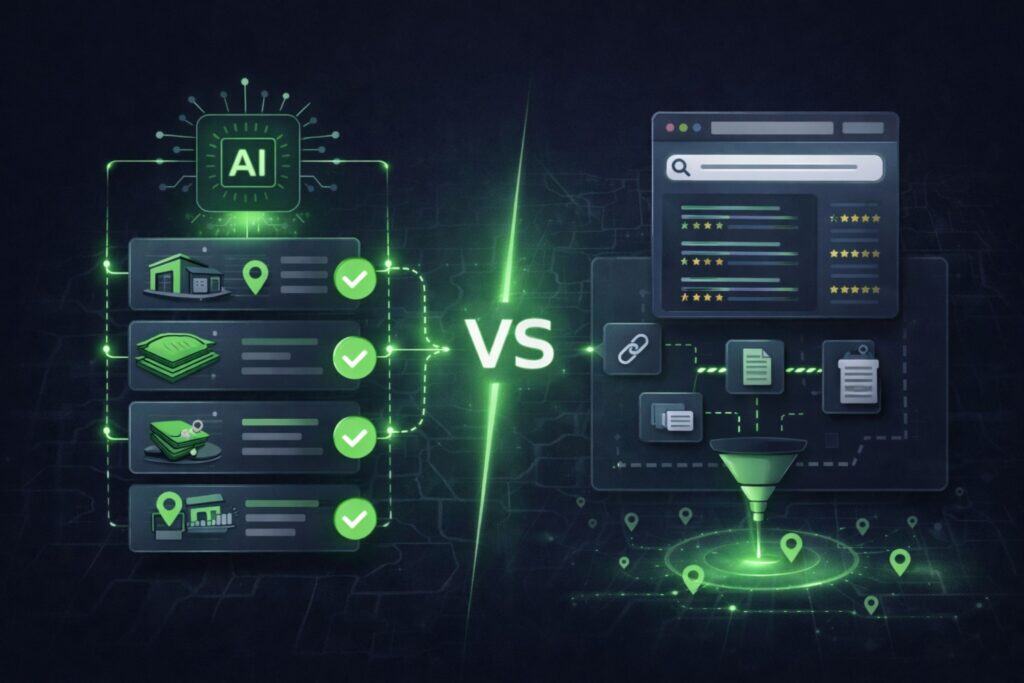

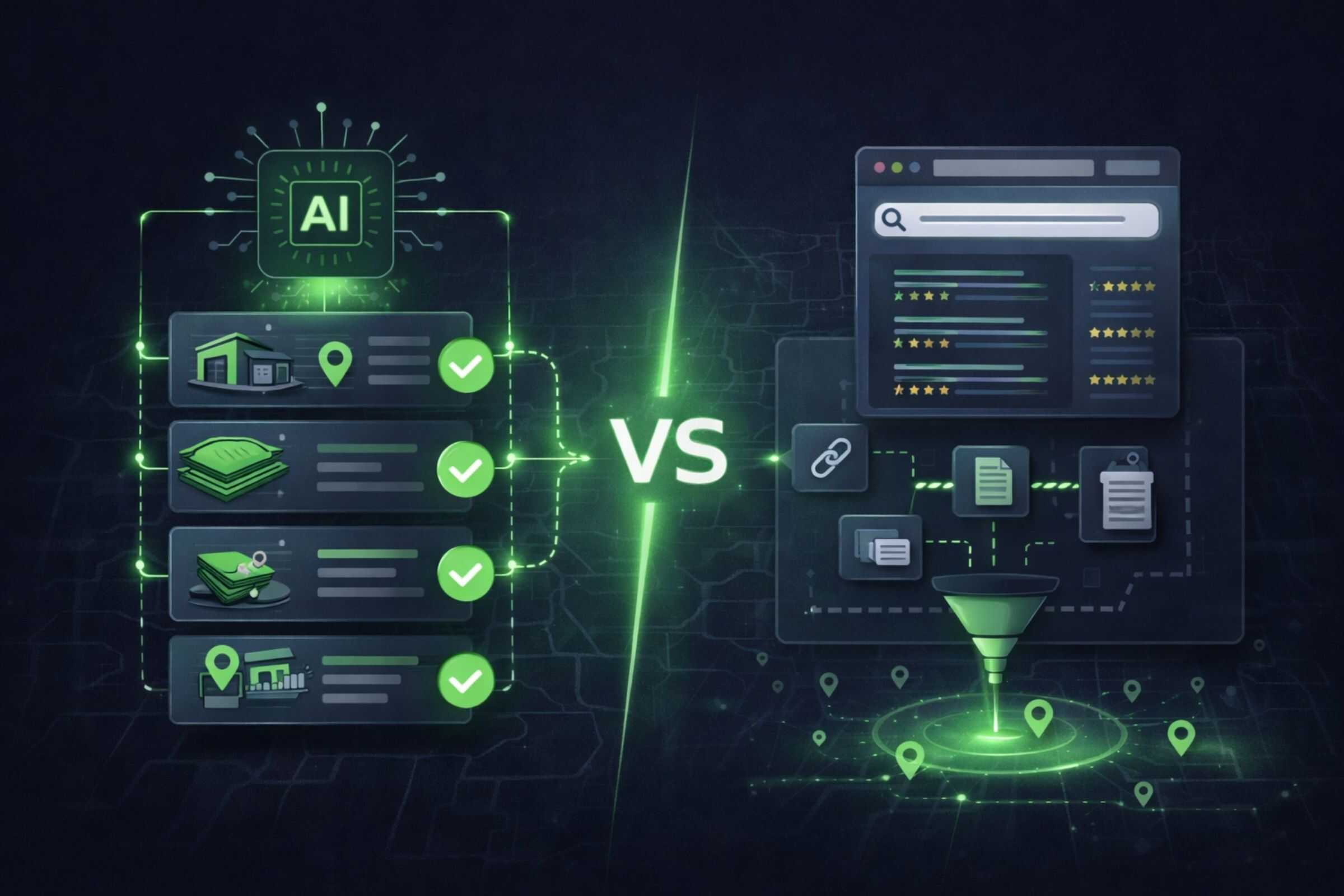
The Evolution of Search and Discovery
Artificial turf companies operate in a landscape that has changed dramatically.
Search engines still matter, but they are no longer the sole gateway to customers.
Large language models (LLMs) and generative AI systems now assemble answers from multiple sources, creating summaries, recommendations and overviews at the top of the results page.
Why this matters:
- SEO isn’t dead. Ranking pages for keywords still drives traffic and builds authority.
- AI isn’t search. Assistants like ChatGPT or industry‑specific bots pull from entity graphs, structured data and verified sources.
- Clarity bridges both worlds. Consistent, machine‑readable information ensures you’re included in AI answers and performs well in organic results.
In plain English: ranking well helps humans find you; AI inclusion ensures machines can recommend you. You need both.
Old Model: Ranking and Keywords
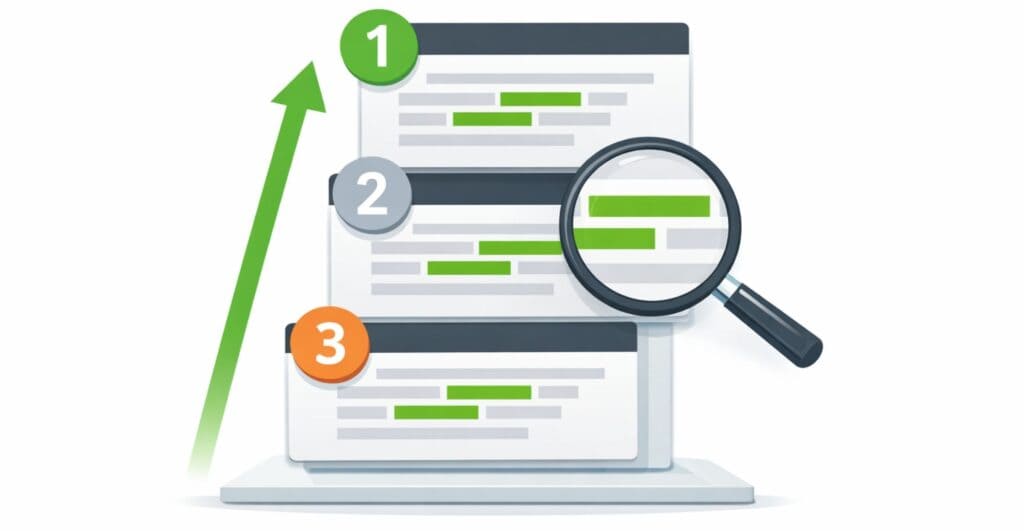
SEO has been the primary visibility strategy for two decades.
Its focus is on pages, keywords, links and engagement signals (How Search Works).
When someone searched “artificial turf supplier Dallas,” search algorithms weighed hundreds of factors to rank results.
How the old model works
- Pages compete on relevance: Search engines evaluate content, metadata and keyword usage.
- Authority matters: Backlinks from reputable sites, domain age and page speed influence ranking.
- User behaviour feeds the loop: Click‑through rates and time on site can improve rankings over time.
An installer could create dozens of city pages or product pages and, with enough SEO tricks, rank for many combinations of “artificial turf + city.”
This approach still drives traffic.
But it also has limitations:
- It encourages duplicate content and thin pages.
- It can create overloaded homepages that list every service area and product, overwhelming visitors.
- It doesn’t ensure that AI systems understand your entity behind the page.
“SEO is about ranking pages, not recognizing entities.”
New Model: AI Overview and Entity Validation
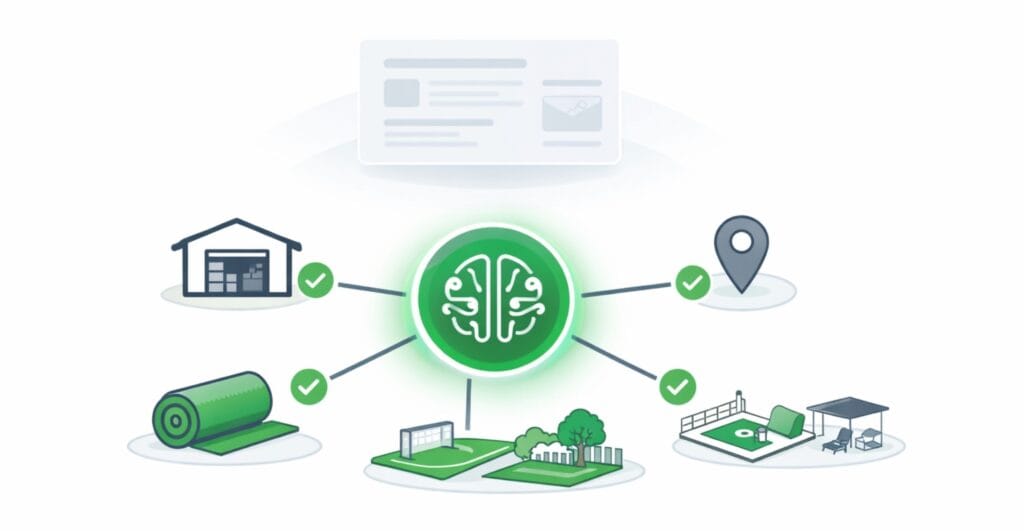
In 2026, the search results page often begins with an AI Overview.
An AI Overview is a generated summary that sits above traditional search results.
This overview answers the user’s question directly, drawing from a knowledge graph of verified entities and facts.
What AI overview models do
- Assemble data from multiple sources: They don’t rely solely on your website; they draw from directories, structured data and citations.
- Validate entities: AI uses matching algorithms to confirm that a business exists and operates in a specific location.
- Summarize and recommend: Once validated, entities may be surfaced in recommendations or natural‑language answers.
Picture a customer asking, “Who supplies artificial turf in California, and what types of turf do they offer?”
The AI system pulls names, locations, products and unique selling points from its database.
If your information is unclear, you may not appear, no matter how strong your SEO.
In plain English: AI acts like a concierge. It introduces only those businesses it knows well enough to vouch for.
Additional Resources:
- Why AI Overviews Ignore Most Turf Suppliers (And What to Do About It)
- Local SEO for Turf Installers & Suppliers in the AI Era (Structure = Inclusion)
How AI builds its knowledge
To be included, AI systems need structured clarity:
- Consistent names and addresses: Variations confuse entity matching.
- Structured data markup: Schema helps machines identify your business type, location, products and services.
- Verified citations: Directories and industry listings that echo the same information reinforce validity.
This is not about coding; it’s about ensuring your digital footprint mirrors your real‑world footprint.
A single warehouse with multiple service areas needs a clear page with accurate NAP (name, address, phone) and a separate section for markets served.
Ranking vs. Inclusion: The Difference
It’s easy to confuse ranking with being included.
They are different processes with different rules.
Ranking (SEO)
- Relative: Your page moves up or down based on content quality, links and engagement.
- Continuous: New pages and competitors constantly shift positions.
- Influencable: You can improve ranking through optimization and content.
Inclusion (AI)
- Binary: A system either recognizes your business as a valid entity or it doesn’t. There’s no “position two.”
- Stable: Once validated, inclusion persists until your information becomes inconsistent.
- Non‑competitive: You’re not competing for “rank”; you’re competing to be recognized at all.
Consider a trade show analogy: ranking is like getting a booth near the entrance; inclusion is like being listed in the official exhibitor program.
If you’re not in the program, some attendees will never know you exist, regardless of how flashy your booth is.
“You can rank high but still be absent from AI answers if you haven’t been validated.“
Turf‑Specific Challenges
Artificial turf companies face unique structural issues that affect both SEO and AI visibility.
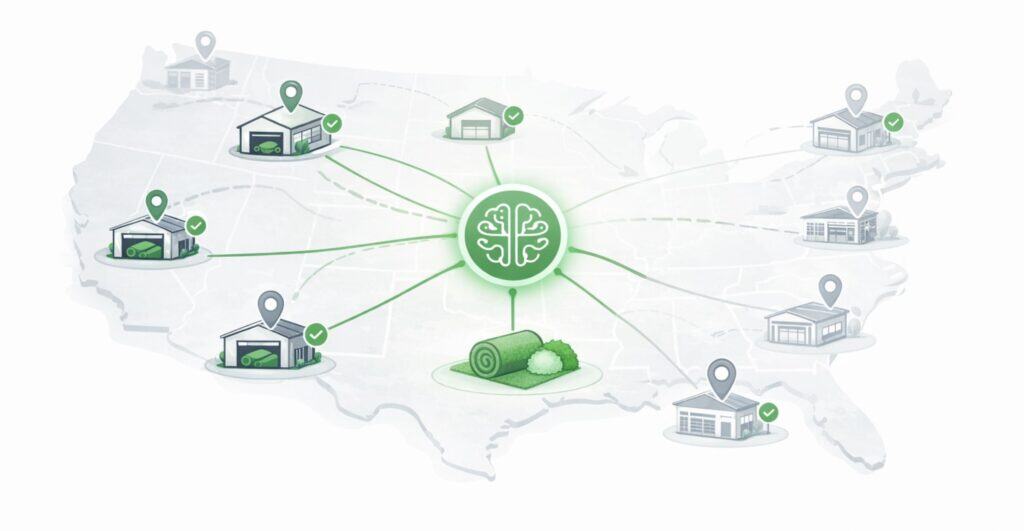
Multi‑Location Complexity
Suppliers and installers often operate multiple warehouses, showrooms and service areas.
Common pitfalls include:
- Single location pages listing many cities: This merges physical addresses with service areas, confusing both users and machines.
- City pages without a footprint: Creating a page for every city you serve can mislead AI into thinking you have a presence there.
- Inconsistent NAP data: “Suite B” vs. “Unit 2” and different phone numbers across listings undermine clarity.
In plain English: treat each warehouse or yard like a separate branch in your accounting system. Don’t mix them.
Product Catalogs
Manufacturers and large suppliers often have extensive product lines: sports turf, pet turf, landscaping turf, infill materials and accessories.
Challenges arise when:
- Product pages contain vague descriptions: AI struggles to classify what you sell.
- Variations of product names appear across pages and brochures.
- Accessory products are hidden deep in the navigation, making them invisible to crawlers.
Simplify by:
- Creating a master product catalogue with consistent names and specifications.
- Using bullet lists of product categories rather than long paragraphs.
- Linking to accessories and infill pages clearly from the main product page.
Homepage Overload
It’s tempting to display everything on your homepage—locations, products, services, testimonials, blog posts, awards.
But an overloaded homepage dilutes focus and confuses AI extraction.
Better approaches:
- Use the homepage to convey your value proposition in a few lines.
- Link clearly to Locations, Products and Services pages.
- Avoid long lists of cities and product variants on the home page; place them on dedicated pages instead.

Myths & Misunderstandings
Many well‑intentioned operators hold misconceptions about how AI and SEO interact.
Let’s debunk a few:
- “If I rank first, AI will mention me.” Not necessarily. AI draws from entity databases, not search rankings.
- “Structured data is for tech people.” It’s increasingly built into modern CMS platforms; you often just fill out fields.
- “City pages help with AI.” They may improve SEO, but without a physical footprint, they confuse AI.
- “AI replaces SEO.” AI answers rely on sources; without content and citations, there’s nothing to summarize.
- “We can wait until this settles.” AI features are already widely adopted and evolving quickly. Waiting risks invisibility.
“Don’t pit AI against SEO. Embrace both as part of a modern visibility strategy.”
John Mueller

What to Prioritize Now
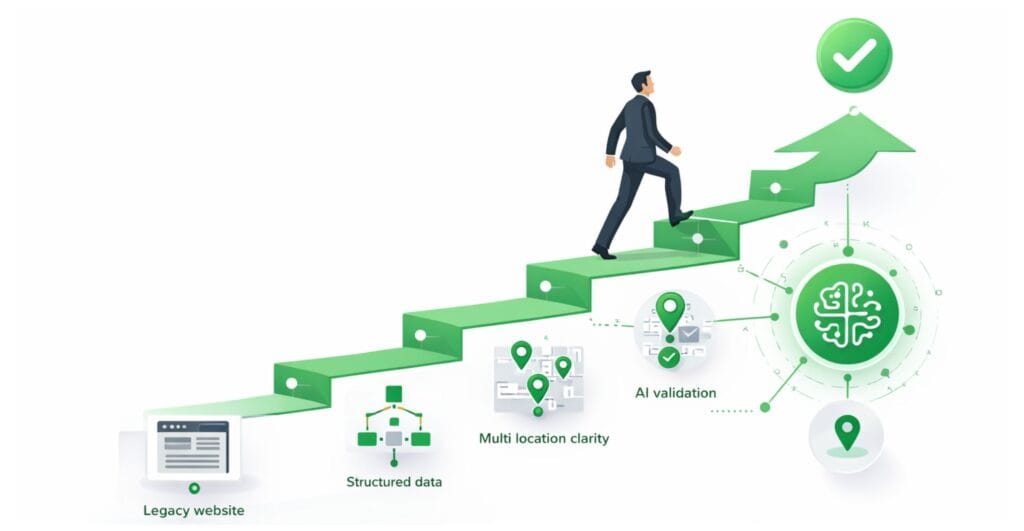
Addressing AI inclusion doesn’t mean abandoning SEO.
It means modernizing your visibility strategy.
Here’s what to focus on:
- Audit your locations.
- List every warehouse, showroom and yard.
- Ensure each has a dedicated page with consistent NAP data.
- Clarify which cities are served from each location.
- Simplify your product catalogue.
- Standardize product names.
- Create a clear hierarchy: categories → products → accessories.
- Use bullet lists to improve skimmability and machine parsing.
- Implement structured data—without the jargon.
- Use built‑in tools or plugins to add LocalBusiness and Product markup.
- Fill out the fields accurately; no coding required.
- Validate with online tools if unsure.
- Maintain healthy SEO practices.
- Continue publishing helpful, people-first content.
- Continue earning backlinks from relevant and authoritative sites.
- Optimize title tags, meta descriptions, and URL structure.
- Add internal links to new content and existing content (to relevant new content).
- Avoid thin, duplicate city pages; focus on quality over quantity.
- Review your homepage.
- Strip it down to essentials: who you are, what you offer, how to find you.
- Stop talking about how great your company is.
- Link to deeper pages for details.
- Make it easy for both humans and AI to navigate.
- Stay current.
- Monitor search announcements and AI feature rollouts.
- Join industry forums or newsletters (e.g., Turf Network’s Knowledge Hub) for updates.
- Schedule periodic audits of your digital footprint.
In plain English: think of this as a visibility upgrade—not a replacement. You’re building a bridge between ranking and AI inclusion.
Timing and Modernization
The year 2026 is a pivotal moment.
Major search engines have rolled out AI overviews as default features, and industry platforms are following suit.
Multi‑location turf companies that adapt early will gain an edge.
Those who wait may find themselves absent from recommendations even if they still rank well.
This is not a crisis.
It’s an evolution.
SEO still matters; it’s just not the only game.
Treat AI visibility as part of your larger digital strategy—alongside search, social and direct relationships.
“Modernization is about alignment, not panic.“

Final Thoughts on AI vs. SEO for Turf Companies
In 2026, turf companies must navigate a dual visibility landscape.
Ranking attracts human attention; inclusion earns AI recommendations.
You don’t have to choose one or the other.
You must embrace both.
Key Points to Remember:
- SEO continues to drive traffic, authority and trust.
- AI overviews assemble answers from entity graphs and structured data.
- Inconsistent or overloaded pages hinder both ranking and inclusion.
- Clarity wins (consistent names, addresses, product descriptions and service areas). It’s the bridge between the old and new models.
- The time to modernize is now.
Turf Network’s mission is to provide the AI visibility infrastructure for the artificial turf industry.
We’re not replacing SEO; we’re augmenting it.
If you’re uncertain about your digital footprint, consider an AI visibility assessment—our Diagnostic—to identify gaps and opportunities.
It’s not an audit; it’s a roadmap to ensure that both search engines and AI assistants see you clearly.