
Most turf suppliers assume that if they rank on Google, they’re visible.
That used to be true.
It’s not anymore.
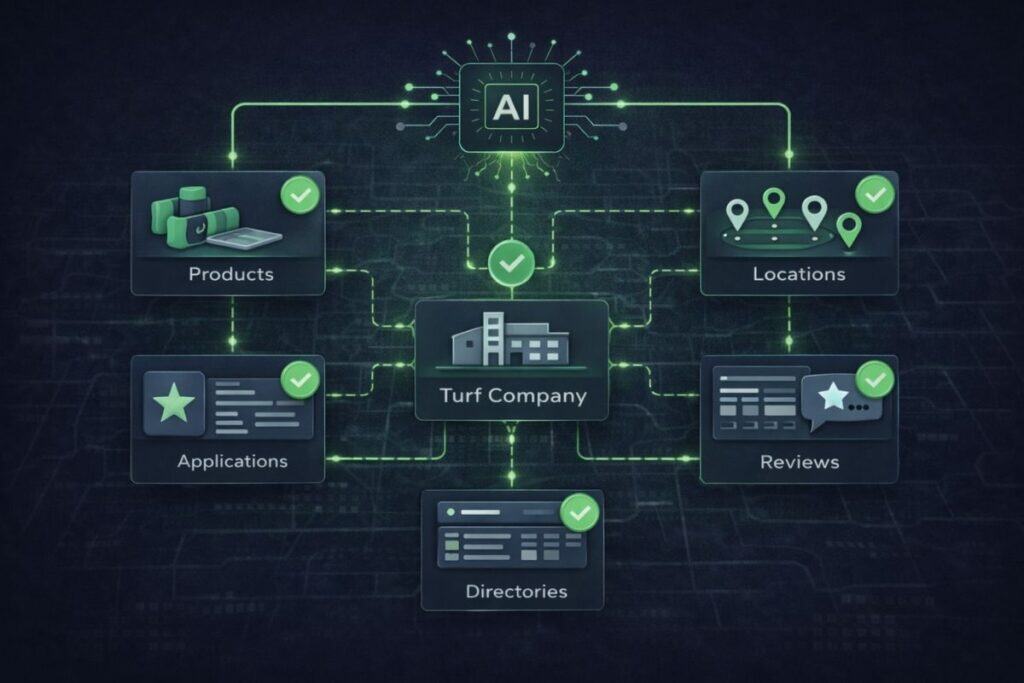
Today, when someone searches “wholesale artificial turf Dallas” or “where do installers buy turf in Texas,” they don’t just see a list of websites.
They see an AI Overview.
- A summarized answer.
- A curated set of suppliers.
- A handful of brands mentioned directly.
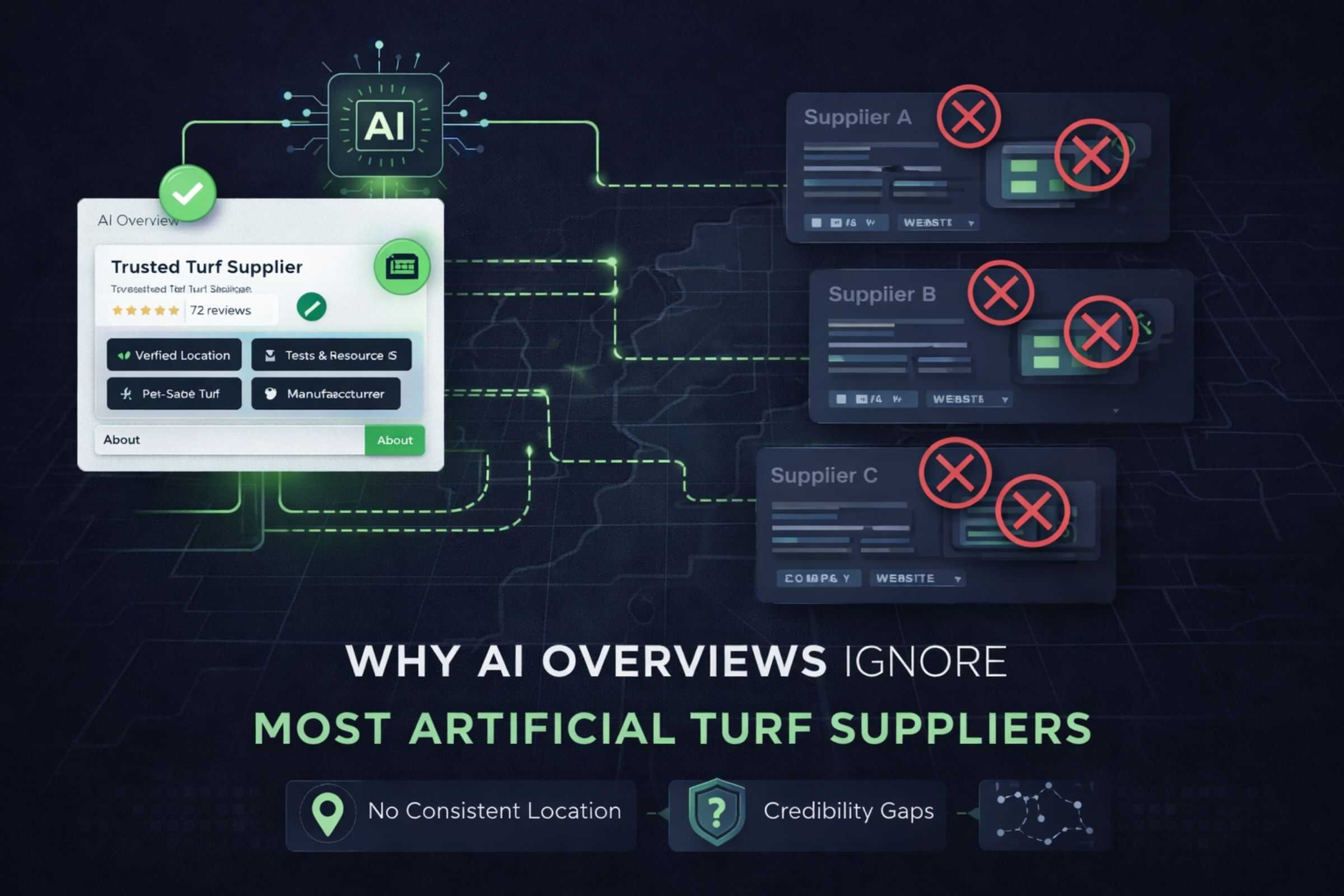
And most turf suppliers aren’t in it.
Even if you’re ranking organically.
That’s not random.
It’s structural.
AI Overviews don’t “rank websites.”
They assemble answers.
And if your structure isn’t clear enough for AI to confidently use your brand in an answer, it ignores you.
Let’s unpack why that’s happening — and what artificial turf suppliers can do about it.
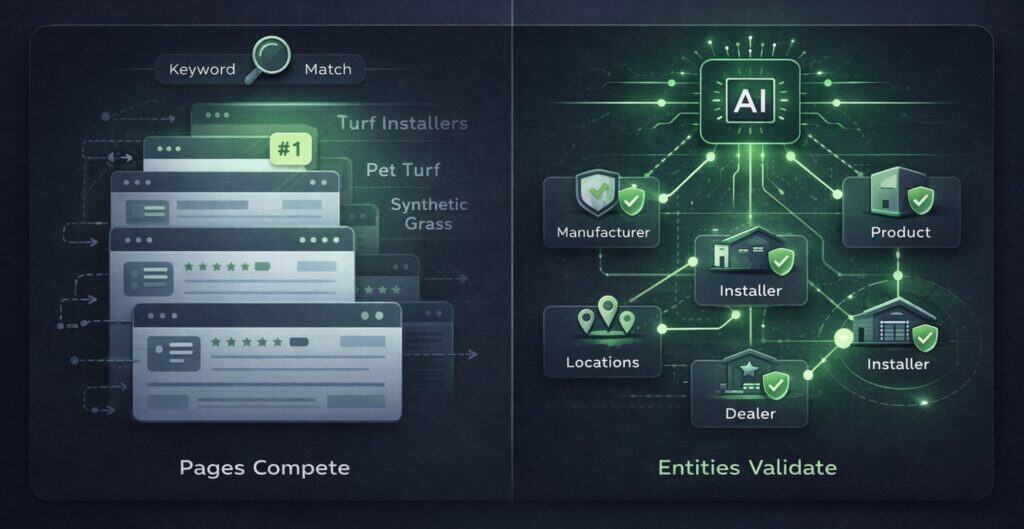
AI Doesn’t Rank Pages — It Validates Entities
Old Google worked like a librarian.
You searched. It handed you a list of books (websites). You chose one.
AI Overviews work differently.
Now the librarian reads multiple books and summarizes the answer for you.
If your book is confusing, outdated, or unclear about what it actually is, the librarian doesn’t quote it.
That’s what’s happening in turf.
AI isn’t just looking for:
- Keywords
- Backlinks
- Blog posts
It’s looking for:
- Clear identity
- Structured location signals
- Defined product categories
- Application relationships
- Consistent external validation
In other words, it’s verifying entities.
If AI isn’t confident in who you are, where you operate, and what you do, it won’t include you.
Additional Resources:
- AI vs. SEO for Turf Companies: Why Structured Clarity Matters
- Local SEO for Turf Installers & Suppliers in the AI Era (Structure = Inclusion)
Why Most Turf Suppliers Get Ignored
There are patterns.
Once you start analyzing supplier visibility across markets, the same structural issues show up again and again.
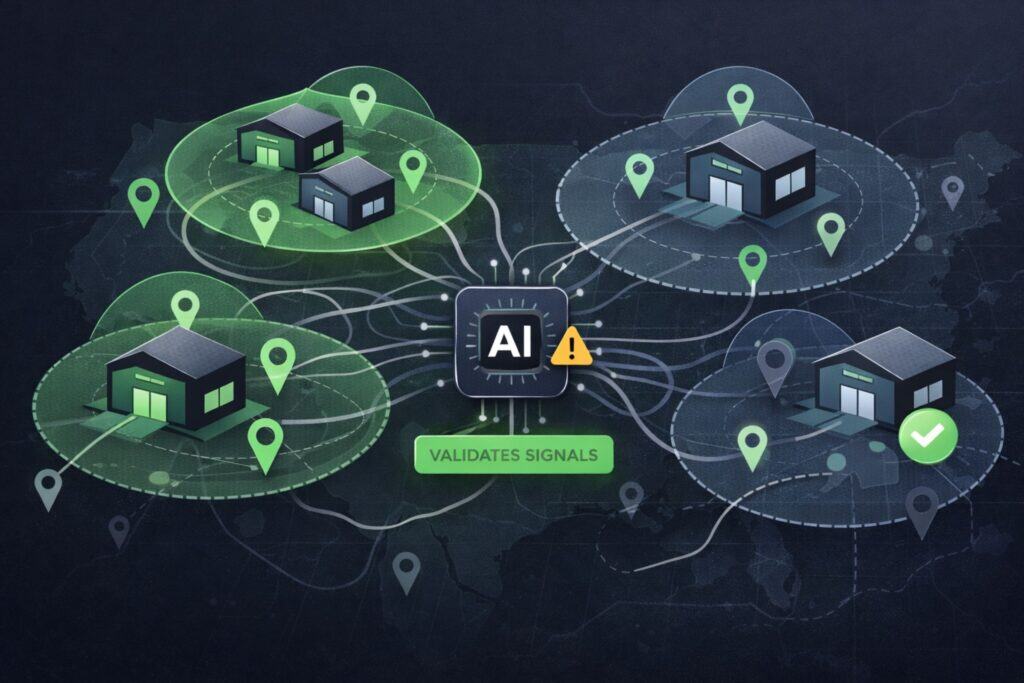
1. Conflicting Multi-Location Signals
Many suppliers operate multiple warehouses.
But their digital footprint looks like this:
- Old warehouse pages still live
- Outdated addresses
- Legacy team members tied to old locations
- Mixed signals about where inventory is actually stocked
AI sees a contradiction.
When there’s conflict, AI chooses clarity.
And clarity often belongs to whoever has fewer locations but a cleaner structure.
If you operate seven warehouses but your digital signals imply ten, twelve, or fifteen, you’re introducing doubt.
AI doesn’t reward doubt.
It avoids it.
2. The “Turf Vomit” Homepage Problem
One of the most common issues in this industry is what I recently heard someone call the “turf vomit” homepage.
Everything is on one page:
- Every product ever sold
- Every application imaginable
- Every claim about quality
- Every marketing statement
It feels comprehensive.
But structurally, it’s chaos.
AI systems try to understand hierarchy:
- What is this company primarily?
- What are its core offerings?
- Where does it operate?
- Who does it serve?
If everything is equally emphasized, nothing is prioritized.
Imagine walking into a warehouse where every product is stacked in one giant pile.
Technically, everything is there.
Practically, nothing is usable.
That’s how many turf supplier homepages look to AI.
Additional Resources: Artificial Turf Website Structure That’s AI-Friendly
3. Product Pages Without Context
Another common issue: product catalogs without relationships.
Suppliers often list:
- Product name
- Pile height
- Face weight
- A few bullet specs
That’s fine for human browsing.
But AI wants relationships.
It wants to understand:
- Which products are suited for pet applications?
- Which are commonly used for putting greens?
- Which are stocked in which warehouse?
- Which are core vs legacy?
If your products exist as disconnected SKUs instead of structured offerings tied to applications and locations, AI has no framework to assemble them into answers.
It doesn’t know which products define your brand.
So it defaults to brands that are easier to interpret.
4. Weak External Validation
AI doesn’t take your website at face value.
It cross-checks.
If your site says: “We are a leading wholesale turf supplier across Texas.”
AI looks for external confirmation.
- Structured listings
- Industry references
- Consistent citations
- Clean geographic footprint
If those signals don’t reinforce what your site claims, your confidence score drops.
That doesn’t mean you’re wrong.
It means your signals aren’t reinforced.
And in an AI environment, reinforcement matters.
5. Outdated or Bloated Content
Many suppliers have been around 15, 20, 25 years.
That’s an asset.
But digitally, longevity often creates clutter.
- Old blog posts
- Discontinued products still indexed
- Archived pages still live
- Messaging written for 2018 search behavior
AI systems favor clarity and consistency.
If half your digital footprint reflects who you were five years ago, and the other half reflects who you are now, AI sees instability.
And again — instability leads to exclusion.
Organic Rankings Don’t Guarantee AI Inclusion
This is the part that surprises most suppliers.
You can rank #1 organically.
And still not appear in the AI Overview.
Why?
Because ranking and inclusion are different problems.
Ranking measures page authority and keyword alignment.
Inclusion measures structural confidence.
AI isn’t just asking: “Is this page relevant?”
It’s asking: “Is this brand clearly defined enough to include in an answer?”
If the answer is uncertain, it moves on.

What Turf Suppliers Should Do Instead
This isn’t about panic.
It’s about structure.
Here’s where to focus.
1. Clean Your Active Warehouse Footprint
Start with clarity.
- List only active warehouses.
- Remove or redirect legacy location pages (a.k.a. Doorway Pages).
- Make sure addresses are consistent across platforms.
- Clearly define what each location does.
If you operate seven warehouses, make sure your digital presence reflects exactly seven.
Not nine. Not twelve. Seven.
Clarity builds confidence.
2. Turn the Homepage Into a Navigation Hub
Your homepage is not a brochure.
It’s a control panel.
Instead of trying to explain everything in one place:
- Segment by buyer type (Installer / Contractor / Retail)
- Segment by application (Pet, Golf, Commercial, etc.)
- Segment by location or region
Less content. More hierarchy.
AI understands structure better than density.
3. Map Products to Applications
Don’t just list products.
Map them.
For example:
Instead of: “Product A – 75 oz Face Weight”
Frame it as: “Best suited for high-traffic commercial installations.”
Create visible relationships between:
- Product → Application
- Product → Warehouse
- Product → Buyer Type
When those relationships are clear, AI can assemble your offerings into meaningful answers.
4. Remove Outdated Signals
Audit your digital footprint for:
- Discontinued SKUs
- Outdated blog posts
- Old address references
- Conflicting service areas
This isn’t about deleting history.
It’s about removing confusion.
Think of it like cleaning up inventory records.
The cleaner your system, the easier it is to trust.
5. Validate Externally
Once your internal structure is clean, reinforce it externally.
That might include:
- Structured industry listings
- Consistent category declarations
- Clean multi-location representation
- Verified business signals
External validation acts like a second set of eyes.
It confirms what you’re declaring internally.
And AI systems reward consistency.

Visibility Is Now Inclusion
The biggest shift turf suppliers need to understand is this:
You’re not optimizing for clicks.
You’re optimizing for inclusion:
- Inclusion in AI answers.
- Inclusion in summaries.
- Inclusion in “where to buy” responses.
That requires a different mindset.
Instead of asking: “How do we rank higher?”
Ask: “How do we make our structure undeniable?”
Because AI doesn’t reward noise.
It rewards clarity.

The Opportunity for Turf Suppliers
This shift isn’t bad news.
It’s an opportunity.
Most suppliers haven’t adapted yet.
They’re still optimizing for:
- More keywords
- More content
- More backlinks
But the suppliers who focus on:
- Clear warehouse footprint
- Clean homepage structure
- Product-to-application relationships
- Consistent external validation
Will be the ones AI confidently references.
Not because they gamed the system.
But because they made themselves easy to understand.
Conclusion: Inclusion is the New Visibility
AI Overviews don’t rank pages.
They validate entities.
Most turf suppliers aren’t being ignored because they lack traffic.
They’re being overlooked because their digital footprint lacks structural clarity.
AI looks for consistency:
- Clear physical locations
- Clean separation of warehouses and service areas
- Structured product relationships
- Consistent name, address, and phone data
- External confirmation of what your website claims
When those signals conflict, confidence drops.
When confidence drops, inclusion drops.
That’s the shift.
The Turf Network exists to bring structural clarity to the industry — mapping suppliers, locations, products, and applications in a way AI can understand.
In an AI-driven search environment, the companies with the cleanest structure win.
Visibility is no longer about ranking higher.
It’s about being recognized at all.