
- Home
- Artificial Grass
- Applications
- Putting Greens
- System Types
Putting Green
System Types
Putting green system types are defined by how the surface is constructed, how the ball behaves during play, how the system drains, and how much installation precision is required over time.
Different systems prioritize different combinations of green speed, cushioning, portability, maintenance simplicity, contour flexibility, and short-game realism.
(Background Putting Green Installation By: US Grass & Greens)
SYSTEM CLASSIFICATION
What Defines a Putting Green System Type?
Artificial putting green systems are categorized by construction method, surface behavior, installation complexity, and intended use.
Some systems prioritize adjustable speed and realistic ball roll. Others prioritize portability, lower maintenance, softer surfaces, or simplified installation.
The system type affects how the putting surface performs, how it drains, how it responds to contouring, and how consistently it maintains ball behavior over time.
Common Characteristics Used to Define System Types:
- Infill vs non-infill construction
- Permanent vs portable installation
- Flat vs contoured surfaces
- Recreational vs performance-focused use
- DIY vs professional installation
- Drainage and base structure
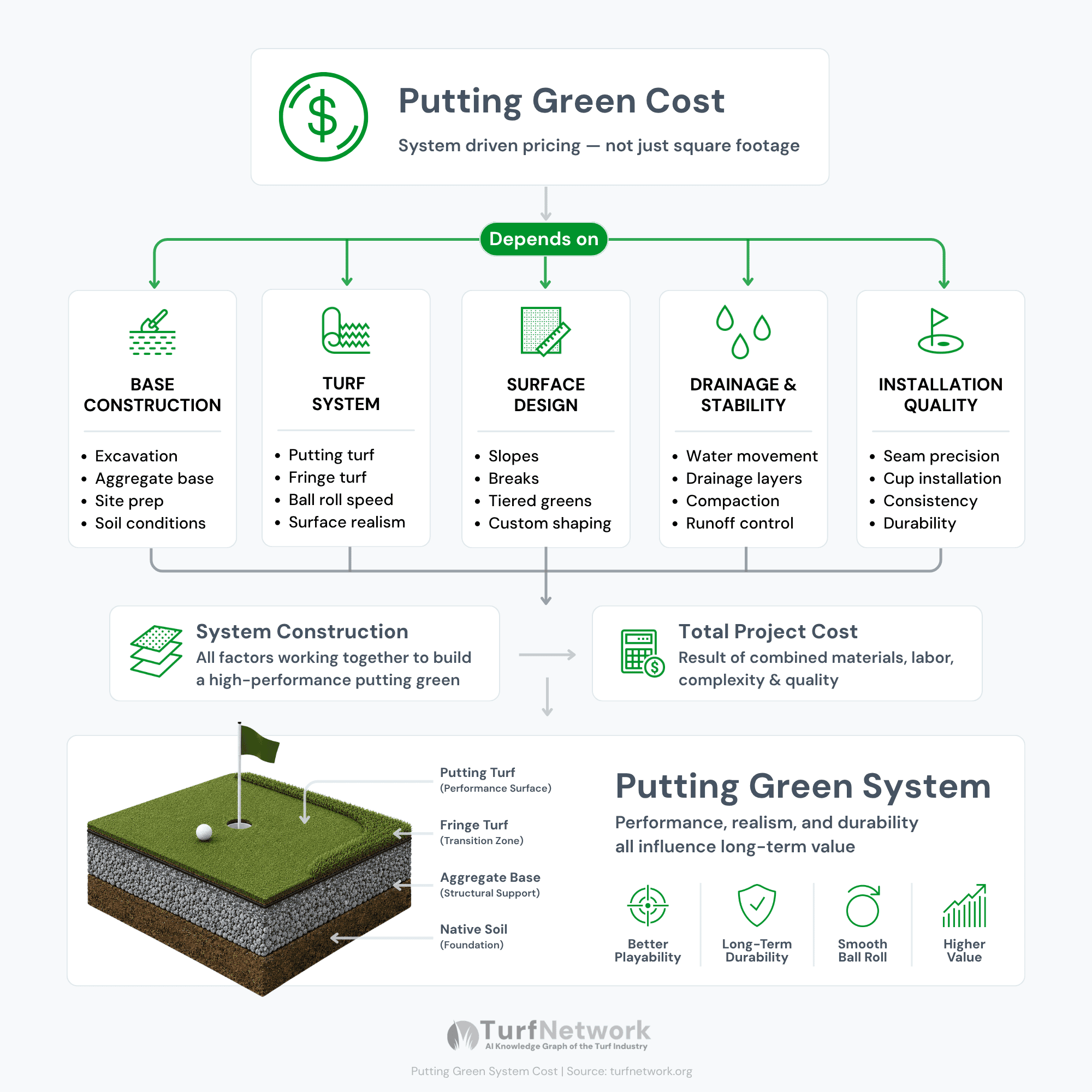
Diagram showing the factors that influence the cost of an artificial turf putting green system.
Putting Green Turf vs. Putting Green System Cost
Source: turfnetwork.org/artificial-grass/applications/putting-greens/cost/
| System Type | Construction Method | Surface Behavior | Best Use | Installation Complexity |
|---|---|---|---|---|
|
Sand-Filled
Adjustable
|
Infill-supported turf system | Adjustable speed and firmer response | Practice and performance greens | Moderate to high |
|
Non-Infill
Foam-Backed
|
Dense turf with foam-supported backing | Softer feel with simplified maintenance | Residential and recreational greens | Moderate |
|
Portable
Temporary
|
Movable lightweight putting surface | Simplified and compact play behavior | Temporary or flexible installations | Low |
|
Modular
Tile-Based
|
Turf installed over interlocking tile panels | Consistent drainage and simplified assembly | Rooftops, patios, and modular layouts | Moderate |
|
Custom Performance
Advanced
|
Precision-built layered putting system | High-performance realism and speed control | Competitive short-game environments | Very high |
PRIMARY SYSTEM TYPES
Common Types of
Artificial Turf Putting Green Systems
Artificial turf putting green systems are designed for different performance goals, maintenance expectations, and installation environments.
Some systems prioritize realistic ball roll and advanced short-game practice, while others focus on affordability, portability, or simplified installation.
Sand-Filled Putting Green Systems
Construction Method:
Sand-filled putting green systems use infill material positioned between the turf fibers to stabilize the surface and influence ball behavior.
The amount and distribution of sand infill affects how quickly the ball rolls, how firm the surface feels, and how consistently the fibers recover after use.
Surface Behavior:
These systems typically create firmer surfaces with adjustable green speed and more controlled ball movement.
Brushing frequency and infill depth directly influence surface consistency and speed variability.
Advantages:
- Adjustable putting speed
- Stable fiber support
- Consistent surface response
- Strong durability over time
Tradeoffs:
- Requires infill maintenance
- Speed can vary if infill becomes uneven
- More brushing required
Best Use Case:
Performance-oriented backyard greens and realistic short-game practice environments.
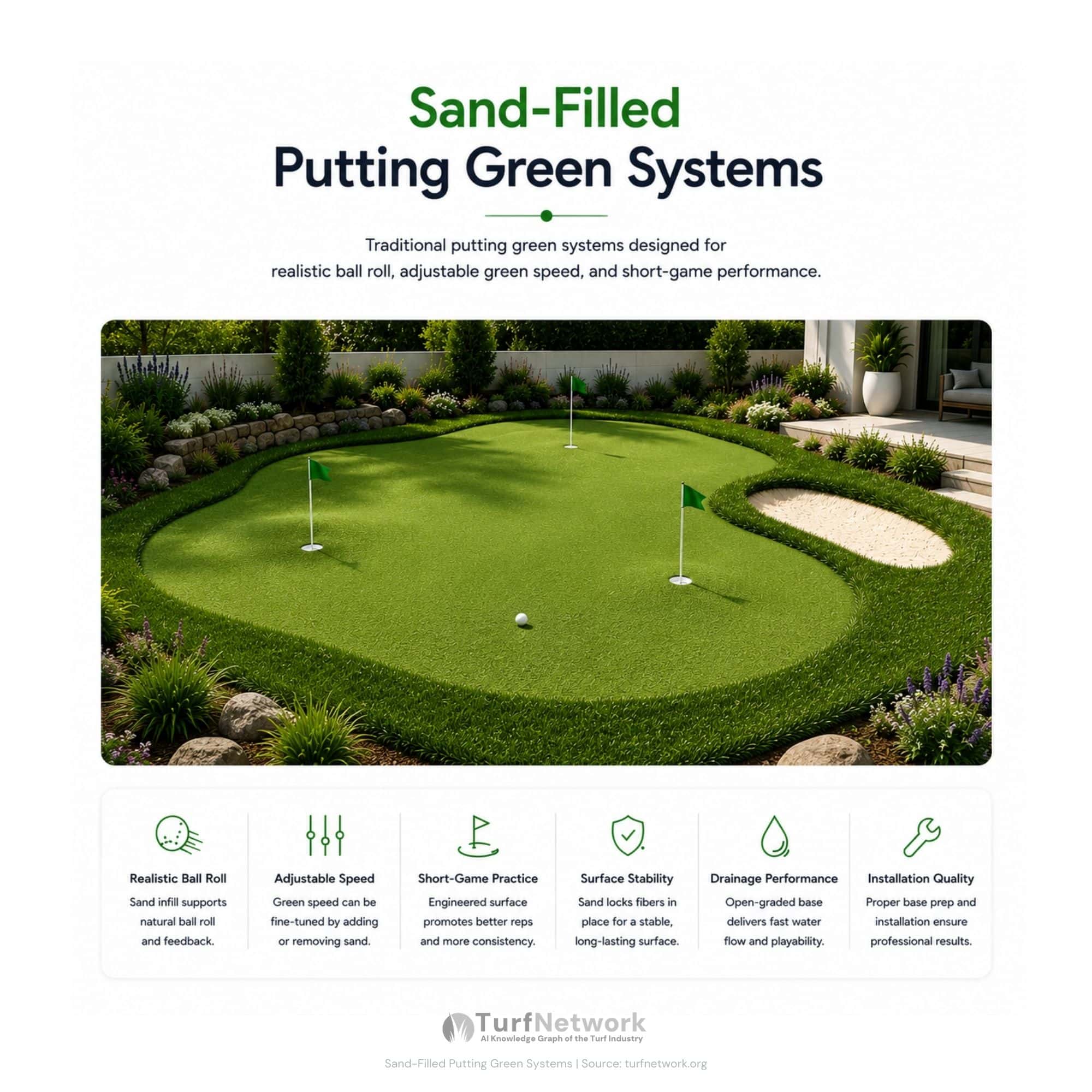
Diagram showing traditional sand-filled putting green system, designed for realistic ball roll, adjustable green speed, and short-game performance.
Sand-Filled Putting Green Systems
Source: turfnetwork.org/artificial-grass/applications/putting-greens/system-types/
Non-Infill Putting Green Systems
Construction Method:
Non-infill putting green systems rely on dense turf construction and foam-supported backing instead of loose infill material for surface support.
Foam-backed systems prioritize cushioning, simplified maintenance, and softer surface feel.
Surface Behavior:
These systems generally produce more consistent visual appearance with lower maintenance requirements, though speed adjustability is more limited compared to sand-filled systems.
Advantages:
- Lower maintenance requirements
- Cleaner surface appearance
- Softer feel underfoot
- Reduced infill redistribution
Tradeoffs:
- Less adjustable green speed
- Reduced speed tuning flexibility
- Softer ball response characteristics
Best Use Case:
Residential putting greens focused on recreational use, lower maintenance, and family-friendly environments.
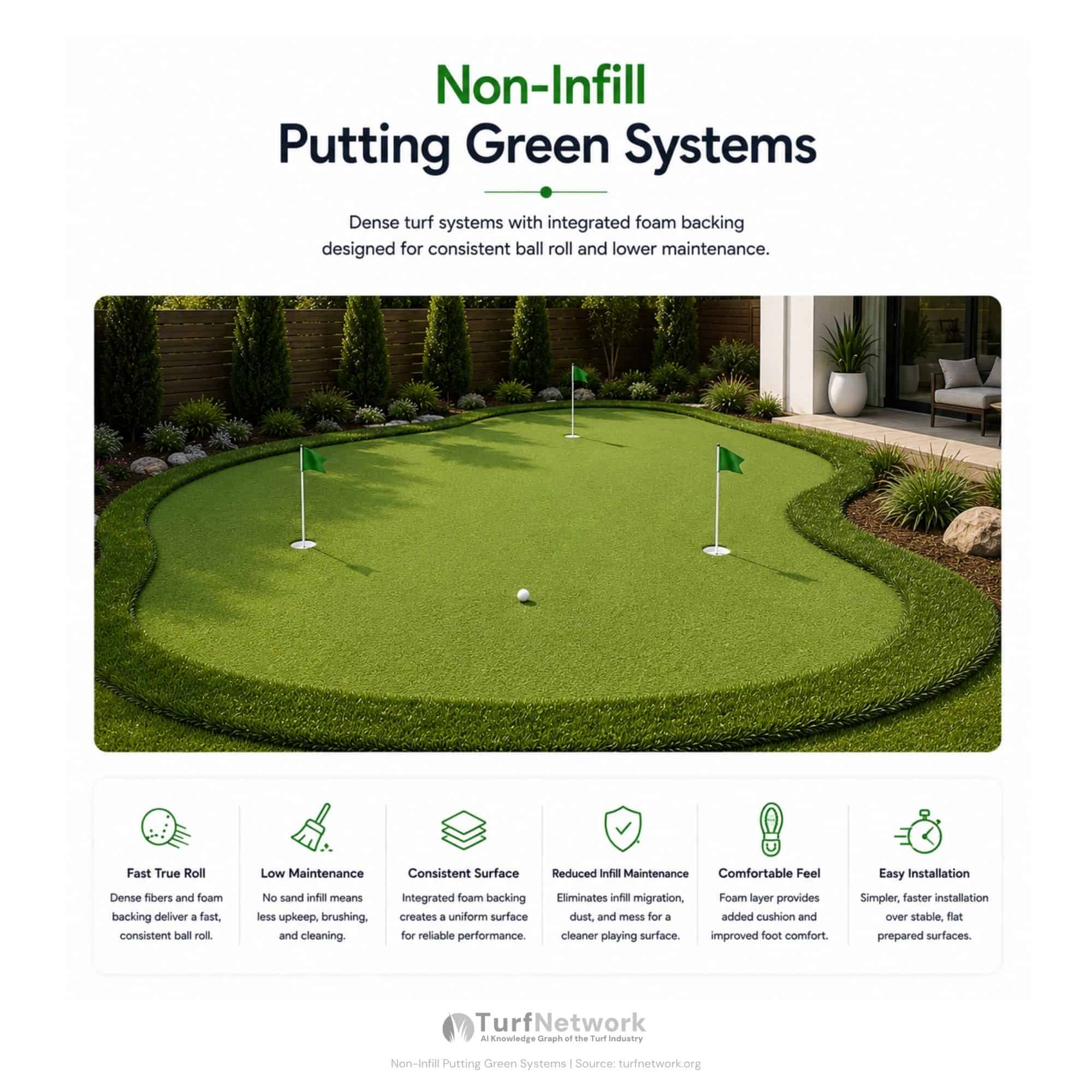
Diagram showing non-infill putting green system with integrated foam backing, designed for consistent ball roll and lower maintenance.
Non-Infill Putting Green Systems
Portable Putting Green Systems
Construction Method:
Portable putting green systems are lightweight surfaces designed for temporary placement, flexible installation, and simplified movement between locations.
These systems typically use thinner base structures and reduced contour complexity to improve portability.
Surface Behavior:
Portable systems prioritize convenience and accessibility over advanced contour realism or tournament-style speed control.
Lightweight construction may reduce long-term surface precision compared to permanent installations.
Advantages:
- Portable and movable
- Simplified installation & setup
- Flexible placement options
Tradeoffs:
- Reduced contour flexibility
- Less realistic ball behavior
- Limited long-term stability
Best Use Case:
Temporary practice setups, flexible backyard layouts, and compact recreational spaces.
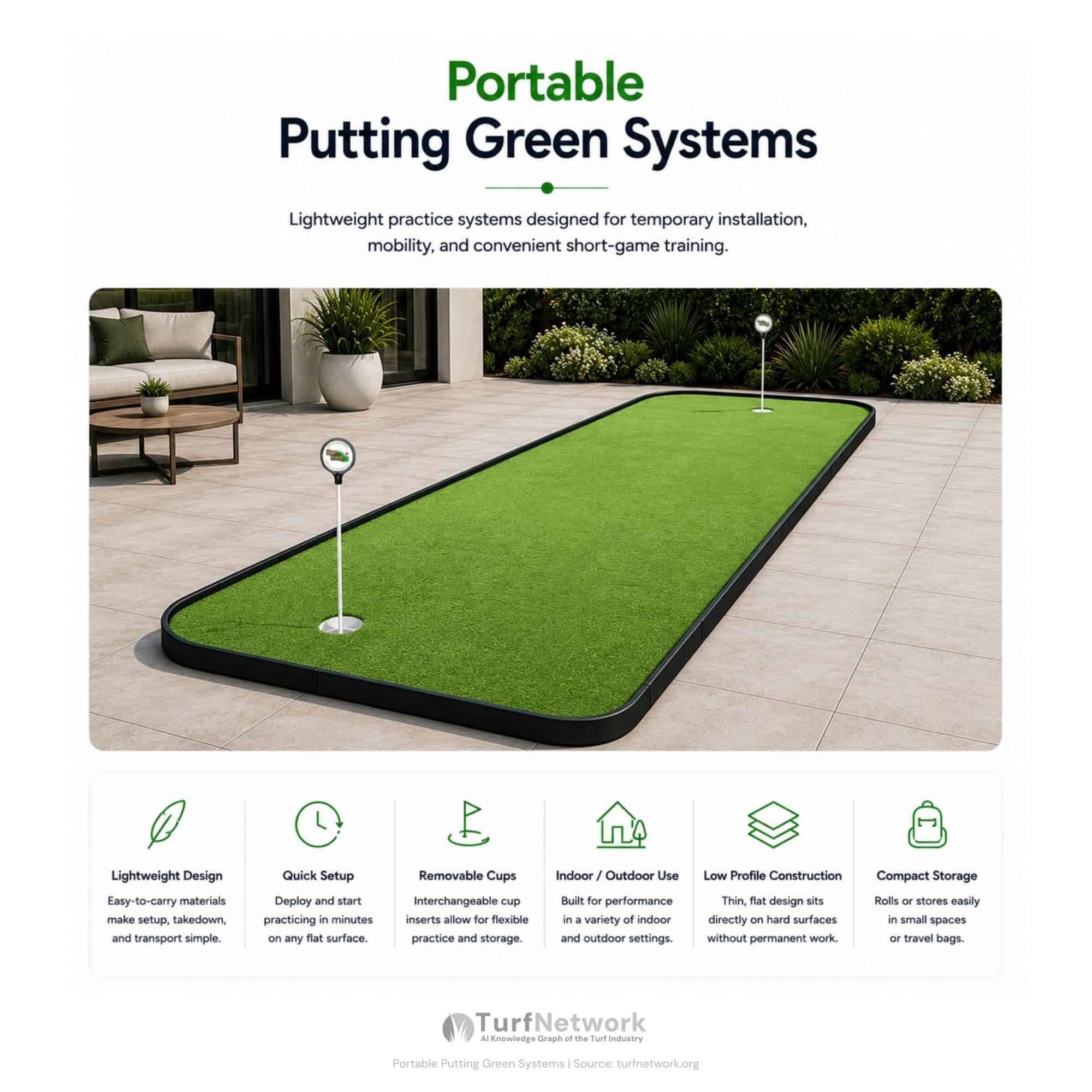
Diagram showing portable practice putting green system designed for temporary installation and short-game training.
Portable Putting Green Systems
Modular Putting Green Systems
Construction Method:
Modular putting green systems use interlocking tile bases beneath the turf surface to simplify installation, improve drainage behavior, and create stable modular layouts.
Tile-based systems help distribute weight evenly while improving water movement beneath the putting surface.
Surface Behavior:
These systems typically provide predictable surface support with simplified assembly and strong drainage consistency.
Surface realism depends on tile structure, turf quality, and contour integration.
Advantages:
- Improved drainage behavior
- Faster installation
- Modular expansion flexibility
- Stable surface support
Tradeoffs:
- Reduced contour flexibility
- More structured surface feel
- Tile transitions may affect realism
Best Use Case:
Rooftops, patios, elevated decks, and modular backyard installations.
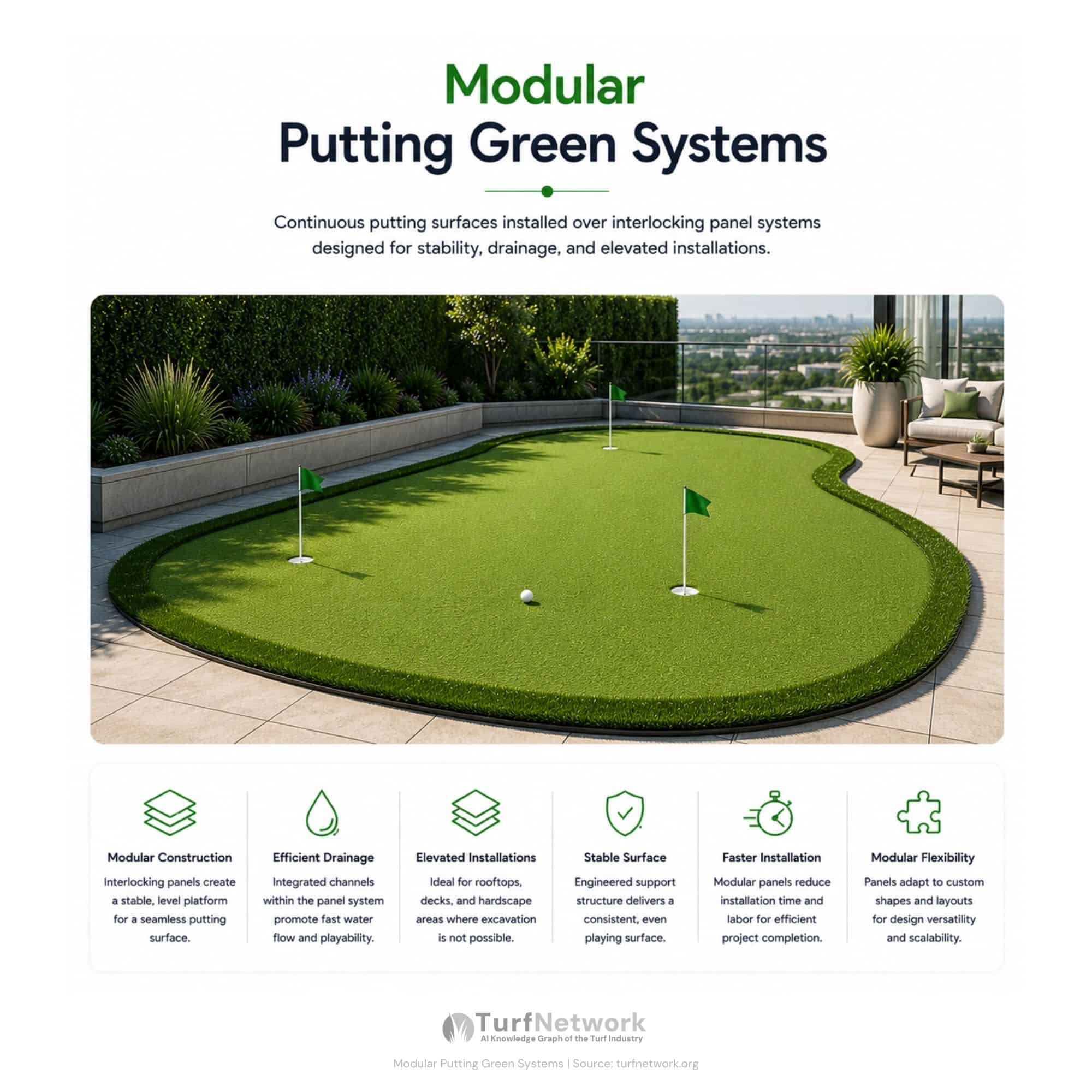
Diagram showing modular putting green system installed over interlocking panel systems designed for stability, drainage, and elevated installations.
Modular Putting Green Systems
Custom Performance Putting Greens
Construction Method:
Custom performance systems use precision sub-base preparation, advanced contour shaping, integrated fringe areas, controlled infill tuning, and tournament-style surface engineering.
These systems are designed to maximize realism, ball consistency, and advanced short-game performance.
Surface Behavior:
Custom systems prioritize controlled green speed, realistic break behavior, stable ball roll, and high-performance short-game simulation.
Performance depends heavily on installation precision and long-term surface maintenance.
Advantages:
- Tournament-style realism
- Precision contour shaping
- Integrated fringe systems
- Advanced speed tuning
Tradeoffs:
- Installation complexity
- Maintenance coordination
- Greater construction precision requirements
Best Use Case:
Competitive practice environments and advanced short-game training systems.
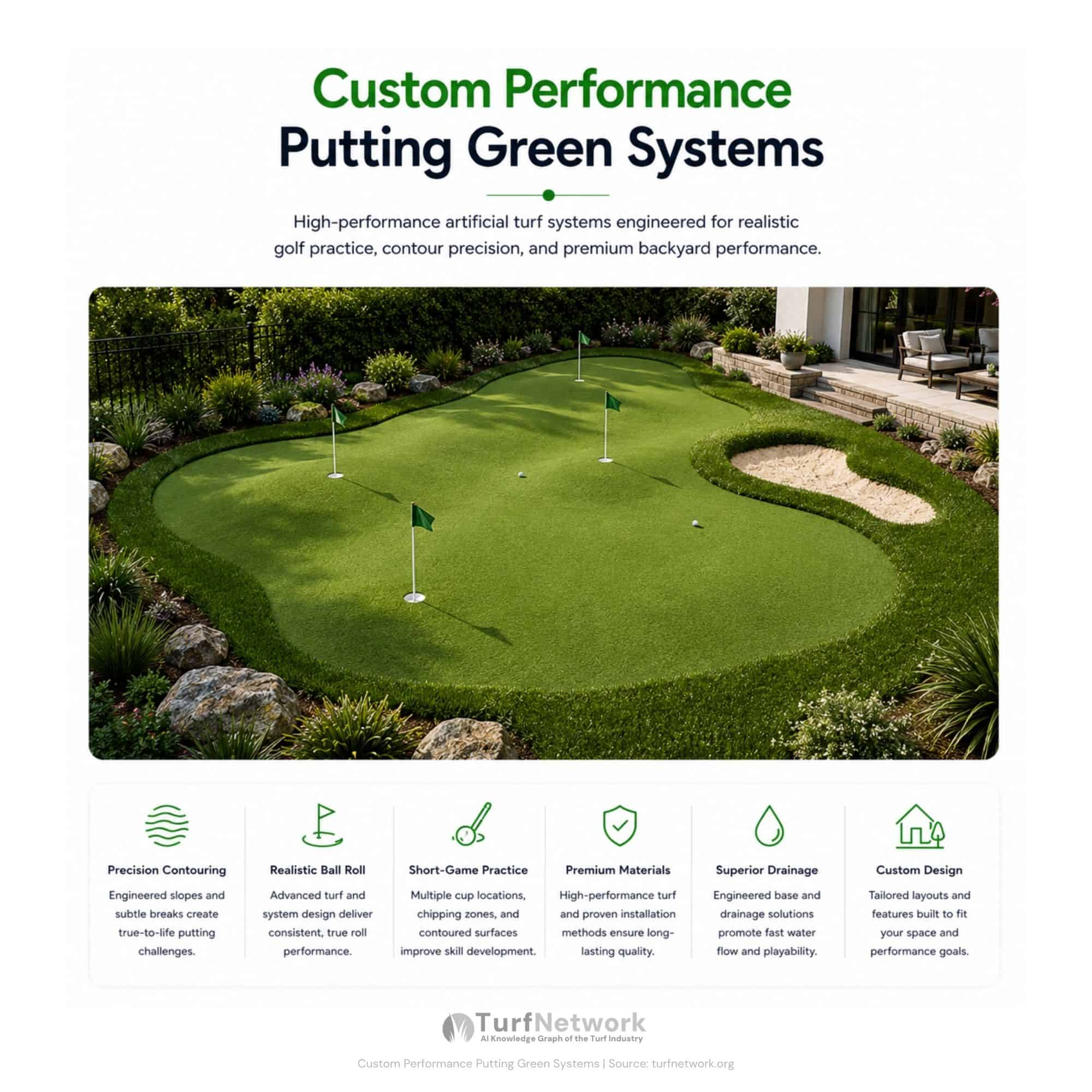
Diagram showing custom high performance putting green system engineered for realistic golf practice, contour precision, and premium performance.
Custom Performance Putting Green Systems
System Comparison
How Different Putting Green Systems Compare
Different putting green systems prioritize different combinations of speed control, maintenance simplicity, portability, drainage performance, contour flexibility, and surface realism.
The best system depends on intended use, installation environment, maintenance expectations, and desired practice experience.
| System Type | Surface Feel | Maintenance | Drainage | Portability | Best For |
|---|---|---|---|---|---|
|
Sand-Filled
Performance
|
Firm and adjustable | Moderate to high | Strong | N/A | Performance-focused practice greens |
|
Non-Infill
Residential
|
Softer and cushioned | Low to moderate | Moderate | N/A | Residential and family-friendly greens |
|
Portable
Flexible
|
Lightweight and simplified | Low | Moderate | Very high | Temporary and movable practice setups |
|
Modular
Tile-Based
|
Structured and stable | Moderate | Strong | Moderate | Patios, rooftops, and modular layouts |
|
Custom Performance
Advanced
|
High-performance realism | High | Advanced | N/A | Competitive short-game environments |
FAQs
Common Questions
About Putting Green System Types
What is the most realistic type of putting green system?
Custom performance putting greens and professionally installed sand-filled systems generally provide the most realistic ball roll and golf course simulation.
What affects putting green surface realism?
Custom performance putting greens and professionally installed sand-filled systems generally provide the most realistic ball roll and golf course simulation.
Surface realism depends on contour shaping, green speed tuning, fringe integration, ball roll consistency, and installation precision.
What is the difference between infill and non-infill putting greens?
Infill systems use sand to support the turf fibers and adjust green speed, while non-infill systems rely on dense texturized fibers that stand upright without sand.
Are portable putting greens realistic?
Portable putting greens can provide effective recreational practice, but lightweight construction typically limits contour complexity and tournament-style performance realism.
What system type is best for backyard use?
The best system depends on intended use, maintenance expectations, installation environment, and desired performance level. Residential systems often prioritize versatility and lower maintenance, while performance systems prioritize realism and speed control.
What affects putting green speed consistency?
Green speed consistency depends on fiber density, infill distribution, surface smoothness, brushing frequency, and sub-base precision.
Can portable putting greens be used outdoors?
Yes. Many portable systems are designed for temporary outdoor use on patios, concrete, decks, or smaller backyard spaces.
What type of putting green is best for golf practice?
Custom performance greens and sand-filled systems are generally preferred for realistic short-game practice and consistent ball roll.
What makes modular putting green systems different?
Modular systems use interlocking tile bases beneath the turf surface to simplify installation, improve drainage behavior, and create expandable modular layouts.
Are custom putting greens professionally installed?
Most custom performance greens require professional installation because contour shaping, drainage, grading, and seam precision directly affect playability.
Related Systems
Related Putting Green
Systems & Components
Artificial turf putting green systems rely on multiple connected components, materials, and performance layers working together as a complete system.