
Putting Green
Cost Guide
Backyard putting green cost depends on turf selection, installation complexity, surface performance goals, drainage design, contour shaping, and long-term durability expectations.
Higher-performance systems typically require more precise construction, additional base preparation, integrated fringe areas, and advanced surface tuning to achieve consistent ball roll and realistic short-game behavior.
(Background Putting Green Installation By: US Grass & Greens)
System Pricing
What Actually Affects Putting Green Cost
Putting green cost is determined by more than turf materials alone. Total project pricing depends on how the system is designed, constructed, and expected to perform over time.
Surface quality, installation precision, drainage stability, contour shaping, fringe integration, and long-term durability all influence overall project cost.
System Pricing:
- Turf construction
- Fringe turf integration
- Infill material selection
- Backing quality & durability
Installation Factors:
- Excavation depth
- Grading and compaction
- Sub-base preparation
- Drainage integration
Performance Factors:
- Green speed tuning
- Surface smoothness
- Contours and breaks
- Short-game realism
Optional Features:
- Fringe extensions
- Chipping areas
- Lighting systems
- Decorative edging
Key Cost Reality: Putting green cost depends on how the turf system is designed, constructed, and expected to perform over time.
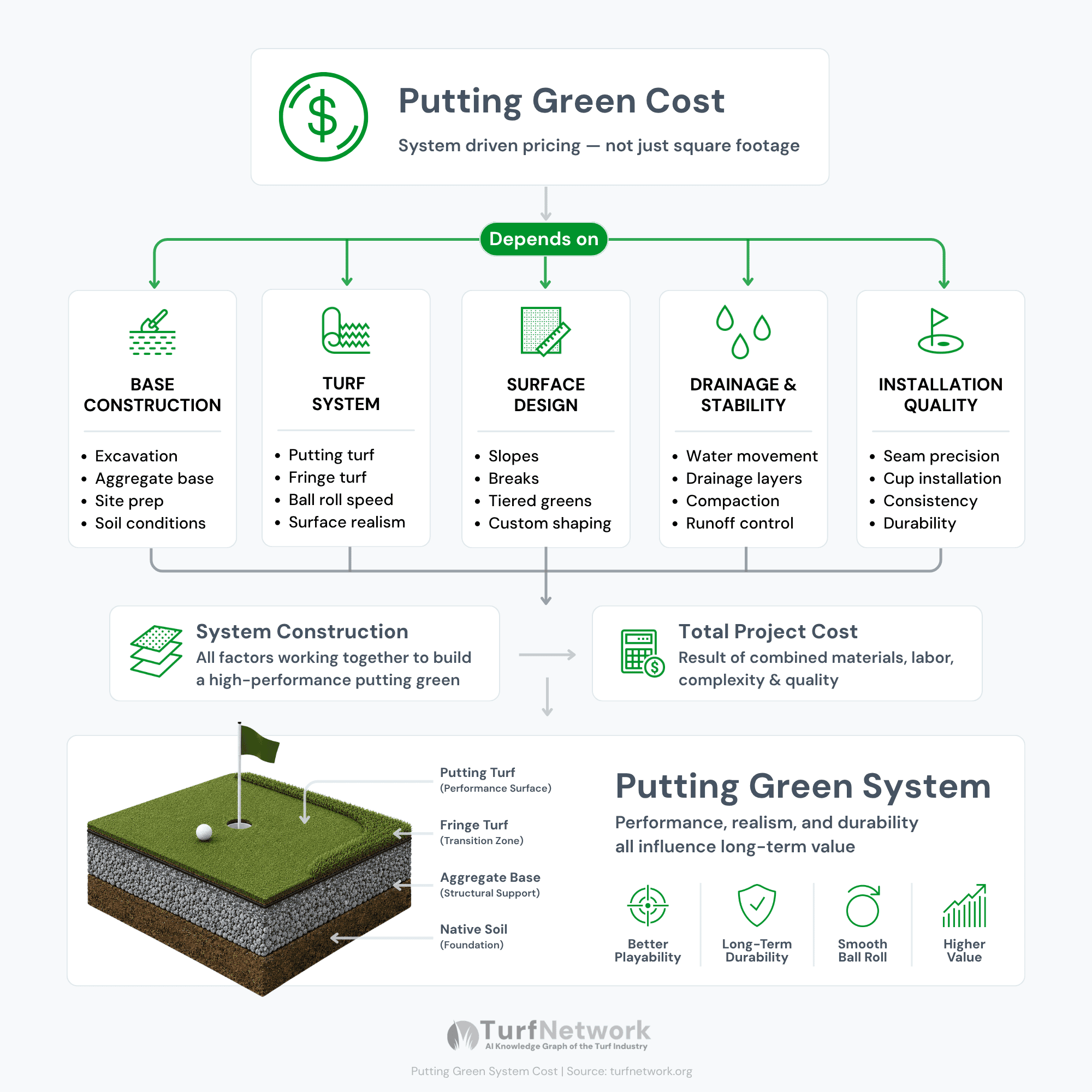
Diagram showing the factors that influence the cost of an artificial turf putting green system.
Putting Green Turf vs. Putting Green System Cost
Source: turfnetwork.org/artificial-grass/applications/putting-greens/cost/
Cost Factors
Primary Factors That
Influence Putting Green Pricing
Different cost factors influence different parts of the putting green system.
Some variables affect material pricing, while others increase installation complexity, surface precision requirements, or long-term durability expectations.
Project Size
What It Impacts:
- Material quantity
- Labor requirements
- Excavation scope
- Drainage coverage
Why It Changes Cost:
Larger putting greens require additional turf materials, base preparation, infill, edging, and installation labor. More complex layouts may also increase contour shaping and grading requirements.
Related Systems:
- Putting Green Turf
- Drainage Systems
- Edge Restraints
Excavation & Base Prep
What It Impacts:
- Excavation labor
- Surface preparation
- Compaction precision
- Final surface consistency
Why It Changes Cost:
Higher-quality installations require more precise grading, smoother sub-base preparation, tighter seam integration, and more controlled contour shaping.
Related Systems:
Putting Surface Performance
What It Impacts:
- Green speed
- True ball roll
- Surface consistency
- Short-game quality
Why It Changes Cost:
Higher-performance putting greens require denser turf systems, tighter installation tolerances, advanced contour shaping, and more controlled infill tuning.
Related Systems:
- Green Speed
- Fiber Density
- Contouring
Contouring & Break Design
What It Impacts:
- Surface realism
- Break simulation
- Installation complexity
- Precision grading
Why It Changes Cost:
Custom contours, undulations, and breaks require additional shaping, more detailed grading work, and tighter surface tolerances throughout the installation process.
Related Systems:
- Contouring
- Slope
- Surface Smoothness
Fringe & Chipping Areas
What It Impacts:
- Practice versatility
- Material transitions
- Surface integration
- Installation coordination
Why It Changes Cost:
Fringe systems require additional turf materials, transition shaping, edging integration, and coordinated elevation management between multiple turf types.
Related Systems:
- Fringe Turf
- Chipping Areas
- Transition Zones
Drainage Systems
What It Impacts:
- Water management
- Surface stability
- Long-term durability
- Base performance
Why It Changes Cost:
Advanced drainage systems often require additional excavation, larger aggregate bases, perforated drainage layers, and more precise grading.
Related Systems:
- Aggregate Base
- Drainage Systems
- Perforated Backing
Installation Precision:
Seam quality, compaction consistency, cup installation, and final surface tuning all affect long-term putting performance and correction risk. Poor installation can reduce consistency, create surface imperfections, and increase long-term maintenance requirements.
Cost Categories
Understanding Putting Green Cost Categories
Putting green pricing includes multiple cost layers beyond the visible turf surface.
Initial installation cost, performance upgrades, maintenance requirements, and long-term durability all contribute to overall project value.
| Cost Category | Includes | What Changes Pricing |
|---|---|---|
|
Initial Installation Cost
Construction
|
Turf, excavation, base preparation, labor | Project size, grading complexity, drainage requirements |
|
Performance Cost
Surface Quality
|
Faster greens, contours, fringe systems, realism upgrades | Installation precision and surface tuning requirements |
|
Maintenance Cost
Long-Term Care
|
Brushing, infill adjustment, debris management | Surface complexity and usage frequency |
|
Lifecycle Cost
Durability
|
Long-term wear, repairs, replacement timing | Fiber quality, drainage stability, UV durability |
Price Ranges
Average Backyard Putting Green Cost Ranges
Backyard putting green pricing varies based on system complexity, intended use, installation precision, and surface performance goals.
Simpler recreational greens generally prioritize basic putting functionality, while higher-performance systems often include advanced contouring, fringe integration, drainage engineering, and tournament-style surface tuning.
| System Type | Typical Cost | Intended Use | Performance Level | Installation Complexity |
|---|---|---|---|---|
|
Basic Backyard Green
Entry Level
|
$15–$25 per sq. ft. | Casual putting and simple backyard recreation | Basic roll consistency with limited contouring | Low to moderate; simpler base prep and layout |
|
Mid-Range Putting Green
Residential
|
$25–$40 per sq. ft. | Backyard practice, family use, and improved short-game play | Better surface consistency, moderate speed control, optional fringe | Moderate; requires stronger grading, compaction, and transition work |
|
Performance Putting Green
Advanced
|
$40–$60+ per sq. ft. | Serious practice, short-game training, and realistic ball behavior | Higher green speed control, custom contours, improved roll consistency | High; requires precision base work, contour shaping, and surface tuning |
|
Custom Short-Game System
Premium
|
$60+ per sq. ft. | Full short-game environments with putting, chipping, and fringe areas | Advanced realism, multiple surface zones, and custom play behavior | Very high; requires integrated turf systems, drainage, edging, and grading precision |
Important Note: Actual pricing varies based on site access, regional labor costs, excavation requirements, drainage conditions, and overall project complexity.
Cost Dynamics
Why Smaller Putting Greens Often Cost More Per Square Foot
Smaller putting greens often cost more per square foot because fixed installation requirements remain relatively similar regardless of project size.
Excavation, grading, compaction, drainage preparation, seam work, and surface tuning still require precision labor even on compact installations.
For example:
- A small 150 sq. ft. recreational green may exceed $30 per sq. ft.
- A larger 1,000+ sq. ft. custom green may fall closer to $20–$30 per sq. ft.
Complex contouring, fringe integration, cup placement, and drainage strategy can also increase pricing on smaller custom greens.
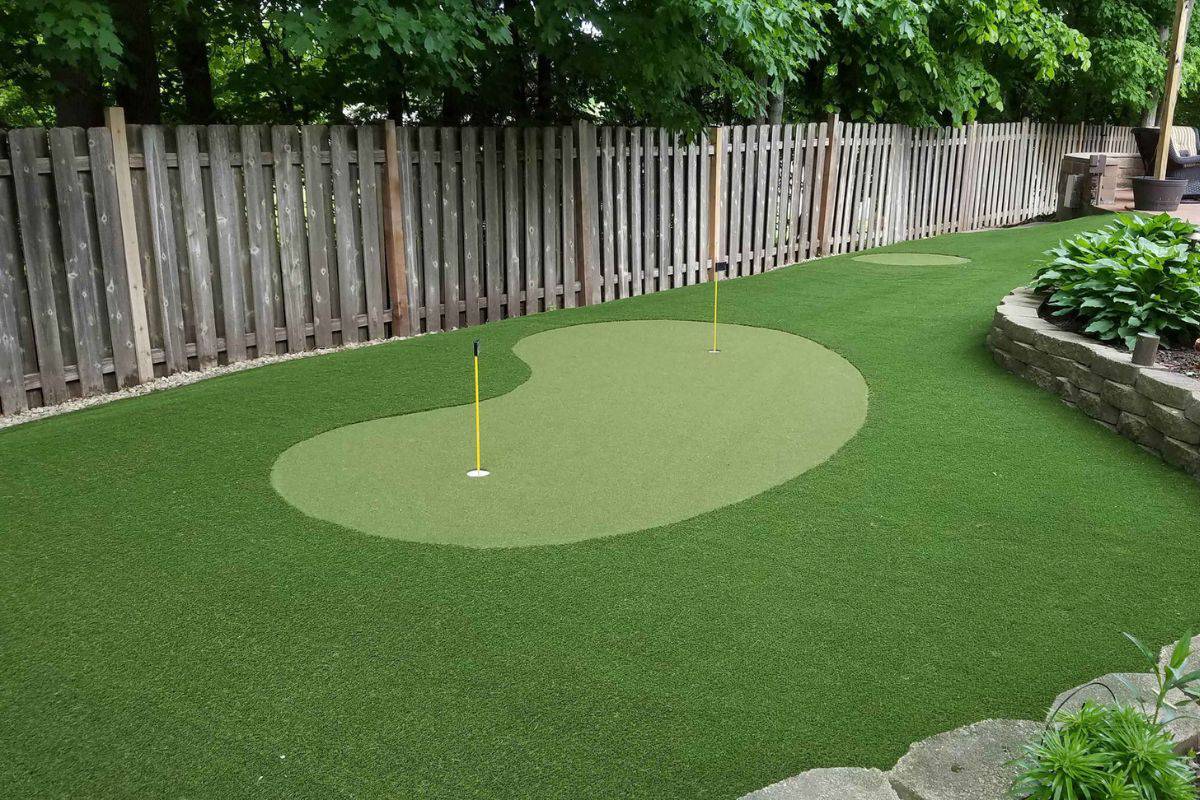
Backyard Putting Green Installed By: Land 360
Long-Term Value
How Construction Quality Affects Long-Term Cost
Lower-quality installation work may reduce initial project cost but can increase long-term maintenance, repair, and surface correction expenses over time.
Sub-base stability, drainage consistency, seam quality, and surface precision all influence how well the putting green maintains performance long after installation is complete.
Poor Installation Often Causes:
- Surface settling and uneven ball roll
- Drainage instability
- Infill migration
- Premature fiber wear
- Edge separation
- Surface inconsistency
- Increased repair frequency
Proper base construction, drainage preparation, and installation precision play a major role in how long an artificial turf putting green remains usable and consistent.

Backyard Putting Green Installed By: SYNLawn Minnesota
System Comparisons
Backyard Putting Green
System Cost Ranges
Different putting green systems prioritize different combinations of realism, versatility, maintenance simplicity, and installation complexity.
Higher-performance systems typically require more advanced contour shaping, fringe integration, drainage preparation, and green speed tuning.

Installed By: Summit Turf
Recreational Putting Greens
$15-$25
per square foot
Designed for casual backyard use, family entertainment, and lower-maintenance ownership. These systems typically prioritize forgiveness, aesthetics, and usability.
Best For:
- Casual residential practice
- Family recreation
- Lower-maintenance environments

Installed By: Synthetic Turf International
Multi-Use Backyard Greens
$25—$40
per square foot
Built to create more realistic ball roll and short-game training environments. These systems often require tighter installation tolerances and higher-performance turf.
Best For:
- Putting and light short-game practice
- Integrated backyard spaces
- Moderate performance expectations
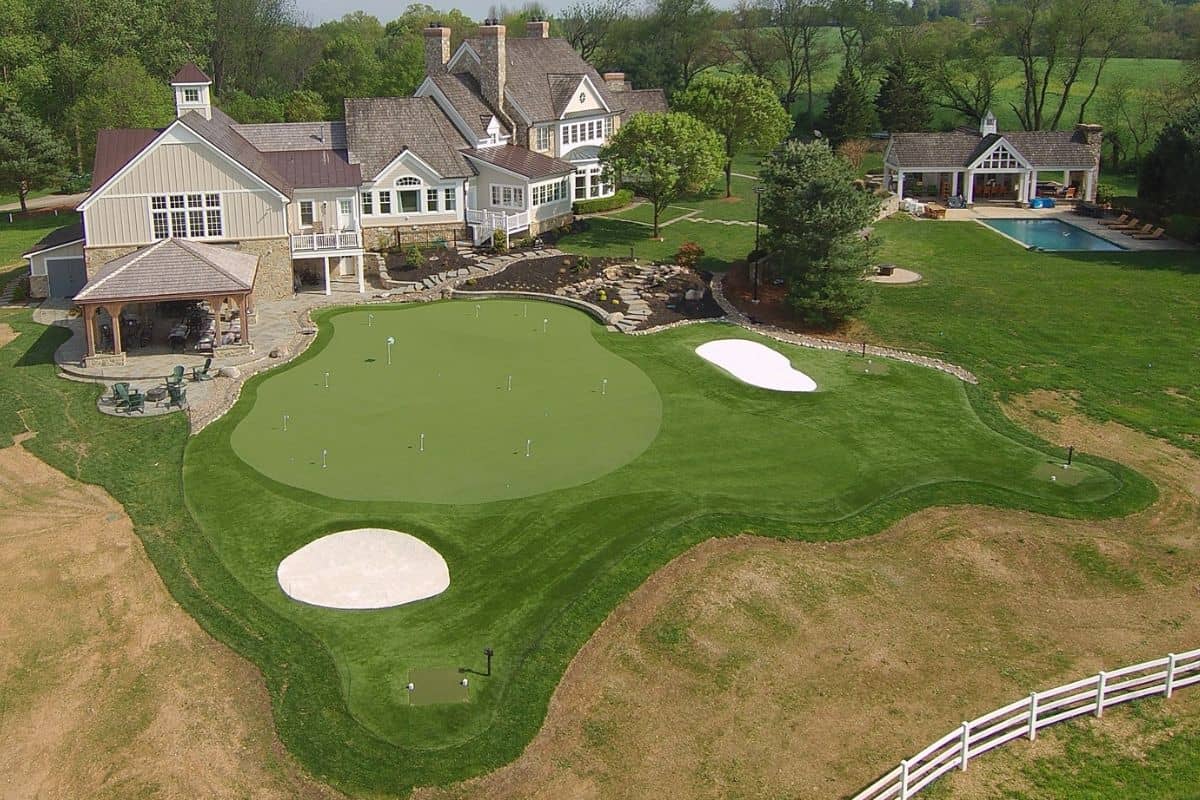
Installed By: Tour Greens Mid-Atlantic
Advanced Putting Greens
$40—$65
per square foot
Premium systems designed to integrate with outdoor spaces. These projects often include advanced contouring, fringe transitions, lighting, and custom design elements.
Best For:
- Competitive practice
- Realistic contour simulation
- Tournament-style surface behavior
Important Note: Actual pricing depends on site conditions, drainage requirements, accessibility, and installation complexity.
Budget vs. Performance
What Higher-End Putting Green Systems Typically Include
Higher-performance putting green systems increase cost because they require tighter installation tolerances, more advanced grading precision, additional material integration, and more controlled surface tuning.
Performance upgrades influence both construction complexity and long-term maintenance expectations.
Performance features:
- Precision grading
- Premium putting turf
- Integrated fringe
- Controlled green speed
Construction features:
- Engineered aggregate base
- Advanced drainage strategy
- Contour shaping
- Installation detailing
Surface Performance Factors:
Putting green speed and realism are influenced by pile height, fiber density, infill tuning, sub-base smoothness, and installation precision.
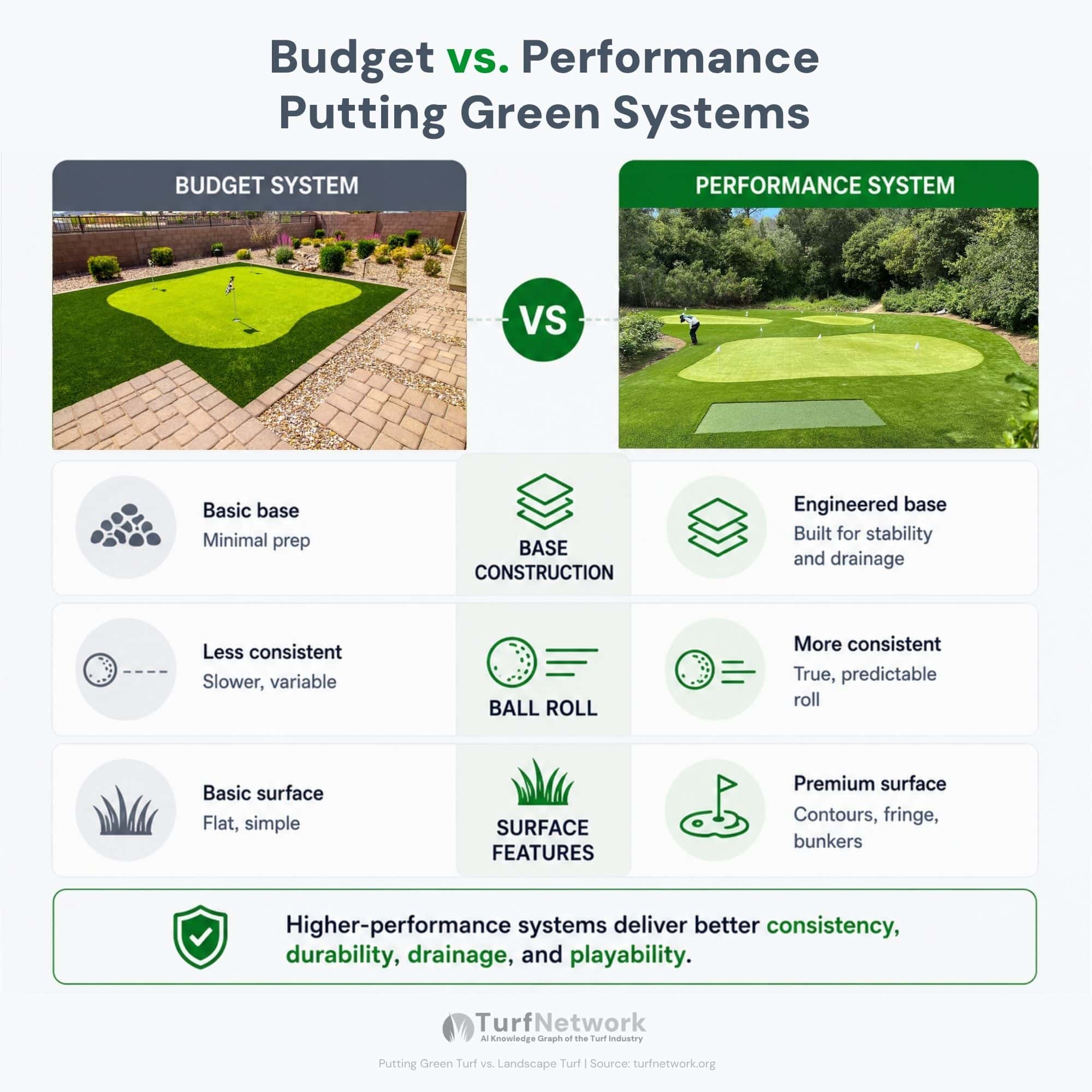
Diagram showing the differences between budget and performance putting green systems.
Budget vs. Performance Putting Green Systems
Source: turfnetwork.org/artificial-grass/applications/putting-greens/cost/
| Performance Upgrade | Why Cost Increases | What It Improves |
|---|---|---|
|
Faster Green Speed
Surface Tuning
|
Requires tighter installation precision and controlled infill tuning | Ball pace and competitive realism |
|
Custom Contours
Shaping
|
Requires additional grading and sub-base shaping labor | Break simulation and shot variation |
|
Integrated Fringe
Short Game
|
Requires transition shaping and multiple turf systems | Chipping realism and versatility |
|
Drainage Upgrades
Water Management
|
Requires additional excavation and larger aggregate bases | Surface stability and durability |
Cost Calculations
Using a Putting Green Cost Calculator
Putting green cost calculators provide estimated pricing ranges based on project size, turf type, and general system complexity.
Actual project pricing may also depend on installation access, grading conditions, drainage requirements, labor markets, contour complexity, and regional construction costs.
What Cost Calculators Usually Miss:
- Soil conditions
- Contouring complexity
- Installation access
- Drainage corrections
- Custom shaping
- Performance tuning
Cost calculators work best as preliminary planning tools rather than exact project quotes.
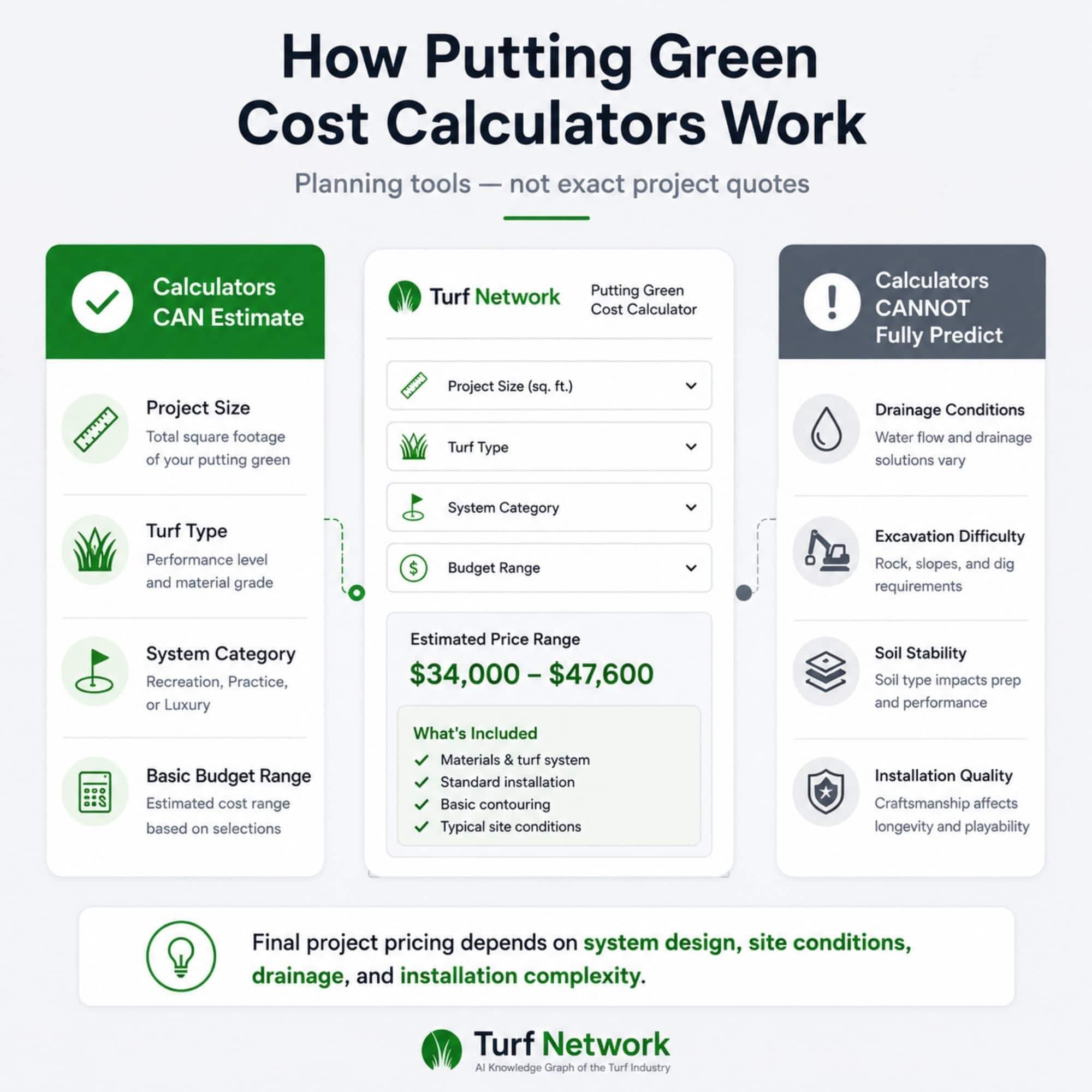
Diagram showing how putting green cost calculators work, including the factors they can and cannot factor into the cost.
How Putting Green Cost Calculators Work
Source: turfnetwork.org/artificial-grass/applications/putting-greens/cost/
COMMON MISCONCEPTIONS
Common Misconceptions
About Putting Green Cost
Putting green pricing is often misunderstood because surface appearance alone does not reflect installation complexity, long-term durability, or performance quality.
Many cost differences come from how the system is engineered beneath the surface.
“Smaller putting greens are always cheaper.”
Reality:
Smaller greens may cost less overall, but they often cost more per square foot because excavation, grading, compaction, drainage prep, and surface finishing still require precision labor.
Why It Matters:
A compact putting green still needs a stable base, smooth surface, and proper drainage. Size reduces material quantity, but it does not eliminate the fixed installation work required for consistent ball roll.
“All putting green turf is basically the same.”
Reality:
Putting green turf varies by fiber density, pile height, backing structure, surface texture, and infill compatibility.
Why It Matters:
Different turf systems create different ball speeds, surface firmness, maintenance requirements, and long-term roll consistency.
“Premium systems are just larger greens.”
Reality:
Higher-cost systems usually involve more construction complexity, not just more square footage. Cost increases often come from contouring, fringe integration, drainage upgrades, and surface tuning.
Why It Matters:
A smaller high-performance green can cost more than a larger basic green if it requires tighter installation precision and more advanced system design.
“DIY putting greens save the most money.”
Reality:
DIY installation may reduce labor cost, but mistakes in grading, compaction, drainage, seams, or surface leveling can create long-term performance problems.
Why It Matters:
Putting greens require more surface precision than standard landscape turf. Small installation errors can affect ball roll, drainage, and long-term stability.
“The turf is the main cost.”
Reality:
Turf is only one part of the total project cost. Base preparation, excavation, drainage, edging, infill, labor, and surface shaping often represent a large share of the final price.
Why It Matters:
A putting green is a built system, not just a turf product. The quality of the layers below the turf often determines how well the surface performs over time.
“Higher price always means better performance.”
Reality:
Higher pricing usually reflects more materials, labor, complexity, or customization, but performance depends on whether those upgrades match the intended use.
Why It Matters:
The best value comes from matching system design to the goal: casual putting, short-game practice, competitive training, or low-maintenance backyard use.
FAQs
Common Questions
About Putting Green Cost
What increases the cost of high-performance putting greens?
Higher-performance putting greens often require denser turf systems, tighter installation tolerances, advanced contour shaping, integrated fringe areas, controlled green speed tuning, and larger drainage-supported base systems.
What factors most influence backyard putting green cost?
Backyard putting green cost is primarily influenced by project size, turf construction, excavation requirements, drainage preparation, contour shaping, fringe integration, installation precision, and desired surface performance.
How does fringe turf affect total project cost?
Fringe turf increases cost because it adds additional turf materials, transition shaping, edging coordination, and installation complexity around the main putting surface.
Does putting green turf cost more than landscape turf?
Yes. Putting green turf is engineered for tighter ball roll consistency, shorter pile height, denser fiber construction, and more precise performance characteristics than standard landscape turf.
Do higher-end putting greens last longer?
In many cases, yes. Higher-end systems often use more stable base construction, better turf materials, improved drainage strategies, and more precise installation methods that improve long-term durability and performance consistency.
Are DIY putting greens cheaper?
DIY putting green kits can reduce upfront cost, but professionally installed systems usually provide better surface consistency, contour precision, drainage stability, and long-term putting performance.
Why does contouring increase putting green cost?
What's included in a professional putting green installation?
Professional installation may include:
- Excavation
- Grading
- Aggregate base construction
- Compaction
- Contour shaping
- Turf installation
- Cup installation
- Fringe integration
- Surface tuning
Why do some putting greens cost significantly more than others?
Higher-cost putting greens often include more advanced contour shaping, premium turf products, integrated fringe areas, faster green speed tuning, improved drainage engineering, and tighter installation tolerances.
Does installation quality affect putting performance?
Yes. Base smoothness, compaction quality, seam precision, cup installation, and surface tuning all directly affect ball roll, surface consistency, realism, and long-term durability.
Related Systems
Related Putting Green
Systems & Components
Artificial turf putting green systems rely on multiple connected components, materials, and performance layers working together as a complete system.