
SafeShell vs Envirofill
Compare two premium pet-friendly infills with different material profiles, odor-control approaches, and long-term maintenance tradeoffs.
Compare in Main Infill Guide →Artificial turf systems are built from multiple structural layers that work together to create a stable and durable synthetic grass surface.
Click or tap an icon to jump to the relevant infill material:
Infill materials consist of granular, sand-like particles distributed between turf fibers to provide weight, stability, and performance support. It plays a critical role in maintaining fiber position, drainage, and overall surface behavior.
Key Functions:
System Role: Sits between fibers and backing, directly affecting surface performance and user experience.
Related Components: Turf Fibers • Turf Backing • Turf Drainage • Antimicrobial Protection
Used With: Turf Fibers • Drainage • Backing
Commonly Used In: Pet Turf Systems • Residential Lawns • Athletic Fields
View in: Artificial Turf Glossary →
System Components
Artificial turf installations are built from multiple structural layers that work together to create a stable, well-drained surface.
Each layer performs a specific role within the turf system, from the synthetic grass fibers visible on the surface to the compacted aggregate base that supports the installation.
The diagram illustrates the primary components found in most artificial turf systems.
Each component affects performance differently.
Compare Turf Specs to see how complete systems vary.
Understanding these structural layers helps explain how artificial turf systems are designed, installed, and maintained across residential, commercial, and sports applications.
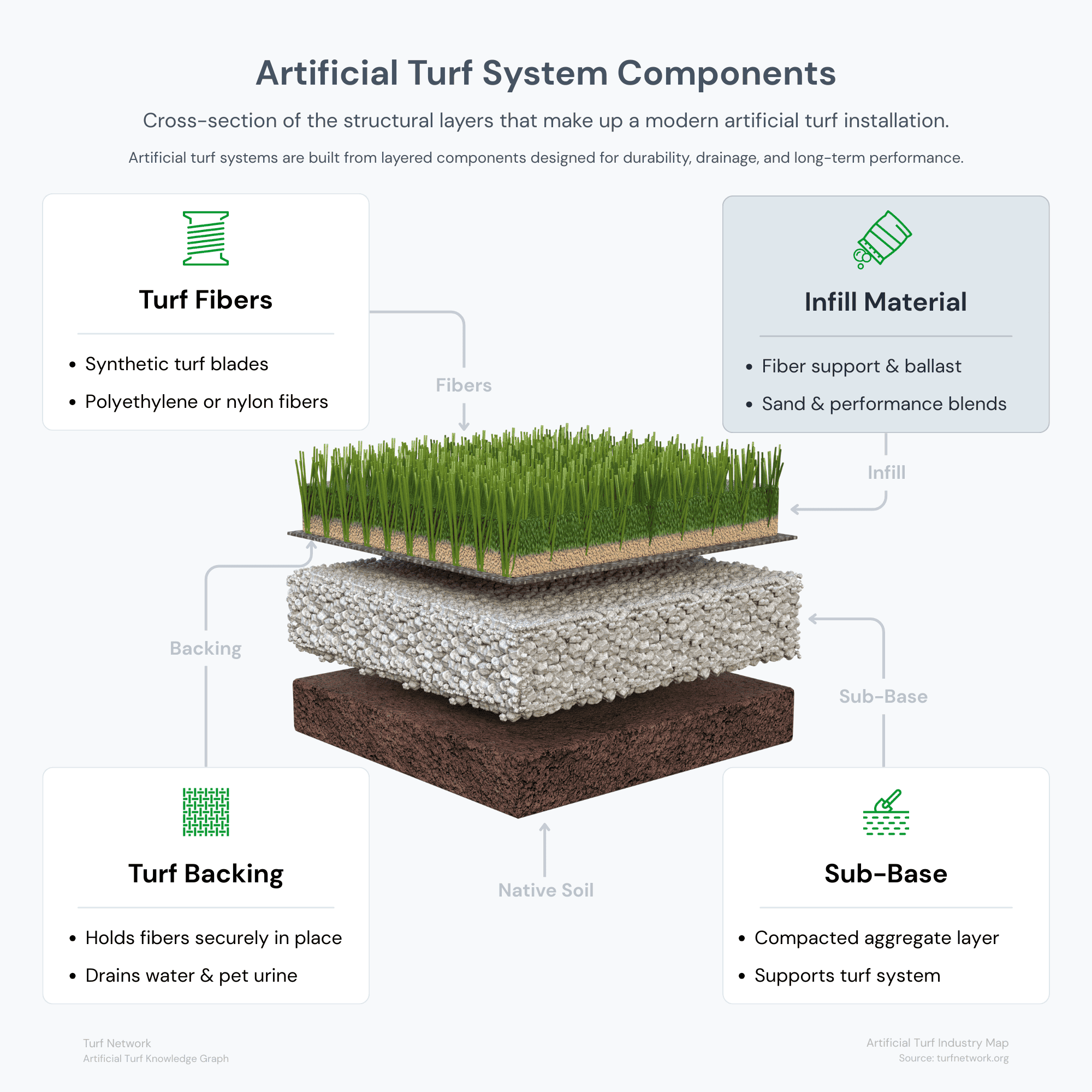
This diagram highlights infill material, the granular layer placed between artificial grass fibers to support the blades and stabilize the turf surface.
Turf Network — Artificial Turf System Components
Source: Turf Network – turfnetwork.org/artificial-grass/components/
Infill is a granular material that fills the spaces between the blades of artificial grass, providing stability and cushioning.
It’s usually spread on top of the grass during the installation using a drop spreader, and then the turf fibers are agitated using a power broom to help the infill settle in place.
Infill is a common requirement for artificial turf lawns and is important for the performance, appearance, and longevity of the lawn.

Let’s explore how infill plays a vital role in maintaining the appearance and functionality of artificial grass.
Once spread on the artificial grass, the infill is power-broomed to evenly distribute it and help it settle between the fibers. This action ensures that the grass blades stand upright. When you step on the artificial grass or apply pressure to it, the infill assists the grass blades in returning to their original upright position. This not only helps to maintain the aesthetic appeal of the grass but also ensures that the turf fibers are prepared to withstand regular use.
Infill not only keeps the turf standing but also shields the backing from the harmful UV rays of the sun. This protective layer helps maintain the quality and lifespan of your artificial grass.
In addition to its appearance-enhancing qualities, infill also provides a cushioning effect that mimics the natural impact absorption capabilities of soil found under natural grass. This means that when you walk on artificial grass, you can expect a similar sensation to walking on real grass. This comfortable experience adds to the overall enjoyment and satisfaction of having artificial grass.
Infill plays a crucial role in preventing the formation of wrinkles, buckles, or ripples on the artificial grass surface. By acting as ballast, the infill weighs down the grass and keeps it securely in place, even during movement or heavy foot traffic. This ensures that the aesthetics and integrity of the grass are maintained over time.
Infill aids in the drainage of water and pet urine from the artificial grass. By keeping the turf fibers upright, the infill allows liquids to flow through the turf’s backing and into the sub-base underneath. This efficient drainage system helps to maintain the cleanliness and hygiene of the artificial grass surface.
For applications like fake grass for dogs, it may be worthwhile to consider upgrading to alternative infill materials that offer additional features to enhance the functionality and performance of the grass.
Infill affects drainage, heat, odor control, comfort, and long-term maintenance.
Use this table to compare the most common options before exploring each material in more detail.
Infill is only one part of the system. 👉 Compare Turf Specs to see how complete turf systems differ.
| Infill Type | Best For | Heat Reduction | Drainage | Odor Control | Durability | Cost |
|---|---|---|---|---|---|---|
|
Silica Sand
Budget-friendly
|
General landscaping, value-focused installs | Low | High | Low | High | $ |
|
T°Cool Infill
Cooling-focused
|
Hot climates, family lawns, sun-exposed areas | High | Medium | Medium | Medium | $$$ |
|
Envirofill®
Pet-friendly
|
Pet turf, residential landscapes, low-odor installs | Medium | High | High | High | $$$ |
|
HydroChill®
Temperature control
|
Heat-sensitive installs, warm regions | High | Medium | Medium | Medium | $$$ |
|
ZeoFill
Odor control
|
Pet areas, odor-prone installations | Medium | High | Very High | Medium | $$$ |
|
BrockFILL™
Athletic performance
|
Sports fields, performance-focused systems | Medium | Medium | Low | High | $$$ |
|
SafeShell®
Natural infill
|
Residential landscapes, pets, natural-material preference | Medium | High | High | Medium | $$$ |
|
Cork Infill
Eco-conscious
|
Natural installs, lower-heat preference | High | Medium | Medium | Medium | $$$ |
|
EPDM Infill
Color-stable rubber
|
Playgrounds, sports, specialty systems | Medium | Medium | Low | High | $$$ |
|
Crumb Rubber
Sports common
|
Athletic fields, impact-heavy applications | Low | Medium | Low | High | $ |
Ratings are generalized for comparison. Performance depends on the full turf system, including fibers, backing, infill depth, and base preparation.
These side-by-side comparisons help users understand the tradeoffs between cooling, odor control, durability, and cost before choosing an infill type.
Compare two premium pet-friendly infills with different material profiles, odor-control approaches, and long-term maintenance tradeoffs.
Compare in Main Infill Guide →Compare two cooling-focused infill options to understand how they differ in heat reduction, recharge behavior, and best-fit applications.
Compare in Main Infill Guide →Compare odor-control performance, pet suitability, drainage behavior, and natural-material positioning for two strong residential options.
Compare in Main Infill Guide →Compare the most common budget and sports-oriented infill categories through the lens of heat, drainage, cost, and typical use cases.
Compare Turf Specs →Compare antimicrobial-coated infill versus mineral-based odor absorption to see which performs better for pet-specific installations.
Compare in Main Infill Guide →Compare athletic performance, heat behavior, traction support, and field-use priorities between engineered wood particle infill and rubber.
Compare Turf Specs →Below are the most commonly used infill materials in artificial grass.
Silica sand is derived of quartz that has been eroded by wind and water.
As the quartz erodes, it breaks down into small granules. This infill is ideal for areas that don’t get a lot of traffic, such as hills, thick turfs, balconies, commercial spaces, or open fields that aren’t used a lot.
Silica sand helps keep the blades of artificial grass standing in an upright position. It also helps to improve drainage. Another benefit of this type of infill is its cost; generally, it is the least expensive type of infill material.
There are some downsides to this type of infill product. The composition of the sand can also harden, which means that your artificial grass can end up losing its permeability. Lastly, it has been known to trap pet odors, so if you have pets, you may want to avoid this type of infill.


TºCool® infill is equipped with evaporative cooling technology that reduces surface temperatures by 35° F – 50° F, combatting the artificial turf “heat issue.”
Hydration in the form of irrigation, rainfall, or humidity continuously activates the process.
TºCool is infused with BacShield®, the non-metal, bio-based antimicrobial derived from Chitosan.
BacShield helps to prevent the growth of bacteria, mold, and mildew, and prevents stains, odors, and product deterioration. BacShield is sustainable, renewable, hypoallergenic, and biodegradable.
Envirofill is essentially a manufactured sand that has less sharp edges than regular sand.
This makes it safer for kids to play on versus regular silica sand. It also tends to have slightly more shock absorption qualities than silica sand.
Envirofill is also an excellent high traffic area turf infill since the “rounder” edges of the product are easier on the artificial grass blades over time.
It also has built-in antimicrobial protection from Microban® that claims to help prevent microbes such as odor-causing bacteria resulting from pet urine.
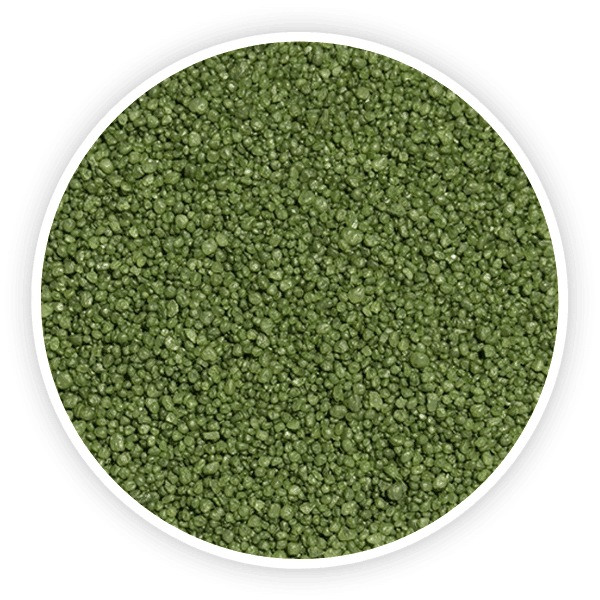

Hydrochill (a.k.a. Chill fill) is the coolest infill available hands down. It is made of sand that’s covered with a proprietary coating from the manufacturer.
With the help of evaporative cooling (think spraying the turf off quickly with a hose or sprinkler), this coating slows heat absorption in direct sunlight and sheds heat at a better rate than any other infill.
Hydrochill is a sand so it will have similar downsides as that of other sands. It won’t absorb shock very well, and it will be slightly more abrasive if one were to slide on it like in soccer.
Zeolite infill (a.k.a. Zeofill or Zeolite Max) is a naturally occurring substance this is generally considered the best infill to use to help eliminate pet waste smells.
Zeolite is also very porous which helps to keep your turf cooler in direct sunlight compared to most rubber or sand infill options.
Zeolite can be too lightweight for use as a primary infill.
Generally, it is best to use a heavier infill, such as one of the sand or rubber infills, as your base infill and to then add a secondary infill layer of Zeolite as your top layer.


BrockFILL™ is a durable, cool, affordable, high-performance infill engineered for athletes.
And it’s organic.
In a world that is getting too hot, it’s time to cool off.
BrockFILL™ is a highly engineered wood particle infill specifically designed to improve traction and reduce artificial turf heat.
It’s made from a species of southern pine grown, harvested, and replanted in continuous cycles.
Through a 9-step manufacturing process, they’ve created a durable, affordable, and renewable organic infill produced here in the USA.
SafeShell® and SafeShell SmoothPlay™ are both part of Motz Group’s organic infill lineup, made from 100% USA-grown walnut shells.
These infills provide all the benefits of a natural infill while maintaining safety, integrity, and quality.
They are low-maintenance, long-lasting, and safe for people, pets, and the environment, making them a significant improvement for turf systems.
Safeshell SmoothPlay is Motz’s latest innovation in infills, designed to be cooler, with less friction and high durability.
Its fine granular size allows it to settle easily into dense turf systems, resulting in a less abrasive surface.
Abrasion in SmoothPlay is reduced by up to 42% compared to traditional crumb rubber and sand systems.
It’s recommended for sports such as soccer, baseball, and American football.

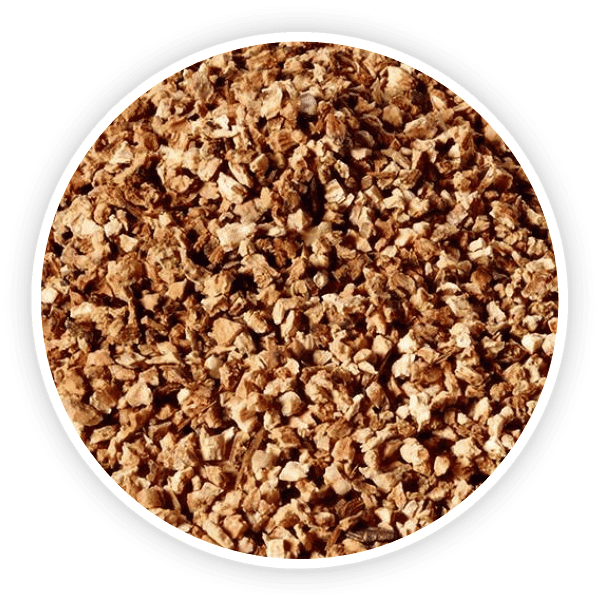
Cork is a natural, renewable material that is also suited to use as infill for synthetic turf pitches.
It boasts good cushioning properties and is applied over a layer of sand.
What’s more, the odorless material obtained from the bark of cork oak and is completely biodegradable.
Cork is a very light infill; it is therefore important to choose a fibre structure that optimally holds the filling material in place with cork-filled synthetic turf systems.
Maintenance requirements and loss of infill are thus significantly reduced.
EPDM (Ethylene Propylene Diene Monomer) rubber is a man-made rubber that can be made in any color and is generally thought to be safer than crumb rubber.
It is also very durable, low maintenance and great for use in artificial turf for athletic fields, to help absorb shock.
EPDM rubber infill tends to cost more than crumb rubber as it is not recycled.
It may also still have some long term health concerns, although once again, studies haven’t definitively stated this yet.
EPDM infill can also get quite hot on a sunny summer day.
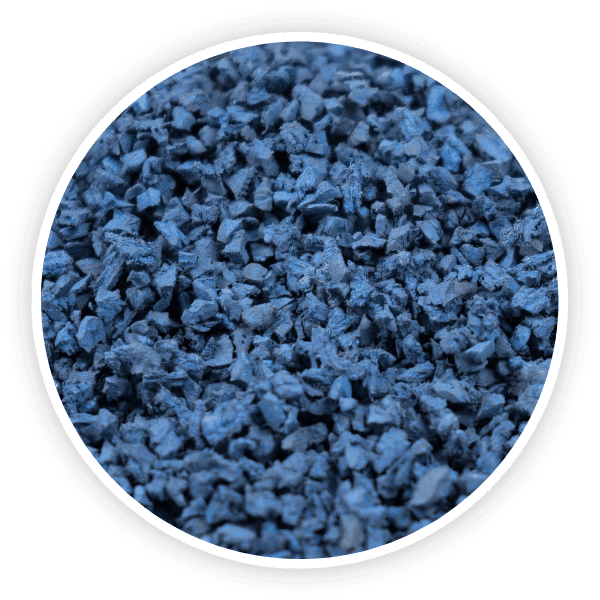
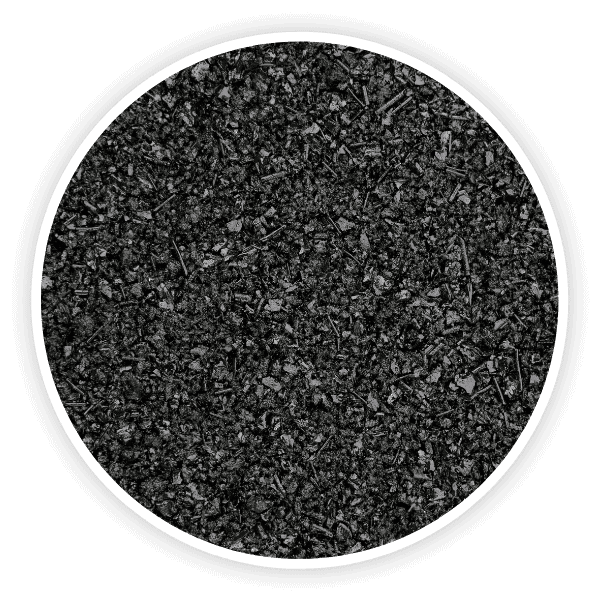
Crumb rubber infill is the most popular turf infill used and is made from recycled tires.
It is inexpensive and will last for years with little to no maintenance required. It is often referred to as SBR Rubber (styrene-butadiene rubber) and is black in color.
Since it is recycled, it helps to keep tires out of landfills.
It is also generally accepted as one of the best infills for athletic fields since it has good shock absorption qualities.
Since this product is made from recycled tires, it tends to be the infill option most often associated with potential health concerns.
There hasn’t been a lot of definitive tests one way or the other but there are studies ongoing and Shaw has released their own statement on the topic.
Crumb rubber also tends to be the hottest infill in direct sunlight.
Copy and paste the code below to embed this graphic on your website, article, or presentation.
Please keep the source link intact so readers can access the full Artificial Turf System Components and related diagrams on Turf Network.
📎 Embed This Graphic
Copy the code below and paste it into the HTML section of your article, blog post, or presentation page.
					<div class="turfnetwork-graphic-embed">
  <a href="https://turfnetwork.org/artificial-grass/components/infill/" target="_blank" rel="noopener">
    <img src="https://turfnetwork.org/wp-content/uploads/2026/03/infill-material-system-components-diagram.png" alt="Artificial turf system diagram highlighting infill material placed between turf fibers" style="max-width:100%; height:auto;">
  </a>
  <p style="font-size:14px; color:#666;">
    Caption: This diagram highlights infill material, the granular layer placed between artificial grass fibers to support the blades and stabilize the turf surface.<br>
    Source: <a href="https://turfnetwork.org/artificial-grass/components/infill/" target="_blank" rel="noopener">Turf Network — Infill Material</a>
  </p>
</div>
This graphic is part of the Artificial Turf System Components published by Turf Network.
You are welcome to share or embed this diagram with attribution.
Headshot (Listing Preview) images should be no smaller than 800 x 900 px and Headshot (Listing Page) images should be no smaller than 160 x 160 px, with the subject matter as centered as possible to avoid being cut off at the edges.
Images can have a maximum file size of 1 MB. Should you need to compress your images, no problem! Here’s a free tool with super simple instructions.
Logos should be no smaller than 160 x 160 px, with the subject matter centered as possible to avoid being cut off at the edges.
Images can have a maximum file size of 1 MB. Should you need to compress your images, no problem! Here’s a free tool with super simple instructions.
Cover and Gallery images should be no smaller than 1920 x 1080 px for the best clarity, and the subject matter should be as centered as possible to avoid being cut off at the edges.
Images can have a maximum file size of 1 MB. Should you need to compress your images, no problem! Here’s a free tool with super simple instructions.
Welcome!
Navigate your turf journey with us.