

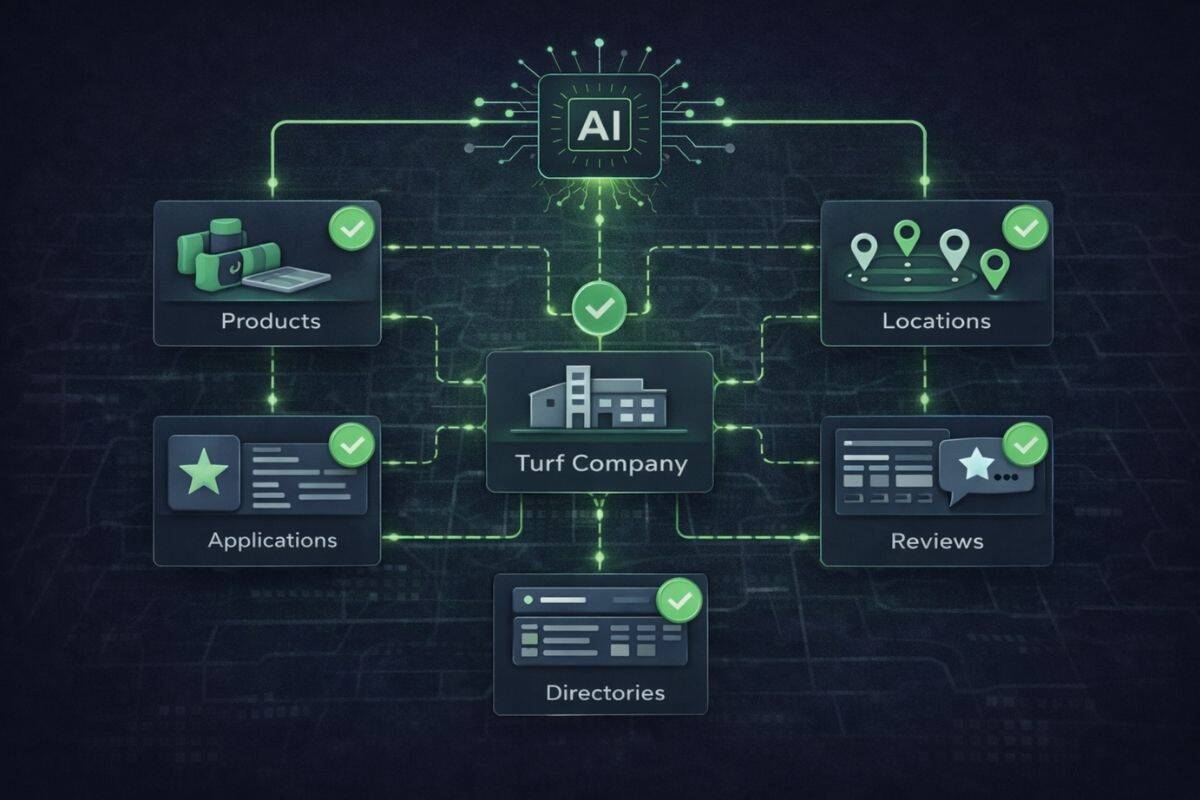
What Changed — And Why This Guide Matters Now
Local SEO didn’t disappear.
But search changed.
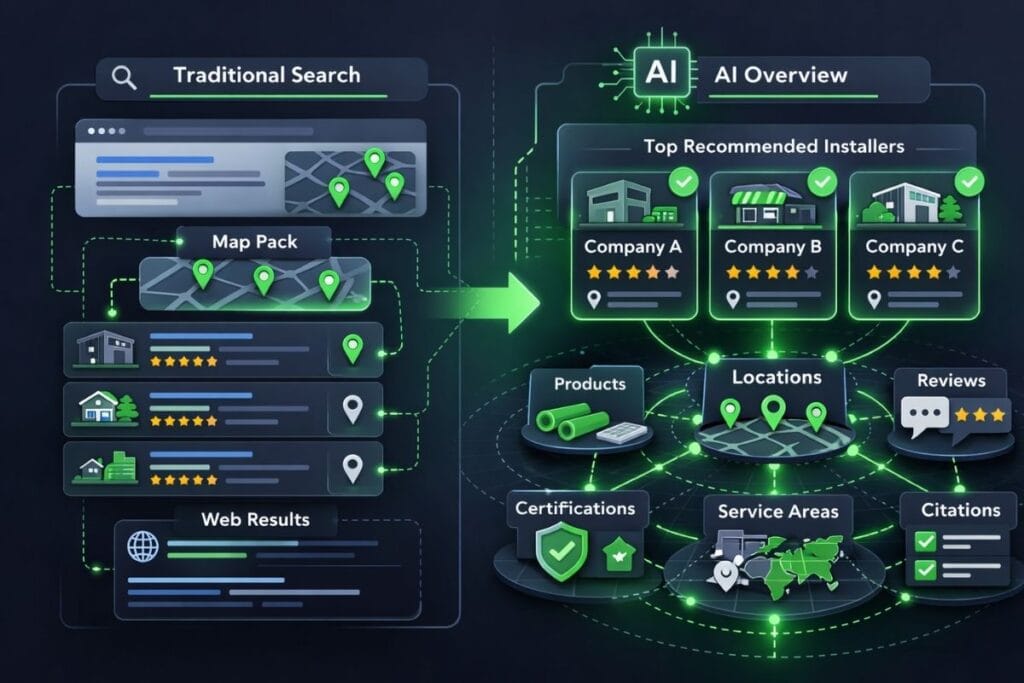
Google doesn’t just show links anymore.
It often generates answers — and those answers mention specific companies.
That means visibility works in two ways now:
- Where you rank
- Whether you’re mentioned
You can rank well and still not be included in AI-generated summaries.
The difference usually comes down to clarity.
If your business is easy to understand, it’s easier to recommend.
If it’s confusing — even slightly — search systems hesitate.
This guide explains how to make your turf business clear, consistent, and stable in modern local search.
🎥 Prefer Video? This is the visual breakdown of the section below.
Ranking vs. Inclusion (Being Mentioned)
Ranking is still important.
- Map Pack results matter.
- Organic results matter.
- High-intent searches still drive real revenue.
But ranking alone isn’t the full picture anymore.
Search systems now try to answer questions directly.
According to industry research, Google’s AI Overviews now appear in more than half of search queries and reach over a billion users globally. That means structured answers are no longer experimental — they are mainstream visibility.
When they do, they choose which companies to reference.
That choice depends on confidence.
If Google isn’t fully confident about:
- Who you are
- Where you operate
- What you specialize in
You’re less likely to be mentioned — even if you rank.
Ranking gets you seen.
Clarity gets you referenced.
Learn more in our guide to AI vs. SEO for Turf Companies.
Search Systems Need Clear Businesses
Think about how a turf company operates in real life:
- You install specific types of turf.
- You carry certain product lines.
- You serve defined cities.
- You may operate from one warehouse — or several.
- You might be an installer, a supplier, a manufacturer — or some combination.
If your website and online profiles reflect that clearly, search systems can understand your business.
If everything is blended together — locations, services, products — it becomes harder to interpret.
Search systems don’t guess.
When they’re unsure, they become cautious.
And caution reduces visibility.
If you’re new to AI Visibility, start here.
This short explanation explains how AI systems interpret businesses online.
The Three Things That Matter Most
Instead of thinking about hundreds of SEO factors, focus on three fundamentals.
1. Clear Identity
Your business name, address, phone number, and category should be consistent everywhere.
- No small variations.
- No outdated information.
- No mixed branding between divisions.
If different platforms describe you differently, trust weakens.
2. Clear Structure
Your website should reflect how your business actually works.
- One physical location per page.
- Separate pages for different services.
- Separate pages for different products.
- Logical internal links between them.
If everything lives on one giant page, clarity drops.
3. Clear Confirmation
What you claim about your business should be supported elsewhere.
If you say you’re an authorized dealer, that relationship should be visible.
If you operate in multiple cities, those markets should be clearly defined.
Consistency across platforms builds confidence.

A Note for Multi-Location Turf Companies
If you operate in more than one market, complexity increases quickly.
Common problems include:
- Shared phone numbers across branches
- Old addresses still indexed
- Multiple city pages with nearly identical content
- Blending warehouse operations with service areas
Individually, these don’t seem serious.
Over time, they add up.
And small inconsistencies compound.
If you want a deeper breakdown of how this happens, see: The Multi-Location Visibility Problem.
Quick Take: Why This Shift Changes How You Compete
Local SEO still works.
But it works best when your business is easy to understand.
- Clear name.
- Clear locations.
- Clear services.
- Clear products.
- Consistent information everywhere.
Before chasing new tactics, make sure your foundation is solid.
Search systems reward clarity.
And clarity compounds over time.

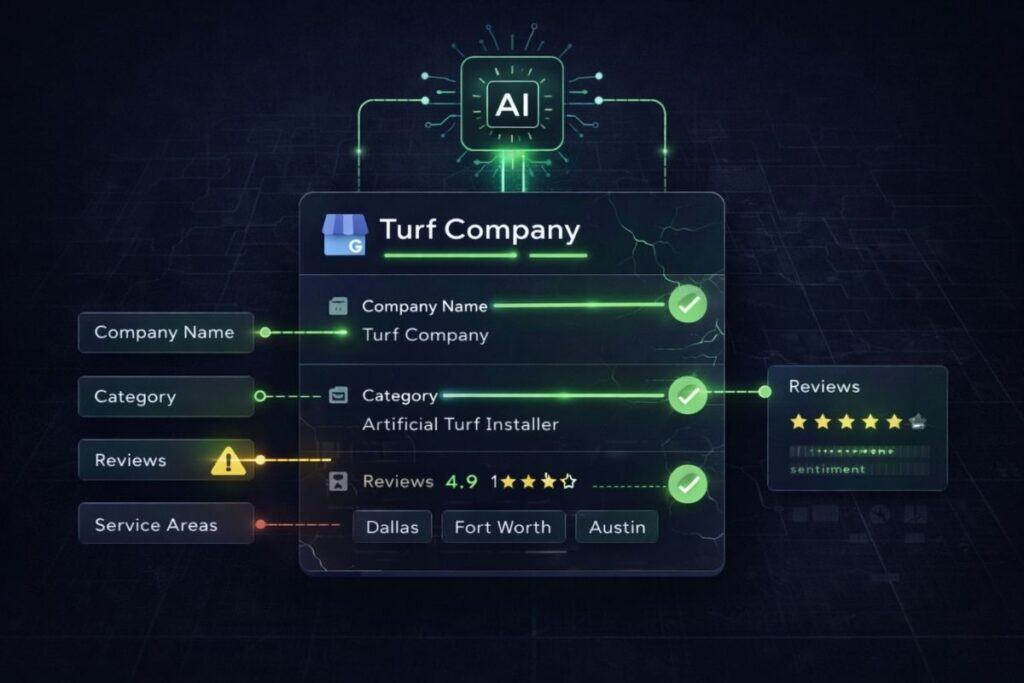
Google Business Profile (GBP) Is Your Primary Local Entity
(If this is unclear, nothing else holds together)
If AI systems are trying to decide whether your business is real, stable, and reliable…
Your Google Business Profile (GBP) is the first place they look.
Not your homepage. Not your blog. Not your Instagram.
Your Google Business Profile.
It functions as your:
- Public business record
- Local identity anchor
- Category declaration
- Review database
- Location confirmation
If your GBP is unstable, everything downstream becomes less trustworthy.
Why GBP Still Matters (Even in the AI Era)
Local SEO did not disappear.
In fact, local intent remains one of the strongest commercial signals in search.
Local intent is high-conversion intent.
AI systems still rely on the same foundational signals — they just interpret them differently.
Instead of asking: “Who ranks highest?”
They increasingly ask: “Which business has the clearest, most consistent local footprint?”
That footprint starts with GBP.
BrightLocal reports that 46% of all Google searches have local intent. Businesses that appear in the local pack receive 126% more traffic and 93% more actions than those ranked below.
Categories Define What You Are (Not What You Wish You Ranked For)
Your primary category tells Google what kind of business you are.
This is not a keyword field.
It is a classification field.
If you are:
- An installer → choose the most accurate contractor category.
- A supplier with a warehouse → choose a supply / distribution category.
- A manufacturer with direct sales → structure that clearly.
Common turf mistakes:
- Choosing a vague category like “Landscaper” when specialization is stronger.
- Adding irrelevant secondary categories, hoping to “expand reach.”
- Mixing installer and supplier roles without structural clarity.
When categories are imprecise, AI confidence drops.
You are harder to classify.
And classification is how AI decides when to include you.
According to Google, 76% of people who search for something nearby on their smartphone visit a business within 24 hours. And 28% of those searches result in a purchase.
Service Areas vs. Physical Locations (The Quiet Visibility Killer)
This is where many turf companies lose structural clarity.
Google treats:
- Physical locations
- Service-area businesses
Very differently.
If you have:
- A staffed warehouse → list it as a physical location.
- A service territory without staff → use service-area settings.
What creates problems:
- Listing cities as physical locations when no address exists.
- Using P.O. boxes.
- Creating multiple profiles that share phone numbers.
- Keeping old warehouse addresses live after moving.
These issues don’t always cause suspension.
But they reduce confidence.
Reduced confidence lowers inclusion.
Reviews Are Behavioral Signals (Not Just Social Proof)
Reviews influence more than conversions.
They influence validation.
Google’s local algorithm uses review signals as a ranking factor.
But in an AI context, reviews also:
- Confirm activity
- Confirm legitimacy
- Confirm category alignment
- Confirm service focus
If you claim to specialize in pet turf but all reviews reference athletic fields, the signal conflicts.
Consistency matters.
Encourage reviews that naturally reflect:
- Actual services
- Real locations
- True product types
Not scripts. Not manipulation. Just clarity.
BrightLocal reports that 87% of consumers read online reviews for local businesses, and 88% say they are more likely to use a company that responds to all reviews.
Photos, Posts, and Activity Signals
Inactive profiles decay in trust.
Profiles with:
- Updated photos
- Accurate hours
- Recent review responses
- Ongoing updates
Signal operational stability.
AI systems prefer stable entities.
A dormant GBP suggests uncertainty.
An active GBP suggests reliability.

Where Turf Companies Typically Break GBP Structure
Across installers and suppliers, the most common issues are:
- Multiple listings for the same address
- Closed locations still indexed
- Slight name variations across branches
- Shared phone numbers between divisions
- Mixing warehouse operations with installation branding
Individually minor.
Structurally compounding.
If you operate in multiple cities, GBP structure becomes even more important.
Each profile becomes a node in your entity network.
Inconsistent nodes weaken the whole structure.
Short Version: Identity is the Foundation Layer
If Google cannot clearly define:
- Who you are
- Where you operate
- What category you belong to
AI systems hesitate to reference you.
Before improving content… Before building links… Before restructuring your website…
Fix your Google Business Profile.
It is the foundation layer.
Everything else builds on it.
🎥 Prefer Video? This is the visual breakdown of the section below.
Website Architecture Is a Structural Map — Not a Brochure
(If your structure is messy, AI assumes your business is too)
Most turf websites are designed to impress humans.
Large hero images. Bold claims. Long service lists. Beautiful project galleries.
That’s fine for branding.
But search systems don’t see design.
They see structure.
Your website functions as a map of your business:
- What you do
- Where you operate
- Which products you carry
- Which services connect to which locations
If that map is unclear, AI struggles to understand your company — even if your work is excellent.
One Location = One Page
(Don’t blend cities together)
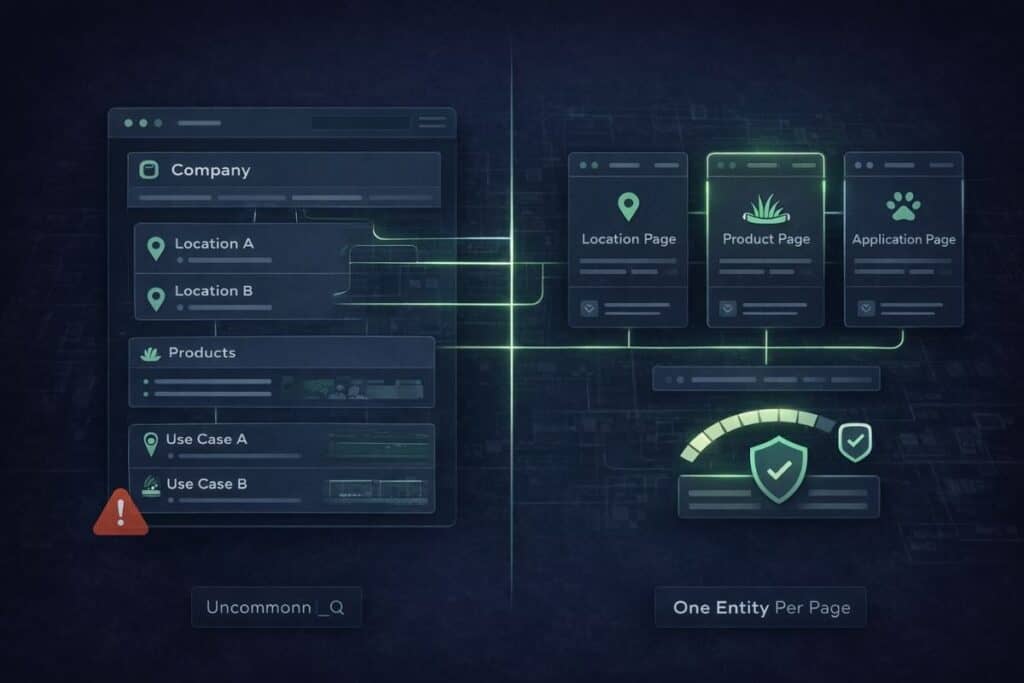
If you operate in multiple cities, each physical location should have its own dedicated page.
Not a paragraph. Not a dropdown list. Not a sentence buried in the footer.
A real page.
That page should include:
- Physical address (if applicable)
- Phone number
- Service area clarification
- Services available at that location
- Relevant projects
- Reviews tied to that market
What causes problems:
- Listing 12 cities on one “Service Areas” page.
- Using the same phone number across every branch.
- Creating fake location pages for cities where no staff exists.
- Copy-paste content with city names swapped.
AI interprets that as ambiguity.
Ambiguity reduces confidence.
Separate Products from Services
(Don’t hide everything on one page)
Many turf companies bury product information inside service pages.
Example:
A “Pet Turf Installation” page that vaguely references three product types without dedicated product pages.
Instead, structure clearly:
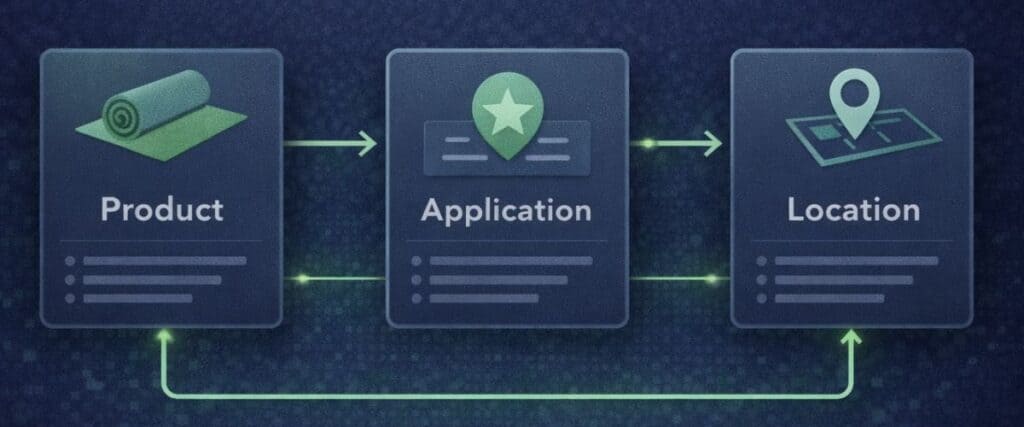
- Product page → describes the turf line, specs, use cases
- Application page → explains installation type (pet, putting green, commercial)
- Location page → explains where you install it
That creates a clean relationship:
Product → Application → Location
When everything is blended together, AI cannot easily map those relationships.
Internal Links Should Reflect Real Relationships
(Navigation isn’t just for users)
Internal linking is not just a usability feature.
It tells search systems how your business is organized.
If you:
- Mention a product on a service page → link to the product page.
- Mention a city on a product page → link to that location page.
- Mention an application → link to its dedicated page.
You are reinforcing real-world relationships.
Disconnected pages create structural gaps.
Connected pages build clarity.
Avoid the “Everything We Do” Page
Many turf websites include one massive page listing:
- Residential
- Commercial
- Sports fields
- Putting greens
- Pet turf
- Rooftop turf
- Playground turf
- Wholesale supply
- Installation
All in one place.
That’s not clarity.
That’s compression.
Instead:
Break these into focused pages.
One main topic per page.
Clear hierarchy in your navigation.
This helps:
- Users find what they need.
- AI classify your services accurately.
- Your content rank for specific intent.
Our knowledge hub is an example of structured educational architecture.
Multi-Location Structure Needs a Clear Hierarchy
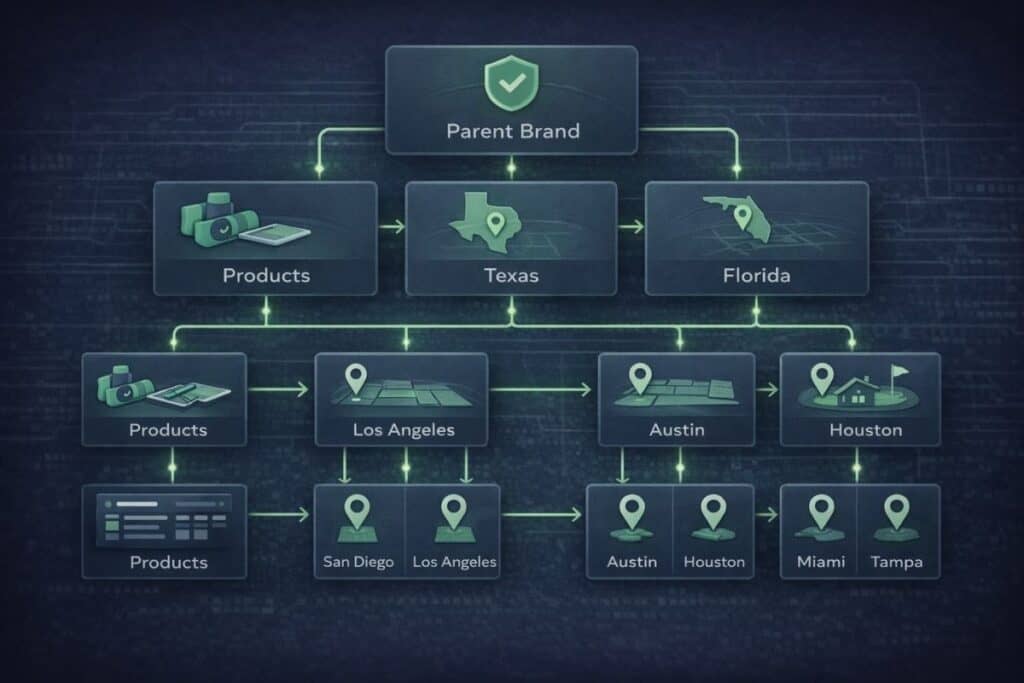
If you operate across multiple markets, your structure should reflect that clearly.
Example hierarchy:
Company → State → City Location → Services Available → Products Carried
Not:
Homepage → “Locations” page → List of 15 city names with no structure
The clearer the hierarchy, the easier it is for AI to understand how your markets connect.
If you want a deeper breakdown of how multi-location companies lose visibility, see:
The Multi-Location Visibility Problem.
Structured Data (Schema) Isn’t Optional Anymore
Behind the scenes, structured data helps machines confirm what each page represents.
Each page should clearly signal:
- Organization
- Local Business
- Product
- Service
- Service area (when applicable)
Without structured signals, AI must infer.
When AI must infer, confidence drops.
Clear data beats guesswork.
Common Website Architecture Mistakes in the Turf Industry
Across installers and suppliers, we repeatedly see:
- One page trying to rank for 15 services
- Location pages that don’t include real addresses
- Product lines without individual pages
- Dealer relationships buried in blog posts
- Duplicate content across city pages
- No logical linking between product, service, and location
None of these cause instant penalties.
They cause gradual erosion.
Gradual erosion is harder to detect — but more damaging long-term.
Google reportsthat 53% of users abandon a site that takes longer than 3 seconds to load. As load time increases from 3 to 9 seconds, bounce rates can climb from 13% to nearly 60%.
Takeaways: Structure Determines Whether You’re Understood
Your website is not just marketing material.
It is a structural map of your business.
If that map is:
- Clear
- Logical
- Segmented
- Consistent
AI systems can confidently understand your company.
If it’s blended, repetitive, or vague, AI hesitates.
And hesitation reduces inclusion.
Before investing in more content or more backlinks, make sure your structure reflects how your business actually operates.
Clarity first. Expansion second.
If you manage multiple locations or service areas, the fastest win is usually removing conflicting signals—not publishing more pages.
🎥 Prefer Video? This is the visual breakdown of the section below.
Off-Page Signals: Your Business Footprint Beyond Your Website
(If the internet describes you inconsistently, AI hesitates)
Your website tells your story.
Off-page signals confirm whether that story is accurate.
Search systems don’t rely on your claims alone.
They compare your website against:
- Business directories
- Google Business Profile
- Industry listings
- Manufacturer dealer pages
- Review platforms
- News mentions
- Social profiles
If those sources align, confidence increases.
If they conflict, trust weakens.
Citations Still Matter — But for a Different Reason
Citations used to be treated as ranking fuel.
Submit to 100 directories. Build local listings. Increase NAP mentions.
That thinking is outdated.
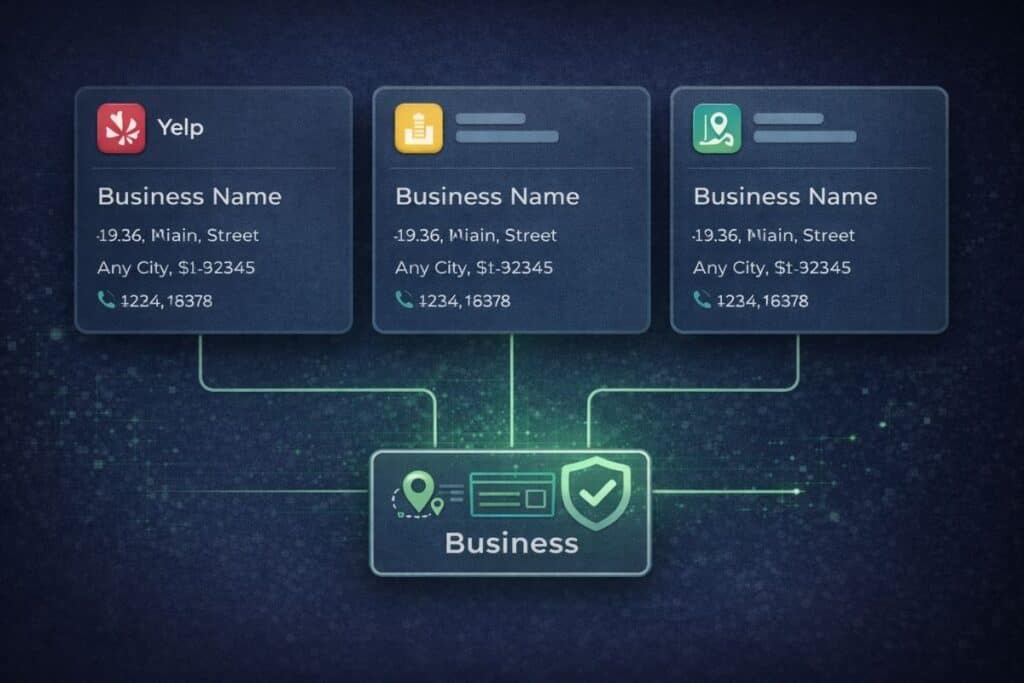
Today, citations function as consistency checks.
AI systems compare:
- Business name
- Address
- Phone number
- Category
- Website URL
Across platforms.
If your Google Business Profile says: Fusion Turf USA
But a directory lists: FusionTurf Co.
And another lists an outdated phone number…
That introduces uncertainty.
Uncertainty reduces confidence.
Confidence influences inclusion.
Small Inconsistencies Compound
Common turf industry issues:
- Old warehouse addresses still indexed
- Closed locations left active
- Slight name variations across markets
- Shared phone numbers across branches
- Installer and supplier divisions blended together
Individually, these seem minor.
But search systems process them as structural contradictions.
The more contradictions exist, the more hesitant AI becomes to reference your company directly.
Industry Directories Are Stronger Than Generic Ones
Not all listings carry equal weight.
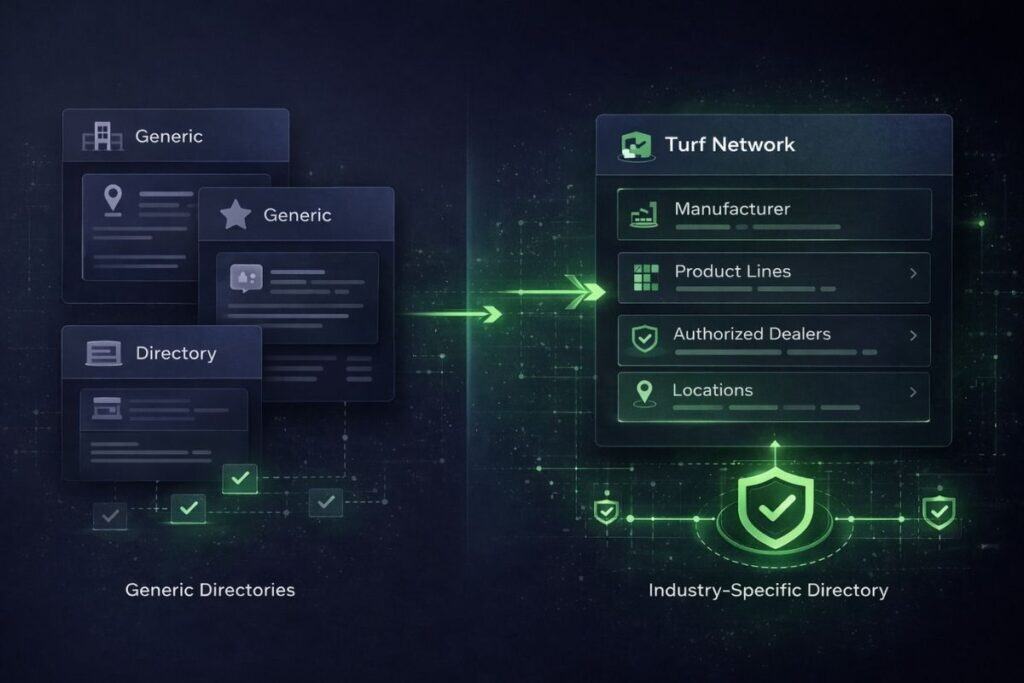
A generic directory confirms existence.
An industry-specific directory confirms role and relationships.
For turf companies, stronger validation comes from listings that clearly define:
- Manufacturer relationships
- Authorized dealer status
- Product lines carried
- Service categories
- Geographic footprint
Structured industry references help AI understand:
Installer → Product → Manufacturer → Location
Generic directories don’t provide that level of clarity.
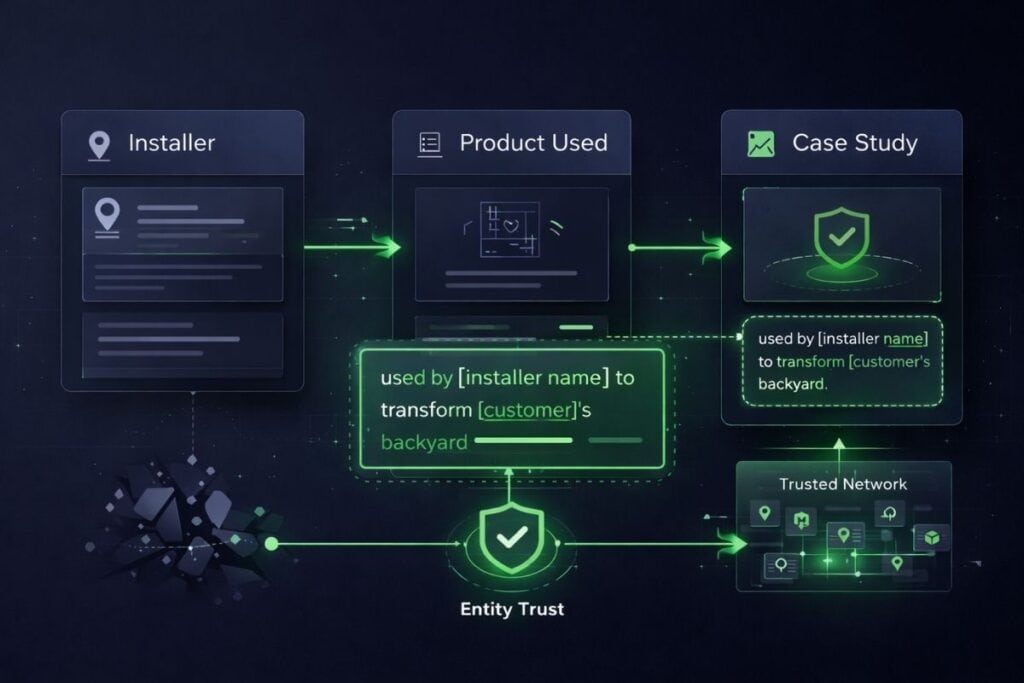
Manufacturer & Dealer Pages Are Validation Signals
If you are:
- An authorized dealer
- A regional distributor
- A certified installer
That relationship should be publicly confirmed.
For example:
- A manufacturer lists you as an authorized dealer.
- Your website links back to the manufacturer.
- Product pages clearly identify the brand carried.
When relationships are only claimed on one side, AI hesitates.
When relationships are confirmed on both sides, confidence increases.
This is especially important for:
- Multi-location suppliers
- Regional turf distributors
- Manufacturers with dealer networks
Relationship clarity strengthens the entire ecosystem.
Backlinks Still Matter — But Context Matters More
Links are not dead.
But volume is no longer the strategy.
AI evaluates:
- Relevance
- Context
- Relationship clarity
A local landscaping partner referencing your turf installation work carries meaning.
A low-quality directory with no category relevance does not.
Prioritize:
- Local partnerships
- Industry associations
- Supplier relationships
- Manufacturer collaborations
- Structured case studies
Noise creates clutter.
Context creates credibility.
Review Platforms Are External Proof of Activity
Reviews aren’t just for conversions.
They are external confirmations that:
- You operate in a real market
- You complete real projects
- You serve specific applications
If your review profile aligns with your stated services, confidence strengthens.
If reviews conflict with your positioning, clarity weakens.
For example:
If your website emphasizes commercial turf, but reviews only mention backyard projects, signals conflict.
Alignment matters.
Clean Up Before You Build
Many turf companies try to “build links” before stabilizing identity.
That’s backward.
Before expanding your footprint:
- Audit existing citations
- Remove duplicates
- Update outdated addresses
- Standardize naming
- Confirm manufacturer relationships
Expansion on top of inconsistency compounds instability.
Stability first. Growth second.
Where Turf Network Fits
AI systems rely on structured reference layers to understand industries.
Industry-specific directories that clearly map:
- Manufacturers
- Suppliers
- Installers
- Products
- Locations
Help reinforce those relationships.
Turf Network functions as one structured reference layer within the artificial turf industry.
It does not replace your website.
It reinforces external clarity.
And external clarity strengthens confidence.
Short Version: External Consistency Builds External Trust
Off-page SEO is no longer about quantity.
It is about consistency.
If the broader internet describes your business clearly and consistently, AI systems are more confident referencing you.
If your external footprint is fragmented, inclusion becomes unstable.
Before chasing more links, make sure your existing footprint is accurate, aligned, and relationship-driven.
Clarity compounds. Inconsistency fragments.
Content Should Answer Real Questions — Not Fill a Blog
(If your content doesn’t solve specific problems, it won’t get referenced)
Content still drives visibility.
But the goal is no longer: “Publish more posts.”
The goal is: “Answer real, specific questions clearly.”
Search systems extract answers.
They don’t reward volume.
If your content is vague, repetitive, or generic, it won’t be cited — even if it ranks.
In other words, it’s about content quality over quantity.
If it’s specific, structured, and aligned with real buyer intent, it becomes usable.
Usable content gets surfaced.
Start With Real Search Intent (Not Just Keywords)
Keyword research still matters.
Installers and suppliers still rely on:
- “artificial turf installation [city]”
- “pet turf installers near me”
- “wholesale turf supplier dallas”
- “how hot does artificial grass get”
- “best turf for putting greens”
Local SEO did not eliminate demand-based search.
It refined it.
Before writing content, ask:
- What is someone actually trying to solve?
- Is this informational, commercial, or transactional?
- Does this apply to installers, suppliers, or both?
Avoid writing posts that exist only because a keyword tool showed volume.
Instead, align content with real decisions:
- Product comparison
- Installation timelines
- Maintenance concerns
- Warranty differences
- Cost breakdowns
- Climate performance
Intent-first content performs better — and gets cited more often.
One Clear Topic Per Page
Many turf websites blend multiple topics together.
Example:
A single page trying to rank for:
- Pet turf
- Playground turf
- Putting greens
- Sports turf
- Commercial turf
- Wholesale turf
All in 1,200 words.
That weakens clarity.
Instead:
- One primary topic per page.
- One primary intent per page.
- Clear headings.
- Direct answers.
Specific pages outperform broad, diluted ones.

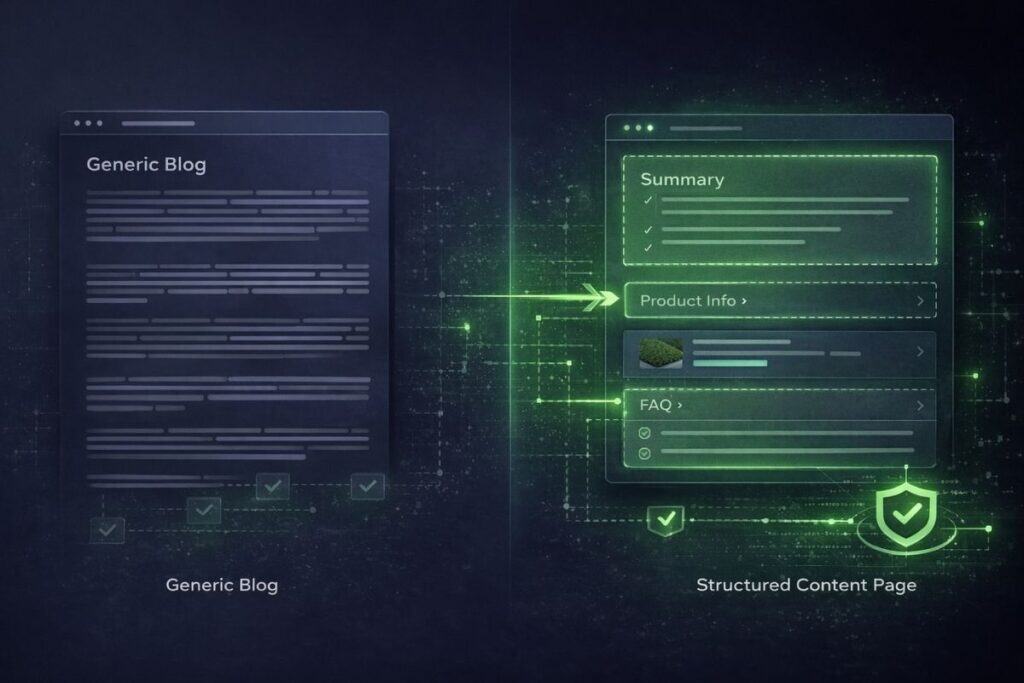
Make Answers Easy to Extract
AI systems look for concise, direct explanations.
Long blocks of filler reduce extractability.
Use:
- Short paragraphs
- Clear subheadings
- Bullet lists where appropriate
- Defined comparisons
- FAQ sections when relevant
Instead of: “Artificial turf is a versatile solution used in many applications…”
Use: “How Hot Does Artificial Turf Get in Texas?“
Direct answer.
Then explanation.
Clarity improves usability for both humans and machines.
Connect Content to Real Entities
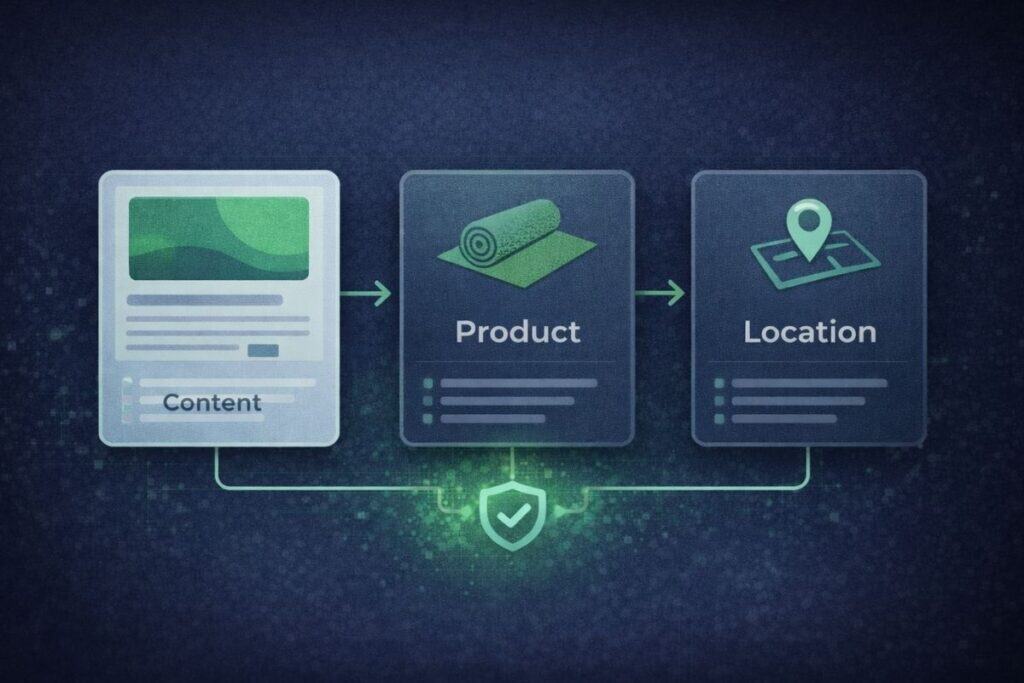
Content should not live in isolation.
Every post should connect to:
- Relevant product pages
- Relevant service pages
- Relevant location pages
Example:
A guide on “Pet Turf Maintenance” should link to:
- Pet turf product page
- Pet installation service page
- Locations that offer that service
This reinforces real-world relationships.
Disconnected blog posts weaken cohesion.
Connected content strengthens understanding.
Case Studies Are Underrated
Generic blog posts rarely get cited.
Detailed case studies often do.
Instead of: “We installed a beautiful backyard.”
Include:
- Square footage
- Product name
- Base depth
- Drainage method
- Timeline
- City
This creates clarity:
Installer → Product → Application → Location
That relationship depth increases trust.
And trust increases inclusion.
Suppliers & Manufacturers: Technical Depth Wins
For suppliers and manufacturers, content should include:
- Product specs
- Fiber type
- Pile height
- Face weight
- Drainage rate
- Backing system
- Warranty structure
Generic marketing language does not differentiate.
Technical clarity does.
If AI systems are comparing turf products, the brands with accessible, structured technical information are easier to summarize.

Avoid These Common Turf Content Mistakes
- Publishing “Top 10 Benefits” posts with no differentiation
- Copying manufacturer descriptions verbatim
- Creating thin city pages with swapped keywords
- Writing long introductions that delay the answer
- Ignoring internal linking between product and service pages
- Ignoring internal linking between location pages and localized blog content
Content should reduce friction — not create noise.
Topic Clusters Build Authority
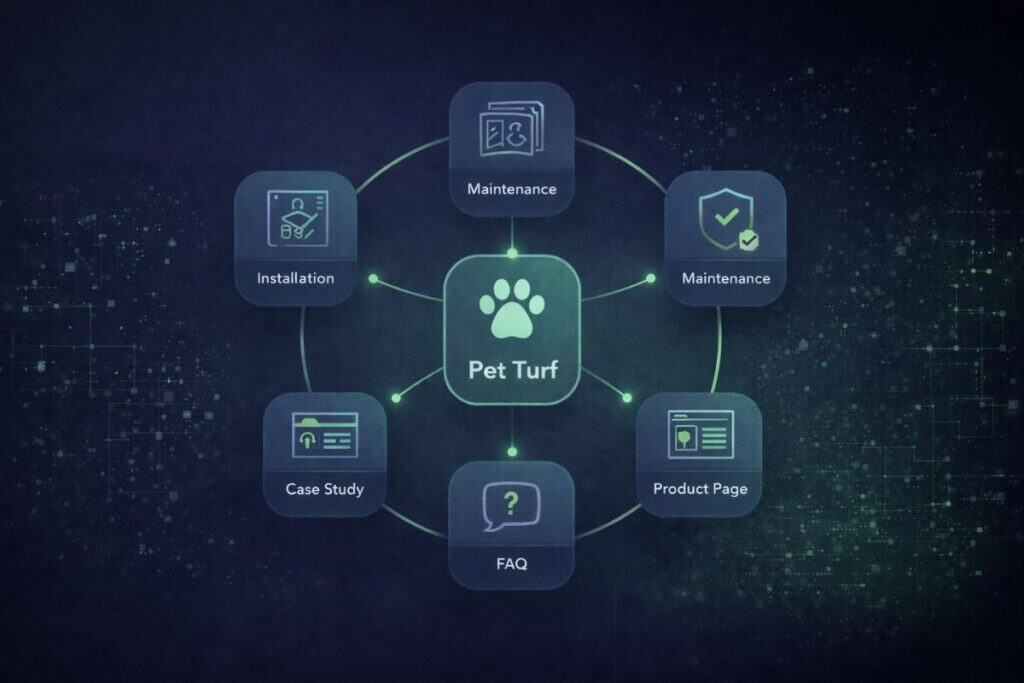
Instead of publishing random posts, build clusters.
Example:
Pet Turf Cluster
- What Is Pet Turf?
- Best Artificial Turf for Dogs
- Pet Turf Installation Process
- Pet Turf Odor Removal Guide
- Case Study: Dog Run Installation
- Product page for pet-specific turf
When multiple pages reinforce one topic, authority strengthens.
Authority increases citation likelihood.
Research shows companies publishing 16+ posts per month generate significantly more traffic and leads. But volume only compounds when structure is stable. Publishing at scale on top of ambiguity compounds confusion.
What Matters Most: Useful Content Gets Referenced
Content still drives visibility.
But visibility now depends on clarity, intent alignment, and connection.
Publish less noise.
Answer more real questions.
Make each page:
- Focused
- Specific
- Internally connected
- Aligned with actual buyer intent
When your content reflects how customers actually search — and how your business actually operates — it becomes usable.
And usable content gets referenced.
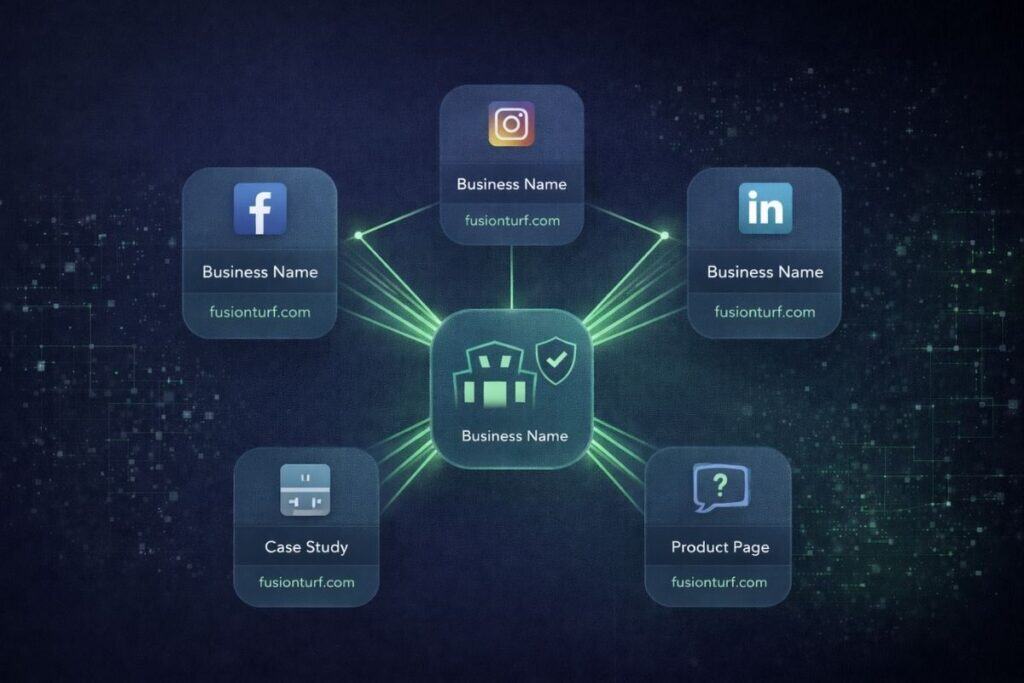
Social Media Supports Visibility — It Doesn’t Replace It
(If your brand looks inconsistent online, trust weakens)
Social media is not a ranking lever.
But it is a validation layer.
Search systems increasingly analyze public brand signals to confirm:
- Business naming consistency
- Location alignment
- Operational activity
- Service focus
- Relationship clarity
If your social presence conflicts with your website or Google Business Profile, it introduces friction.
If it reinforces them, it strengthens confidence.
Consistent Naming Across Platforms
Your business name should appear the same on:
Small variations create unnecessary ambiguity.
Examples that cause confusion:
- “Fusion Turf USA” on Instagram
- “FusionTurf Co.” on Facebook
- “Fusion Turf Supply” on LinkedIn
Standardize:
- Business name
- Website URL
- Primary location reference
- Category description
Consistency strengthens recognition — for both users and search systems.
Your Bio Should Say What You Actually Do
Avoid vague bios like:
“Transforming outdoor spaces.”
Instead, be specific:
- “Artificial turf installer serving Dallas–Fort Worth.”
- “Wholesale turf supplier with warehouse distribution in Houston.”
- “Manufacturer of commercial-grade synthetic turf systems.”
Clarity reinforces classification.
Classification influences when and how you appear.
Location Tagging Reinforces Geography
For installers and multi-location operators, geo-signals matter.
Use:
- Accurate location tags on projects
- City names in captions
- Market-specific hashtags when appropriate
If you install turf in Plano, say Plano.
If your warehouse serves San Antonio, mention it.
Over time, consistent geographic signals reinforce market alignment.

Captions Should Reflect Real Services
Every project post is an opportunity to reinforce clarity.
Instead of: “Another beautiful install!”
Try:
“1,200 sq ft of pet turf installed in Frisco, TX.
4” compacted base with drainage layer.
Designed for multi-dog durability.”
This does three things:
- Identifies the application
- Identifies the location
- Identifies the product type
It strengthens real-world relationships.
Generic captions create noise.
Specific captions build consistency.
Social Proof Must Match Positioning
If your website emphasizes:
- Commercial turf
- Sports field installation
- Wholesale distribution
But your social feed shows only residential backyards, signals conflict.
Alignment matters.
Your social content should reflect the services you actually want to be known for.
Activity Signals Stability
Dormant social profiles don’t destroy rankings.
But they do suggest inactivity.
Profiles that show:
- Recent posts
- Updated photos
- Review responses
- Project documentation
Signal operational stability.
Stability increases confidence.
Confidence influences inclusion.
Manufacturers & Suppliers: Relationship Clarity Matters
For manufacturers and suppliers, social media should reinforce:
- Dealer relationships
- Product launches
- Distribution footprint
- Installation partnerships
If you announce a dealer partnership, tag the dealer.
If an installer uses your product, reference the product clearly.
Public relationship confirmation strengthens ecosystem visibility.
Don’t Overcomplicate It
You don’t need:
- Viral reels
- Complex funnels
- Daily posting schedules
You need:
- Consistency
- Clarity
- Alignment with your real operations
Social media should reinforce the structure you’ve already built — not create a separate version of your business.
BrightLocal’s consumer survey found that 67% of 18‑24‑year‑olds use Instagram and 62% use TikTok to look up local business information. Additionally, 37% of U.S. consumers use Instagram and 29% use TikTok specifically to find local business reviews.
Key Takeaways: Consistency Extends Beyond Search
Social media won’t fix structural problems.
But it can reinforce structural clarity.
If your business name, services, products, and locations are consistent across:
- Your website
- Google Business Profile
- Directories
- Social platforms
Search systems gain confidence.
And confidence increases inclusion stability.
Social media is not the engine of local visibility.
It is the reinforcement layer.
Use it to clarify — not to confuse.
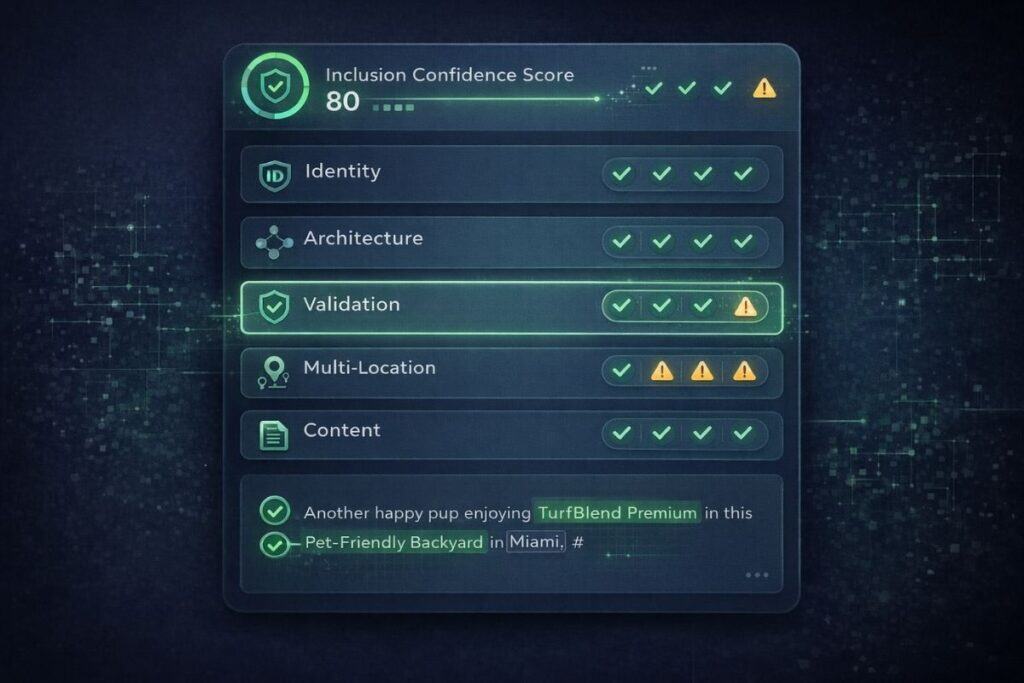
AI-Ready Local SEO Audit Framework
(How to evaluate whether your visibility is stable — or fragile)
Local SEO problems rarely show up as dramatic drops.
They show up as:
- Inconsistent inclusion
- Market-to-market instability
- Strong rankings but weak citation
- Good traffic but uneven lead flow
The issue is often structural — not tactical.
Use this framework to evaluate whether your local presence is stable, aligned, and trustworthy.

1. Identity Layer
(Is your business clearly defined everywhere it appears?)
Start with the basics.
If these are unstable, nothing else holds.
Business Name
- Is your business name consistent across GBP, website, directories, and social?
- Are there old name variations still indexed?
- Are you keyword-stuffing your legal name?
Location Accuracy
- Does each physical location have its own verified profile?
- Are closed or moved locations removed?
- Are service areas separated from physical addresses?
Category Alignment
- Does your GBP category reflect what you actually do?
- Do your website and directory listings reinforce that same role?
- Are installer, supplier, and manufacturer roles clearly distinguished?
If the internet describes your business differently in different places, confidence weakens.
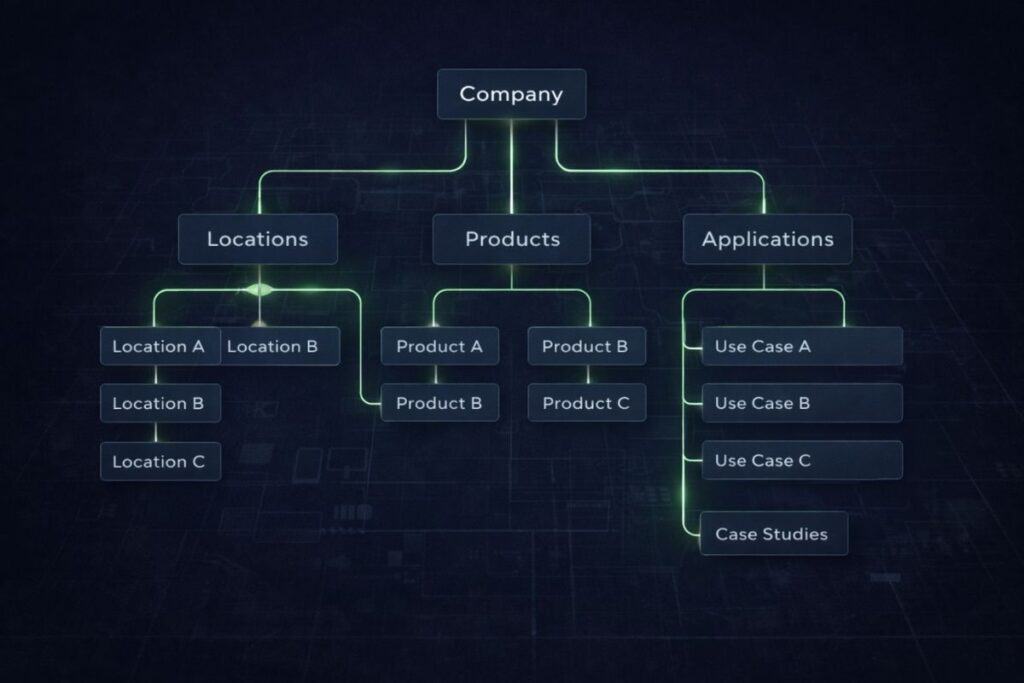
2. Website Structure Layer
(Does your website clearly reflect how your business operates?)
Your website should function like a map — not a brochure.
Location Structure
- Does each physical location have its own page?
- Are service-area-only pages clearly labeled?
- Are city pages unique and not copy-pasted?
Service & Product Separation
- Are products on their own pages?
- Are services on their own pages?
- Are applications (pet turf, putting greens, commercial) clearly segmented?
Logical Linking
- Do product pages link to relevant services?
- Do service pages link to relevant locations?
- Do location pages reflect what’s actually offered there?
If everything is blended together, clarity drops.

3. External Validation Layer
(Does the broader internet describe you consistently?)
Your website is not the only source search systems use.
Citation Consistency
- Is your Name, Address, Phone number identical across major platforms?
- Are old phone numbers still indexed?
- Are duplicate listings active?
Relationship Confirmation
- If you are an authorized dealer, is that confirmed publicly?
- If you distribute a product line, is it referenced on both sides?
- Do manufacturer and installer pages link logically?
Review Alignment
- Do reviews reflect your stated services?
- Are reviews properly distributed across locations?
- Are you actively responding?
If external sources conflict, inclusion becomes unstable.
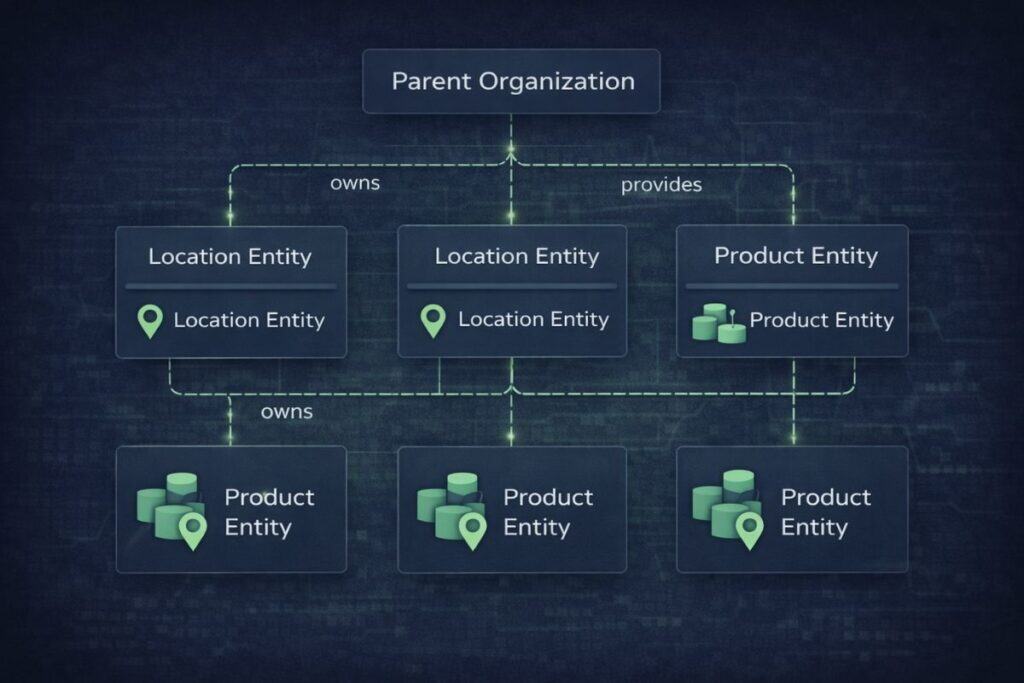
4. Multi-Location Stability Layer
(If you scale, does your structure scale with you?)
Multi-location operators face higher complexity.
Evaluate:
- Do all locations use distinct, accurate profiles?
- Are phone numbers separated where appropriate?
- Are warehouse operations clearly distinguished from service territories?
- Are products mapped accurately to specific markets?
- Is your brand hierarchy clear (parent company vs divisions)?
Growth amplifies whatever structure exists.
If it’s clean, it compounds.
If it’s messy, it fragments.
For a deeper dive, see: The Multi-Location Visibility Problem.
5. Content Alignment Layer
(Does your content reflect real search intent and real operations?)
Content should support clarity — not dilute it.
- Does each page answer a specific question?
- Are pages focused on one main topic?
- Do you connect blog posts to relevant product and service pages?
- Are technical details included where relevant?
- Are city pages genuinely localized?
If content feels generic, search systems treat it that way.
Specificity builds authority.
6. Activity & Consistency Layer
(Does your business look operational and stable?)
Search systems prefer active, consistent businesses.
Evaluate:
- Is your Google Business Profile updated?
- Are new reviews being added?
- Are you posting updated projects?
- Are social profiles consistent and active?
- Are hours and contact information current?
Inactivity doesn’t cause penalties.
But inconsistency introduces doubt.
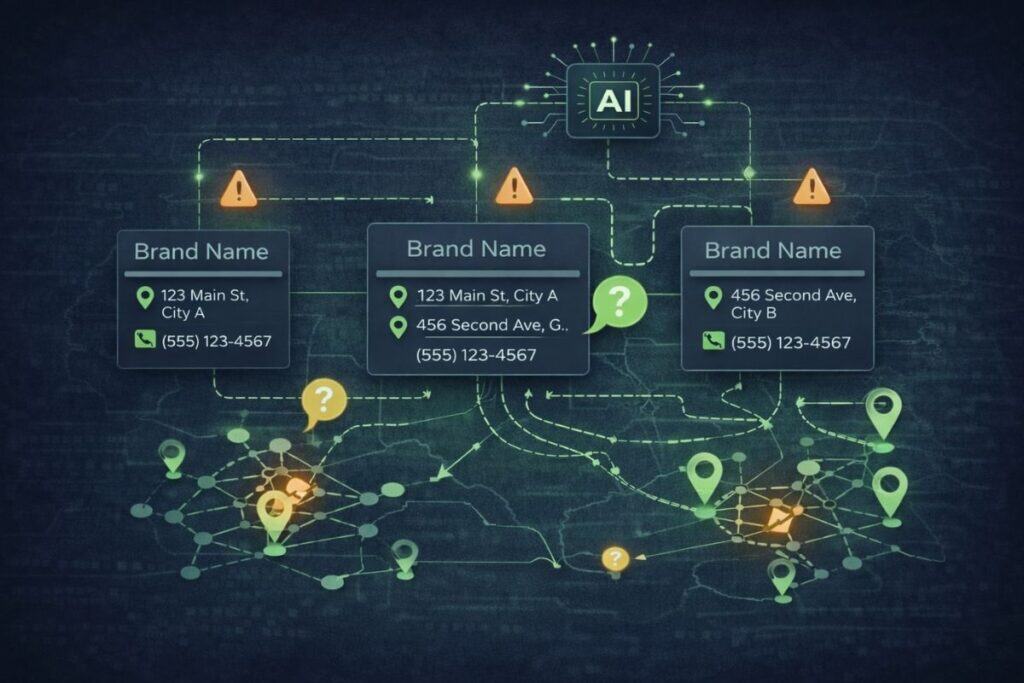
How to Interpret Your Results
After reviewing each layer, patterns matter more than perfection.
If identity and structure are strong → You likely have stable local visibility.
If structure is strong but validation is weak → You may rank, but inclusion may fluctuate.
If multi-location structure is inconsistent → Secondary markets may underperform.
If everything looks blended → Clarity is your primary issue — not keywords.
Discover Why AI Overviews Ignore Most Turf Suppliers (And What to Do About It).
Local SEO rarely fails because of one missing tactic.
It fails because of accumulated ambiguity.
Short Version: The Long-Term Advantage of Structural Clarity
Local SEO in the AI era is not about chasing algorithms.
It’s about reducing ambiguity.
Clear businesses:
- Are easier to classify
- Easier to trust
- Easier to reference
As AI systems expand, structural clarity becomes a competitive moat.
The turf companies that define themselves precisely will become the defaults.
The rest will gradually fade from direct mention.
Clarity compounds.
Ambiguity erodes.

Final Thoughts on Local SEO for Turf Installers & Suppliers
Local SEO did not go away.
It became foundational.
- Map Pack visibility still matters.
- Reviews still matter.
- Keyword intent still matters.
But today, visibility depends on more than placement.
It depends on clarity.
If your business is:
- Clearly defined
- Logically structured
- Consistent across platforms
- Externally validated
Search systems can understand you.
When they understand you, they are more likely to reference you.
When they reference you, visibility stabilizes.
Most turf companies don’t lose visibility because they lack tactics.
They lose it because ambiguity accumulates.
- Clean up inconsistencies.
- Separate locations properly.
- Align products and services.
- Stabilize your external footprint.
Clarity first. Growth second.
Local SEO in the AI era isn’t about chasing new tricks.
It’s about tightening the fundamentals — and structuring your business so it’s easy to understand.
That’s what sustains visibility long term.
The Turf Network functions as a structured reference layer for the artificial turf industry.
Key Takeaways
- Ranking and inclusion are different: You can rank well and still not be referenced.
- Google Business Profile is your foundation: If your identity is unstable there, everything else weakens.
- Website structure matters more than design: One topic per page. Clear location separation. Logical internal linking.
- External consistency builds trust: Citations, manufacturer relationships, and review alignment reinforce credibility.
- Multi-location growth increases complexity: Expansion without structure fragments visibility.
- Content should answer real questions: Specific, intent-driven pages outperform generic blog volume.
- Clarity compounds over time: Small inconsistencies, if ignored, gradually erode visibility.
Local SEO still works.
But it works best when your business is easy to understand — not just optimized to rank.
Frequently Asked Questions (FAQs)
Does Ranking in the Top 3 Still Matter?
Yes. Map Pack and organic rankings still drive high-intent traffic.
But ranking alone does not guarantee inclusion in AI-generated summaries.
Ranking determines placement.
Clarity determines whether you’re referenced.
The strongest local businesses achieve both.
What’s the Difference Between Ranking & Being Mentioned in AI Results?
Ranking means your website appears in search listings.
Being mentioned means Google’s AI selects your company inside an answer.
AI systems reference businesses when they have high confidence in:
- Identity consistency
- Structural clarity
- Verified relationships
- Category precision
You can rank well and still not be cited if structural ambiguity exists.
Is Google Business Profile More Important Than My Website?
They serve different roles.
Your website explains your business. Your Google Business Profile confirms it.
If GBP identity is inconsistent, your website becomes less trustworthy in AI systems.
GBP is the identity anchor. Your website is the structural map.
Both must align.
Do I Need Separate Pages for Every City I Serve?
Only if you have a real, physical presence there.
If you operate a warehouse or staffed location in a city — yes, create a dedicated page.
If you simply serve that city from another location, clarify it as a service area.
Creating fake or thin location pages reduces structural trust over time.
How Many Blog Posts Should We Publish Each Month?
Volume is secondary to clarity.
A smaller number of highly structured, internally connected pages will outperform a large number of generic posts.
Focus on:
- Clear topics
- Defined products
- Specific applications
- Real geographic connections
Structure first. Scale second.
Do Backlinks Still Matter?
Yes — but context matters more than volume.
AI systems evaluate:
- Relevance
- Relationship clarity
- Industry confirmation
A manufacturer listing you as an authorized dealer is stronger than 50 generic directory links.
Validation beats quantity.
How Long Does it Take to See Improvement?
Structural cleanup often produces gradual improvements over 3–6 months.
Multi-location businesses may take longer because inconsistencies compound over time.
Local SEO in the AI era is infrastructure work — not a quick tactic.
Clarity compounds.
Is This Only Relevant for Large Turf Companies?
No.
Single-location installers benefit from clarity too.
But the impact is most dramatic for:
- Multi-location installers
- Regional suppliers
- Manufacturers with dealer networks
- Private equity-backed turf groups
The more complexity you operate with, the more structure matters.